Verse 2[1816 and] 1821aarhai
G3
1
whose is the sign/trace of glory/appearance to Amazement, oh Lord ?
2 a
the mirror is a carpet of six directions of waiting
2 b
the carpet of six directions of waiting is a mirror
'Sign, mark, footstep, trace, track, clue; search, inquiry; spying'.
'Perturbation and stupor (of mind), astonishment, amazement, consternation'.
| References | |
|---|---|
| Arshi, Imtiyaz Ali | Ghazal# 176 |
| Raza, Kalidas Gupta | 262-263,344-345 |
| Nuskhah-e-Hamidiyah | 266-269 |
| Asi, Abdul Bari | 267-268,269 |
| Gyan Chand | 391-392,392-394 |
| Hamid Ali Khan | Open Image |
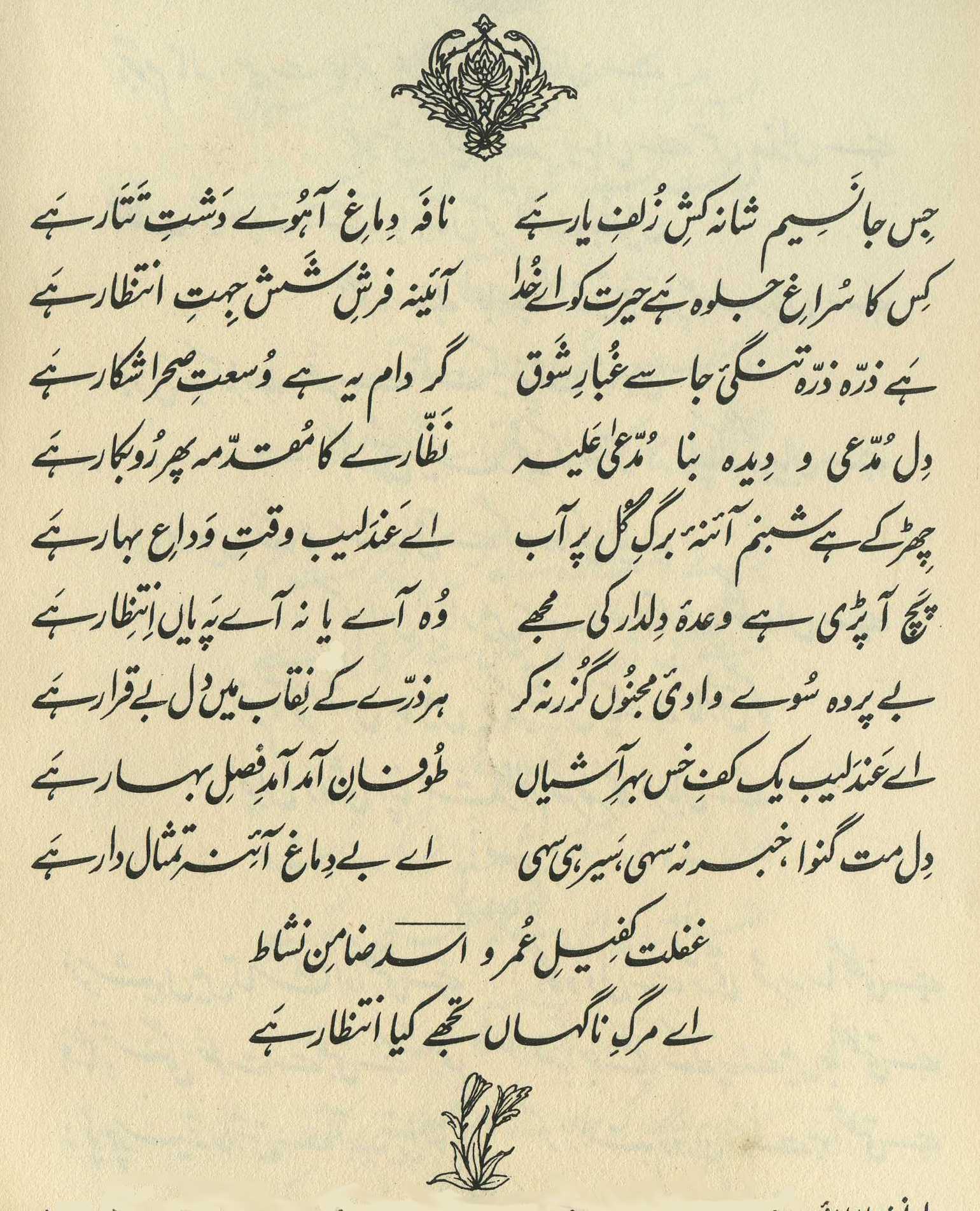
Waiting is a world in which there are six directions, and in its six directions Amazement has spread a carpet of mirror: 'May his/her glory/appearance somehow become visible'. (255)
== Nazm page 255

He says, oh Lord, You ought to know about whose glory/appearance Amazement wants to learn, that it has in the six directions bound 'waiting' into a mirror; and it wants somehow for a reflection of that one's glory/appearance to come into view. (312)
He has supposed 'waiting' to be a world, in which there are six directions; in which Amazement has spread a carpet of mirror: 'May his/her glory/appearance somehow become visible'. (463)
.... Now the meaning will emerge, of whose glory/appearance has Amazement seen a sign/trace? That is, of whose glory (or the trace of whose glory) was such Amazement born, that in waiting, the world is appearing to be nothing but a mirror?
Here the question can arise, if Amazement has already received a sign/trace of the glory/appearance, then what does the waiting mean? To this there are three answers. (1) As yet only the sign/trace has been received; thus this state of amazement. The whole world thus seems to be a mirror, since it's waiting for the whole glory/appearance, that the glory/appearance would become embodied. (2) It had seen the glory/appearance only one time; it desires, and waits, to see it again. (3) The quality of amazement is composed of two parts: in the mirror, and in the amazed individual. In the state of waiting too, there's the same motionlessness and quiet that is in amazement. Someone who is waiting doesn't stir from his place.... Thus we can call the person who is amazed a waiting one, because both don't stir from their places. In this way we can call the person who is all amazement from head to foot a waiting one, and a waiting one we can call a mirror.
[The prose order of the second line can be either:] ; or else . This latter reading supports the assumption I've made in (3) above.... From it the point emerges that the whole mirror has become embodied 'waiting', to the extent that if we assume waiting to be a world (six directions), then the mirror appears to be its carpet. That is, in the mirror glory/appearance had been reflected one time; the mirror became carried out of itself to such an extent that it became entirely amazement. Or some person saw glory/appearance one time, and became amazed to such an extent that he became amazement from head to foot-- that is, a mirror from head to foot. Then the glory/appearance vanished from the mirror (or from sight). Now the mirror is constantly waiting with such intensity for that glory/appearance, or even now the viewer is in such amazement, that the amazed person is amazement from head to foot (or, is a mirror from head to foot), as if he has become a carpet of six directions of waiting.
The verse is extremely convoluted, but the theme is straightforward. This too is a form of ' meaning-creation '.
== (1989: 356-57) 2006: 383-85
About the nature of , see 51,9x .
As for the faux-naïf rhetorical question in the first line, its lineage runs right back to 1,1 . And who better to be asked such a question, than 'the Lord' himself?
Faruqi observes that the mirror, the carpet, 'waiting', and the amazed person all have in common that they are frozen in place, unable to move. But this stupefaction tends to make the verse itself feel inert and perfunctory.
On several other occasions as well, Ghalib invokes the 'six directions' (see 41,4 ). As a provocative verse for comparison, to remind us of what Ghalib can do when he's really being Ghalib, consider 152,4 . There we have the 'six directions', but we also have a sense of energy and activity in the verse: we have the 'rakish ones' and the 'heedless one' and plenty of intoxication to allure us into figuring it out. Similarly in 128,1 , we have that hypnotic first line, and also a parrot to intrigue us. And in 41,4 , the mirror is a door that seems to open into a magic (and/or delusory?) land.
Compared to any of those more energetic verses, the present verse really doesn't evoke much , or any keen desire to analyze it. If you want to have a go at an equally obscure but far more fascinating one, take a look at the next verse, 228,3 .
graphics/ambermirrorchamber.jpg
