Verse 12x[1816 and] 1821aarhai
G3
1
admonition-seeking is the solving of the riddle/enigma of awareness
2
dew is the melting-away of the mirror of confidence/trust
'Admonition, warning, example'.
'What is made unapparent, or obscure, or difficult, or enigmatical'; a verse of mysterious meaning; — an acrostic; — an enigma; an anagram; a riddle, rebus; an innuendo; a dark saying; — a difficult or complicated matter'.
'Melting; liquefaction; consumption; anguish'.
'Confidence, trust, reliance, faith, belief; respect, esteem, repute; credit, authority, credibility; weight, importance; regard, respect, view, consideration, reference'.
| References | |
|---|---|
| Arshi, Imtiyaz Ali | Ghazal# 176 |
| Raza, Kalidas Gupta | 262-263,344-345 |
| Nuskhah-e-Hamidiyah | 266-269 |
| Asi, Abdul Bari | 267-268,269 |
| Gyan Chand | 391-392,392-394 |
| Hamid Ali Khan | Open Image |
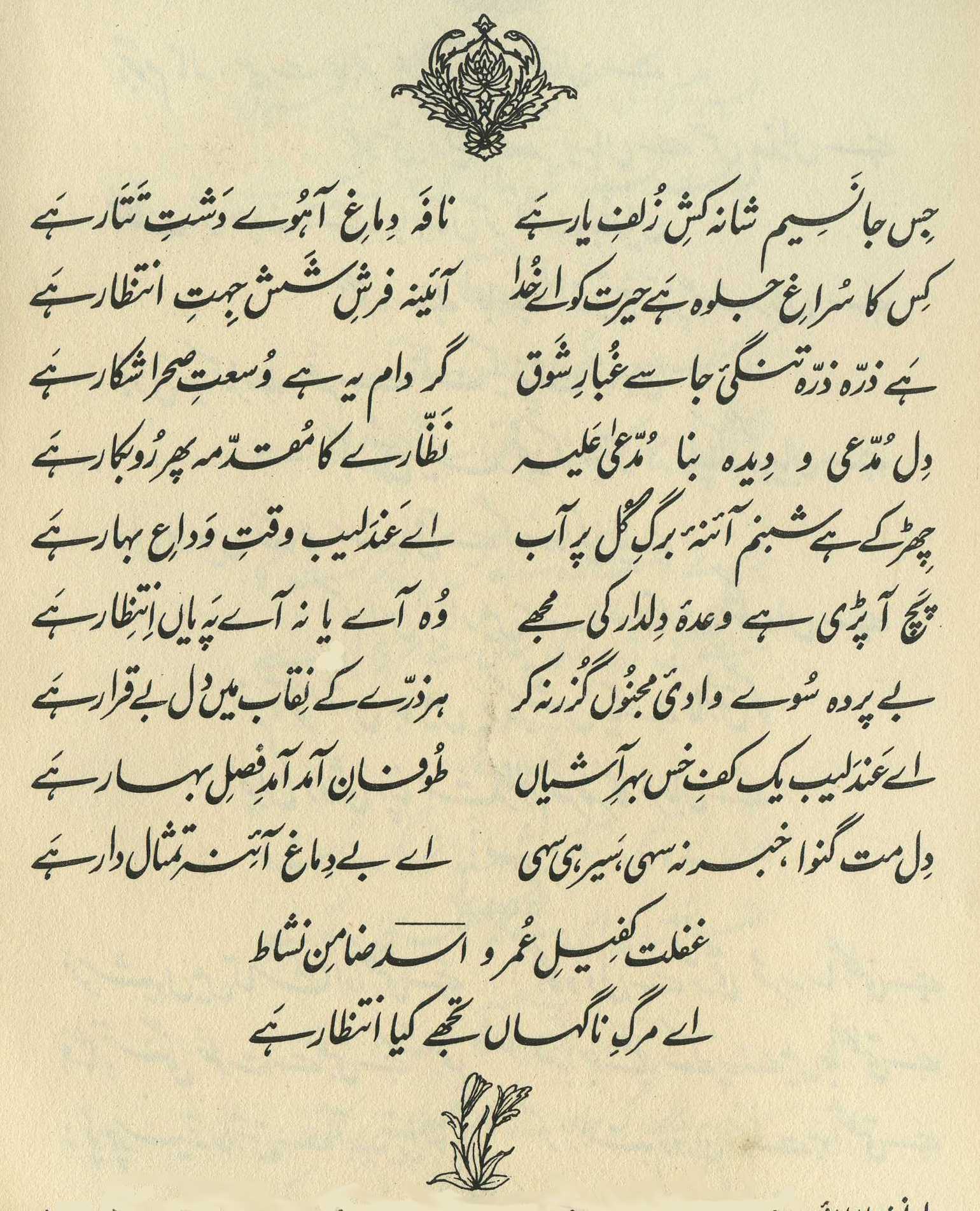
Why do you ask, and what do you ask? Awareness is a riddle, and for it to be solved, or for one to solve it, is admonition-filled. First create the admonition, then solve the riddle of awareness. The truth is that dew is a single melting of the mirror of confidence. Now reflect, to what extent is this admonition-filled-- that a thing that apparently seems to be a decoration is in reality a ruination. And all this admonition has come from the solving of the riddle of awareness.
== Asi, p. 268
= to obtain admonition, and for admonition to go from heedlessness toward awareness. The mirror is awareness, and awareness is a means of admonition. The second line is an illustration of the first line. He says that the reality of the dew is that it is melted from the mirror of admonition. The reason for the dew's being a mirror of admonition is that it has seen the instability of the rose, from which it received such a shock that it became melted. Thus the melting of the dew and its becoming water, which was in reality a mirror of admonition, is for the people of insight an occasion of admonition. That is, the effort to solve the riddle of awareness yields no result except the attainment of oblivion; the attainment of awareness is impossible.
== Zamin, p. 392
The truth/reality of the world is a mystery/secret. The truth is that the life of things is extremely uncertain and brief. If there would be awareness of this, then it will be an admonition. What is dew? The meltedness of the mirror of the confidence in life-- that is, for confidence to keep departing. I n the very beginning, what confidence there is in life! --that it will remain established for some interval. But having seen oblivion, this confidence kept departing. The mirror of confidence melted away, and in its form became manifest a proof of that instability. From the melted mirror of the dew is the similitude; from the mirror is admonition.
== Gyan Chand, pp. 391-392
For background see S. R. Faruqi's choices . For more on Ghalib's unpublished verses, see the discussion in 4,8x .
What kind of mirror 'melts away' and turns into dew? Not any kind of actual mirror, whether a glass one or a metal one-- only one of Ghalib's hyper-metaphysical ones, such as the idea of trust in this physical world. (It did occur to me that the mirror might be showing the 'sweat of shame' at its own inadequacy, like the sea in 141,6 , but that doesn't really work; the mirror seems to be melting away entirely.)
It's an 'A,B' verse, so we have to decide for ourselves the relationship between the two abstract and cryptic lines. The commentators seem to be more confusing than helpful on this one, so let me propose the best reading that I can.
If we are perplexed by the riddle or enigma of awareness (Who are we? What is the nature of our life, and of the world? and so on), then the only real way to 'solve' the riddle is to seek out an admonitory example that will suitably chasten us and cause us to despair of our quest. One such admonitory example is the way our confidence and trust in the world as a kind of mirror (of our own reality? of the Divine creative power?), steadily melts away under scrutiny, as we interrogate it, until all that's left of the solid 'mirror' and the solid world is the ephemerality of dewdrops.
These dewdrops we can then envision as more or less mirror-like. They do shine, they do reflect things, they do their mirror-like best-- for the brief span of their own utterly vulnerable and doomed little lives. And they seem to be presented in the verse as both the 'admonition' and the 'mirror' of our own lives.
graphics/dewdrops.jpg
graphics/dewdrop.jpg