Verse 7[1816 and] 1821aarhai
G3
1
without veiling/pardah, don't pass through the valley of Majnun
2
within the face-veil of every sand-grain, a heart is restless
'A curtain, screen, cover, veil, anything which acts as a screen, a wall, hangings, tapestry; ... secrecy, privacy, modesty; seclusion, concealment; secret, mystery, reticence, reserve; screen, shelter, pretext, pretence'.
'A veil, hood, or covering (for the face)'.
'Restless, uneasy, discomposed, disturbed in mind, disquieted, anxious, distracted; unsettled, variable, vacillating, inconstant'.
| References | |
|---|---|
| Arshi, Imtiyaz Ali | Ghazal# 176 |
| Raza, Kalidas Gupta | 262-263,344-345 |
| Nuskhah-e-Hamidiyah | 266-269 |
| Asi, Abdul Bari | 267-268,269 |
| Gyan Chand | 391-392,392-394 |
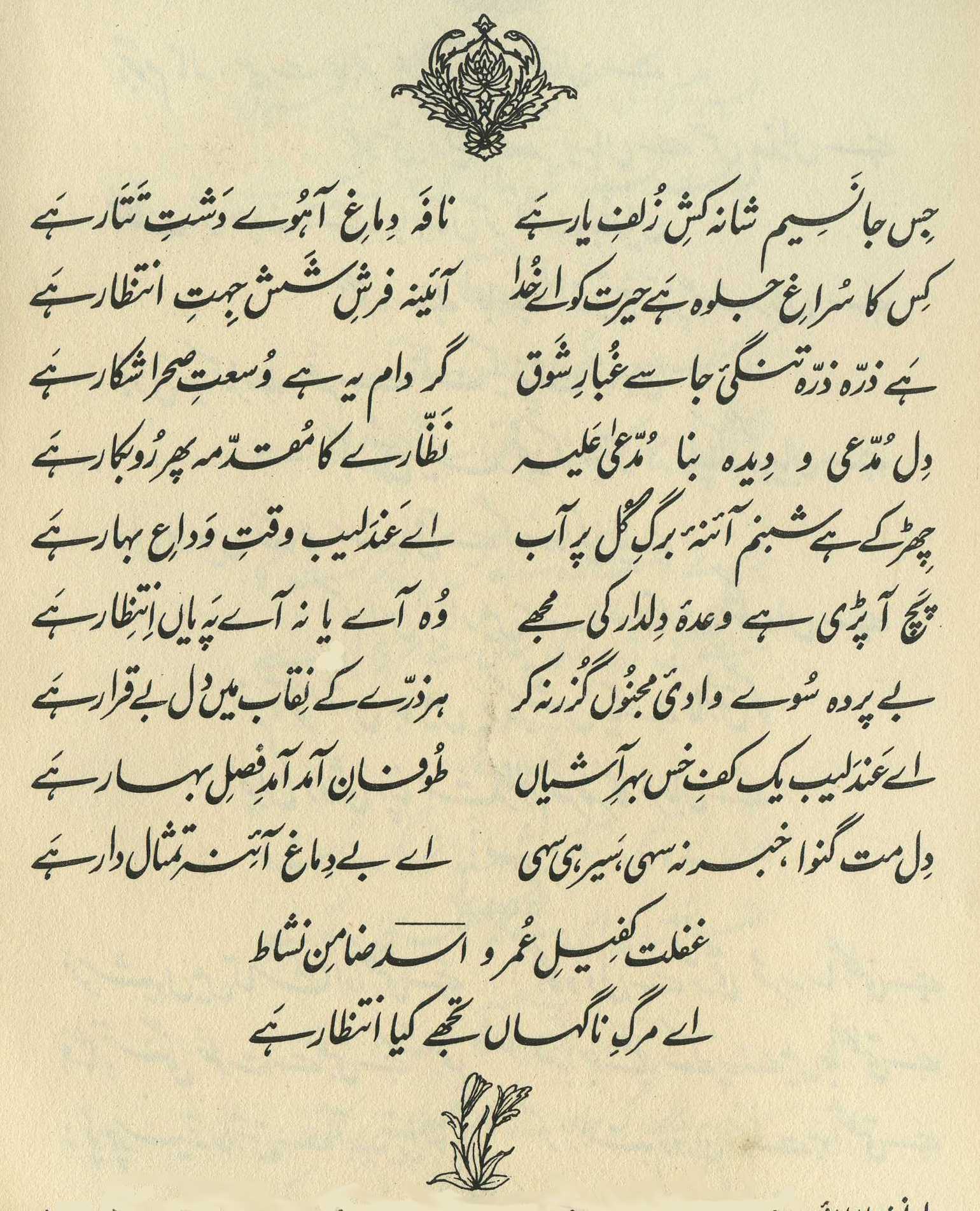
| Hamid Ali Khan | Open Image |
For the quivering of the heart there's the simile of the glittering of the sand-grain. The gist is that in the valley of Majnun, every sand-grain is a mirror-possessor of the restlessness of Majnun. (257)
== Nazm page 257

He says, 'Every sand-grain in the valley of Majnun acts as a restless heart; in such a situation I ought not to travel without veiling/pardah'. (313)
Compare 29,1 . (74)
One pleasure in this verse is that merely by saying 'the valley of Majnun' the poet has shown that his beloved is not only like Laila in appearance, but rather that she herself is a Laila in beauty. No, no-- she herself is Laila. Through the restlessness of the sand-grains he has shown that Majnun was a lover such that whatever wilderness he lived in, he dyed its every sand-grain in his color, and now there every sand-grain acts as a mirror. (468)
[See his discussion of Mir's M 377,15 .]
In the first line, who is the addressee? It could be the beloved, as most commentators think; in which case the injunction would seem to be an expression of jealousy or possessiveness. But Bekhud Dihlavi takes it to be the lover talking to himself, and this is also possible. All we can tell from the intimate imperative is that it's someone close to the speaker.
And right away, that striking second possibility-- that the lover may be speaking to himself-- grabs our attention. What does it mean for a masculine speaker (since the first-person lover's voice in the classical ghazal is basically always masculine) to adjure himself not to travel somewhere without veiling/pardah? Is he thinking of himself as a woman (with shades of bhakti poetry hovering near)? Piquant as that possibility would be, I don't think he is. The range of meanings for includes, after all, 'secrecy', 'concealment', 'reticence', a 'screen', and even a 'pretense' (see the definition above). And we know that Majnun's desert has its own dangerous jealousies, as in 3,1 . The speaker may simply be reminding himself of certain prudent precautions that a traveler in that desert should take.
Or perhaps he means the injunction respectfully. Other, later lovers should remember and honor Majnun's role as their paradigmatic ancestor. They shouldn't presume to disturb Majnun and his desert with their presence. Rather, they should travel quietly, tiptoeing through the desert, discreetly (or even deferentially) wrapped in a cloak.
Needless to say, the second line doesn't clarify the context of the first line, but further complicates or enriches it: 'in the veil of every sand-grain, a heart is restless'. Here the word makes for both word- and meaning-play. If the veiling enjoined on the lover might include 'concealment' or 'pretense', what about the veiling practiced by a sand-grain? Here it's clearly not about feminine modesty, so it might indeed have something to do with 'guise' or 'disguise'. Perhaps the sand-grains are simply proud or stoical, and want to conceal the wild restlessness of their tiny hearts? Perhaps they become inwardly desperate with desire when they see a beautiful traveler pass through their valley? Or perhaps there is actually something dangerous about them-- might they somehow be lurking in ambush, jealous of other lovers? (Remember 3,1 .)
Or, as another possibility, perhaps the sand-grains themselves are the veil for something else-- for 'a heart'. Concealed by, or masquerading as, countless tiny sand-grains, this single 'heart' is restless. Does its restlessness perhaps motivate, or even constitute, the glitter and flow of the sand-grains? (Or does the glitter of the sand-grains constitute the heart's restlessness?) We are juxtaposing so many abstractions here that the metaphors become finally opaque.
For that matter, the 'valley of Majnun' too becomes more opaque, the more we look at it. Is it a valley where Majnun lived? A valley in which Majnun somehow, mystically, still lives? A valley that somehow, in its very sand-grains, remembers Majnun? A valley that Majnun owns or claims? An archetypal lover's pathway, named in honor of Majnun? Or even a valley that 'is' Majnun, one with sand-grains 'dyed with his color' and wild with his own passion?
It's a subtle and haunting verse, a verse of mood . For structural parallels, see 16,6x .
graphics/sandgrains.jpg