Verse 11821ilbaa;Ndhaa
G5
In this meter the first long syllable may be replaced by a short; and the next-to-last long syllable may be replaced by two shorts.
1
when with the motive/pretense of travel the beloved arranged/'bound on' a camel-litter
2
the heat of ardor bound on to every sand-grain a single/particular/unique/excellent heart
'That by which anything is supported, that in (or on) which anything is borne; that which carries the double load of a camel, a camel's saddle; a camel litter or dorser (in which women travel)'.
'To bind, tie, fix, fasten; to tie up, tighten; to bind up, dress (hair, &c.); to fasten or tie (on or round), bind (round)... ; to chain, enchain, fetter; to take captive, enthral, captivate, bring under (one's) influence; to shut up, confine, imprison; to fix, direct, fasten ... join, connect, conglomerate, unite, gather, pack, set... ; to build, construct (dam, bridge, &c.); to compose (verses); to form, produce, make, constitute'.
| References | |
|---|---|
| Arshi, Imtiyaz Ali | Ghazal# 8 |
| Raza, Kalidas Gupta | 321-322 |
| Nuskhah-e-Hamidiyah | 41-42 |
| Asi, Abdul Bari | 56-57 |
| Gyan Chand | 73-78 |
| Hamid Ali Khan | Open Image |
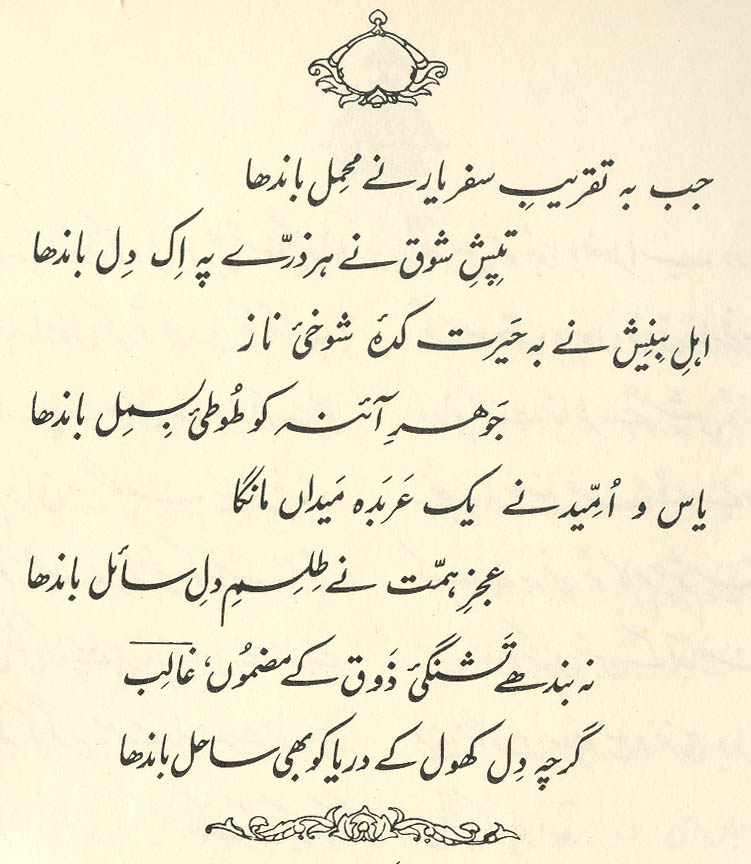
In the burning of the sand-grains and the heat of the heart, the cause for similitude is clear. (29)
== Nazm page 29

Urdu text: Vajid 1902 {29}
He says, at the time of travel, when the beloved placed a litter on a camel and bound it on, the heat of our ardor bound to every sand-grain a heart that remained in the company of the beloved until the end of the journey. (58)
In the road the dust constantly flies around, and the sand-grains move convulsively. But the lover, since he himself is extremely anxious about the beloved's departure, considers that the sand-grains are restless with ardor for the beloved.... At another place he has said: 228,7 . (74)
This is the kind of verse that I've called a ' mushairah verse'; for more on this see 14,9 . The first line is opaque without the second; the second defers gratification till the very end, and then delivers one good big punch. After you've enjoyed that, you're ready to go on to the next verse; you don't keep on thinking and thinking about it.
Here, as is often the case with such verses, the pleasure is in unexpected wordplay. The whole occasion is 'hot', of course, as Nazm points out, but that's just the foundation. It's the juxtaposition of the prosaic, practical, commonplace act of 'binding on' a litter to a camel's back for travel, and the impossibly extravagant, futile, crazy absurdity of 'binding on' a heart to every sand-grain in the vicinity (or in the whole desert), that can't help but be amusing. There is a Persian idiom, , 'to bind one's heart upon a thing' (Steingass p. 531), that Ghalib is literally translating.
The evocation of a 'binding on' activity as performed-- how differently, in such different situations!-- by both beloved and lover, makes this a kind of 'here/there' verse; for more on these, see 15,2 .
This verse also performs the clever negative feat of avoiding in both lines something that the audience would certainly be expecting: the literary sense of as 'to compose (a verse)'; for more on this sense, see the next verse, 29,2 . Out of the four divan verses in this ghazal, only this opening-verse -- the only one that must use the refrain twice-- wittily and perversely refuses to introduce this hovering (and strongly inviting) sense of the term.
Note for the literal-minded: A male beloved might possibly 'bind on', we might imagine, a camel-saddle like the elaborate ceremonial ones depicted in this photo (late 1800's):
"The Maharaja's camels," c.1880's
For a female beloved, however, the case would be different; see 147,7x for further discussion of the nature of a . For other verses, see 259x,1 ; 352x,1 .