Verse 21821ilbaa;Ndhaa
G5
In this meter the first long syllable may be replaced by a short; and the next-to-last long syllable may be replaced by two shorts.
1
the people of vision, in the amazement-chamber of the mischievousness of coquetry
2
versified/'bound' the polish-marks on the mirror as a wounded/slaughtered parrot
'The diversified wavy marks, streaks, or grain of a well-tempered sword'.
'To bind, tie, fix, fasten; ... to bind together, join together ... to compose (verses)'.
| References | |
|---|---|
| Arshi, Imtiyaz Ali | Ghazal# 8 |
| Raza, Kalidas Gupta | 321-322 |
| Nuskhah-e-Hamidiyah | 41-42 |
| Asi, Abdul Bari | 56-57 |
| Gyan Chand | 73-78 |
| Hamid Ali Khan | Open Image |
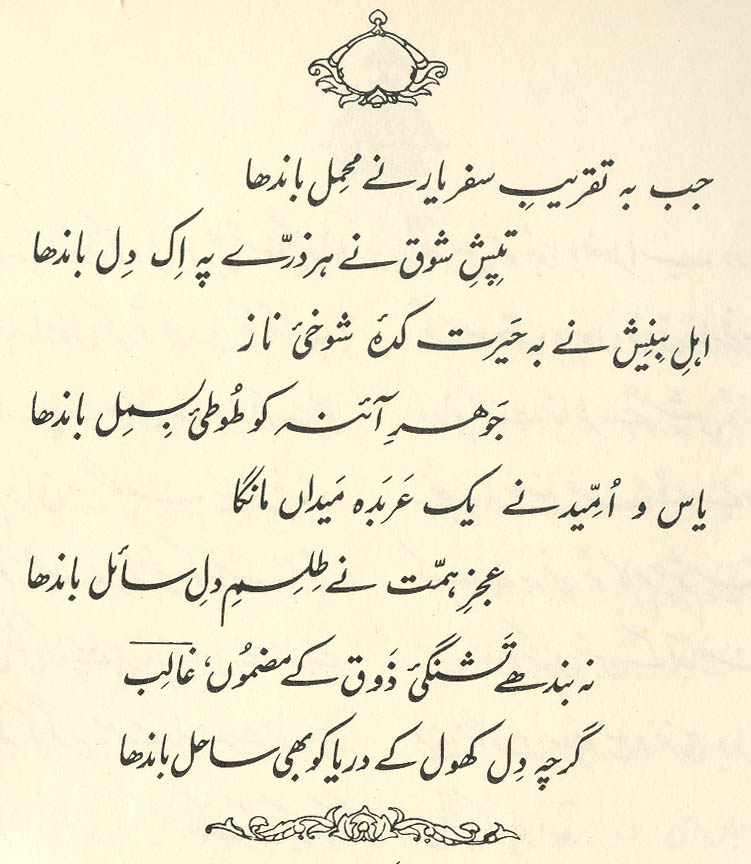
People use for the greenness of a garden, of a beard [], of verdigris, and of a tempered sword [], the simile of a parrot. And the greenness of the polish-marks on an iron mirror is not established in every way. For this reason he's used for it the simile of a wounded parrot: because there seems to be movement in it, and the simile of the movement of the moving one, in which the reason for the similitude would be itself be movement, is extremely subtle and rare.
In short, in his iron mirror the greenness of the polish-marks, which is shown in various aspects, is a wounded parrot. The mischievousness of coquetry that has wounded it is the kind of simile for agitation and restlessness of heart that is in the previous verse [ 29,1 ] as well. (30)
== Nazm page 30

Urdu text: Vajid 1902 {29}
The meaning of the verse is that the brightness of the polish-marks on an iron mirror (which seem to be moving in different ways and directions) is a wounded parrot, which has been wounded by the dagger of the mischievousness of coquetry. (59)
The greenness of the polish-marks on an iron mirror doesn't stay [visibly] steady from every direction. For this reason they have given it the simile of a wounded parrot.... And there can also be this interpretation, that her coquetry, and her beauty, are such that if someone with a heart like iron sees her, first he will be struck with amazement, then like the polish-marks on the mirror he will keep writhing forever. (74)
Janab Hasrat says that in this verse there is a delicate suggestion that the mischievousness of the beloved's coquetry changed amazement into restlessness. All the same, I don't understand this. But my understanding and not understanding are on a par. (163)
ABOUT PARROTS AND MIRRORS: In the ghazal world, parrots are often associated with mirrors, apparently because mirrors were used to teach parrots to talk; the process is discussed by Gyan Chand in 9,8x , 41,9x , 104,3x , and 217,10x . And perhaps also a parrot 'reflects' human speech the way a mirror reflects human faces? Dalpat Rajpurohit says (Mar. 2013) that he's always been told that mirrors can be used to dazzle wild parrots into immobility, so that they can be captured. More parrot-and-mirror verses: 9,8x ; {29,2}; 29,6x ; 41,9x ; 60,10 ; 88,7x ; 104,3x ; 128,1 ; 173,5 ; [ 217,10x ] // 297x,2 ; 308x,6 ; 355x,1 ; 434x,3 .
The verb , literally 'to bind', has a related sense of 'to incorporate into a line of poetry', Since the refrain is , this whole ghazal is full of chances to declare that various things were 'set in a verse as' other things. The audience must in fact have been surprised and amused that the opening-verse did not make use of this opportunity; now this verse does; the next verse does so only secondarily; and then the closing-verse does: 29,4 . For more examples see 29,5x ; 29,6x ; 29,9x . For another whole ghazal of this kind, see 108 , with refrain .
Anyway, here is Ghalib being, surely self-consciously, 'Ghalibian'. Parrots and mirrors tend to bring out the best (or worst?) in him. The verse is so heavy-handedly esoteric: you have to know a lot about ghazal conventions to get it, and when you have gotten it (more or less), apart from a display of technical skill there's not that much 'there' there.
I think the idea is that an 'amazement-chamber' (on the special nature of see 51,9x ) is something like a carnival 'fun-house'-- something full of distorting, disorienting, shocking novelties for the spectator's amusement. The 'people of vision', in a fun-house generated by the 'mischievousness of coquetry', become confused and disoriented, so that in their poetry they depict the polish-marks on a mrror as a 'wounded/slaughtered parrot'. Yet they are still called 'people of vision'-- does that become a satirical epithet that in their folly they no longer deserve? Or does that epithet reflect a deeper insight about the disorienting power of the beloved's beauty? Or are they in fact just poets skilfully and luckily coming up with a new and suitably extravagant metaphor?
graphics/parrot.jpg