Verse 8x1821iinah hu))aa
G5
In this meter the first long syllable may be replaced by a short; and the next-to-last long syllable may be replaced by two shorts.
1
it was not done by us, the reckoning/writing of the amazement of the down/writing on the beloved's cheek
2
the page of the mirror did not become the movement-place of a parrot
'Mark, sign, price-mark; writing, hand-writing, character; notation of numerals (chiefly taken from the initials of the terms for the Arabic numbers); one character in the notation above described; --arithmetic; figure, number; entry, item; amount, sum, total; ... --manner, kind, method, sort; article (of goods)'.
'Perturbation and stupor (of mind), astonishment, amazement, consternation'.
t:t>> : 'A line, a streak, or stripe, a mark; lineament; --writing, character, handwriting chirography; a letter, epistle; --down on the face, incipient beard, &c.; beard; moustaches'.
'Walking round, going about; turning round, revolving (as dust or wind, &c.); motion, agitation'.
| References | |
|---|---|
| Arshi, Imtiyaz Ali | Ghazal# 7 |
| Raza, Kalidas Gupta | 321 |
| Nuskhah-e-Hamidiyah | 40 |
| Asi, Abdul Bari | 55-56 |
| Gyan Chand | 62-63 |
| Hamid Ali Khan | Open Image |
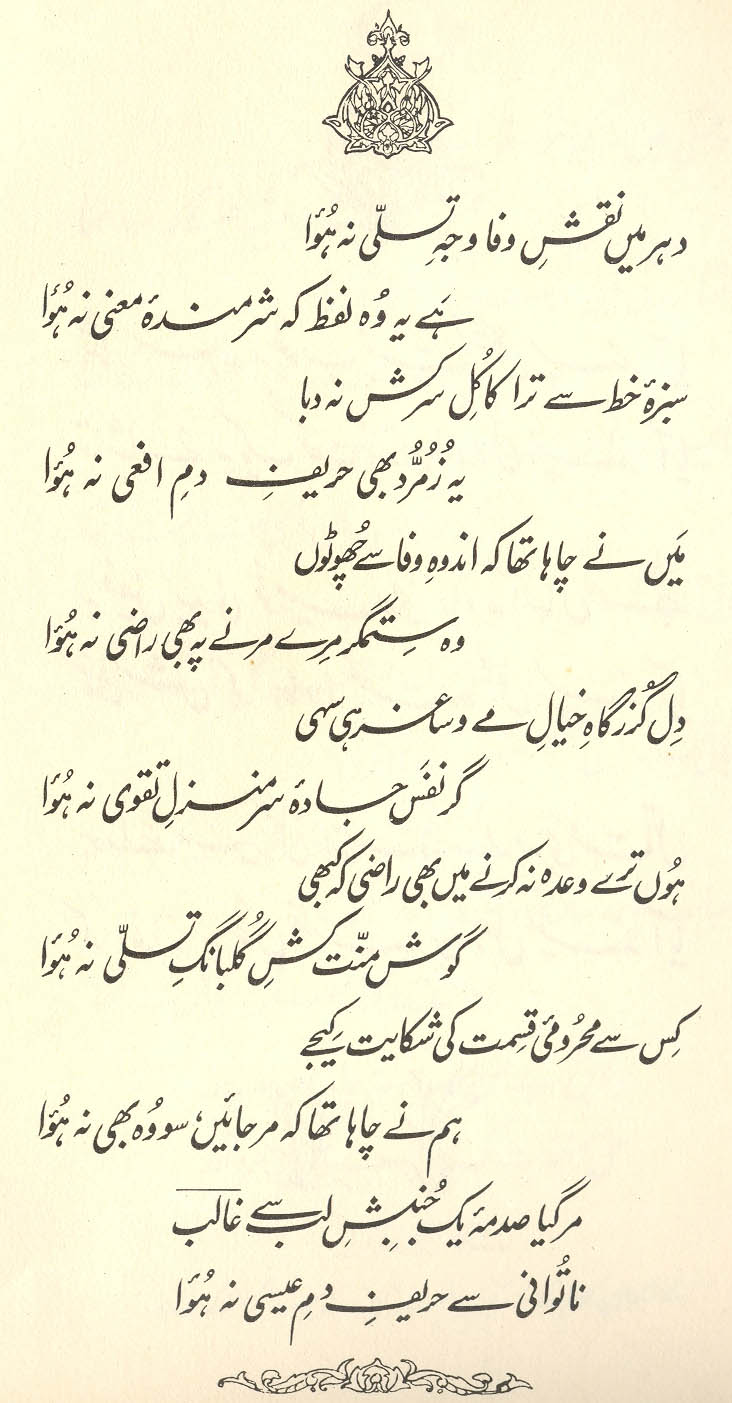
The amazement of the down on the beloved's cheek could not be written by us. The page, because of amazement, became a mirror. But the mirror was not able to become a parrot-- that is, we were amazed and could not describe the down on the cheek.
== Asi, p. 55
I don't understand the 'amazement of the down'. It's possible that Mirza might have [made an error], or it might be an error of the copyist....
The meaning of the verse is that in order to write the praise of the cheek, the sheet of paper with regard to simplicity became a mirror, but on it the kind of praise of the down that ought to have been written, could not be written. The mirror, so to speak, was not able to become a parrot, so that it could warble the praise of the beloved's down. Between the green parrot and the green down there's a similarity.
== Zamin, p. 37
In this verse are a number of affinities . People versify the mirror as 'amazed', and upon seeing the down on the beloved's face we became stricken with amazement. They call the down 'green'; thus its reflection in the mirror seems like a parrot. In addition to this, when they teach a parrot to speak, then they seat it before a mirror. From behind the mirror a man speaks, and the parrot, seeing its own reflection, considers that the parrot in the mirror is speaking. For this reason it too begins to speak. It's obvious that at the time of speaking, it must also be moving a bit. In this way the mirror becomes the 'movement-place of the parrot'. By the 'movement-place of the parrot' is meant the place where the parrot speaks.
He says, having seen the beautiful down on the beloved's cheeks, the state of amazement that overcame us-- on a page of paper we would not be able to explain it. Our page was the kind of mirror in which no parrot moved or spoke.
== Gyan Chand, pp. 72-73
For background see S. R. Faruqi's choices . This verse is NOT one of his choices; mostly for the sake of completeness, I have added it myself. For more on Ghalib's unpublished verses, see the discussion in 4,8x .
This is a verse in which the beloved is imagined as an adolescent boy; for others, see 9,2 .
The combination of parrots and mirrors seems to bring out the maximally abstract side of Ghalib's temperament. At the center of the present verse is , which means 'writing', 'down on the cheek', or any 'line, mark' (see the definition above). In the sense of 'writing', it has an affinity with 'reckoning/writing' and with 'page'. Its sense of 'down on the cheek' is the primary meaning used in the verse. And in the sense of 'line, mark', it can't help evoking-- since the verse contains a 'mirror'-- the countless small 'polish-marks' [] that necessarily appear over time on any metal mirror. (On this see 5,4 .)
A prose paraphrase of this verse would seem to be, 'We didn't/couldn't record our amazement at the line of down on the beloved's cheek; the passive page didn't become activated by containing our writing-- it remained an inert mirror, stupefied by amazement, that didn't display the movements of a parrot who was speaking in front of it'. Mirrors frequently show their own 'amazement' (on the special nature of see 51,9x ) at the beauty displayed in them, by exactly this inertness and stupefaction; see for example 63,1 .
Gyan Chand gives a helpful explanation of the mirror-based training process that is used for parrots, and that seems to underlie the imagery of the second line. For other parrot-and-mirror verses, see 29,2 .
This verse is aggravating: it seems that if we could just put the imagery together a bit more subtly, and manipulate all those words and ideas more cleverly, something fascinating and deep would emerge. But as far as I can tell, nothing that's worth the effort ever does emerge. We're left with 'we were unable to describe/record the amazing beauty of the down on the beloved's cheek', plus a lot of cleverly interrelated wordplay. This is something worth having, of course; it's just not Ghalib at his smashing, irresistible best.
Note for meter fans: This meter can alternatively begin with a short syllable instead of a long one. That's the case here, so there's no need to take the initial as the variant (as for example in 169,2 ).
graphics/parrotmirror.jpg
.jpg)