Verse 61821iinah hu))aa
G5
In this meter the first long syllable may be replaced by a short; and the next-to-last long syllable may be replaced by two shorts.
1 a
to whom would complaint be made about the deprivedness of [our] destiny?
1 b
to whom would complaint be made about [our] being excluded from [our] portion/share?
2
we wanted to die-- and even/also that didn't happen
'Forbidden, prohibited; debarred, excluded (from hope, or favour); frustrated, disappointed, repulsed; ... unlucky, unfortunate, wretched'.
'Division, distribution, partition (of a thing); ... a portion, share, lot; fortune, fate, destiny'.
is an archaic form of the passive; GRAMMAR .
| References | |
|---|---|
| Arshi, Imtiyaz Ali | Ghazal# 7 |
| Raza, Kalidas Gupta | 321 |
| Nuskhah-e-Hamidiyah | 40 |
| Asi, Abdul Bari | 55-56 |
| Gyan Chand | 62-63 |
| Hamid Ali Khan | Open Image |
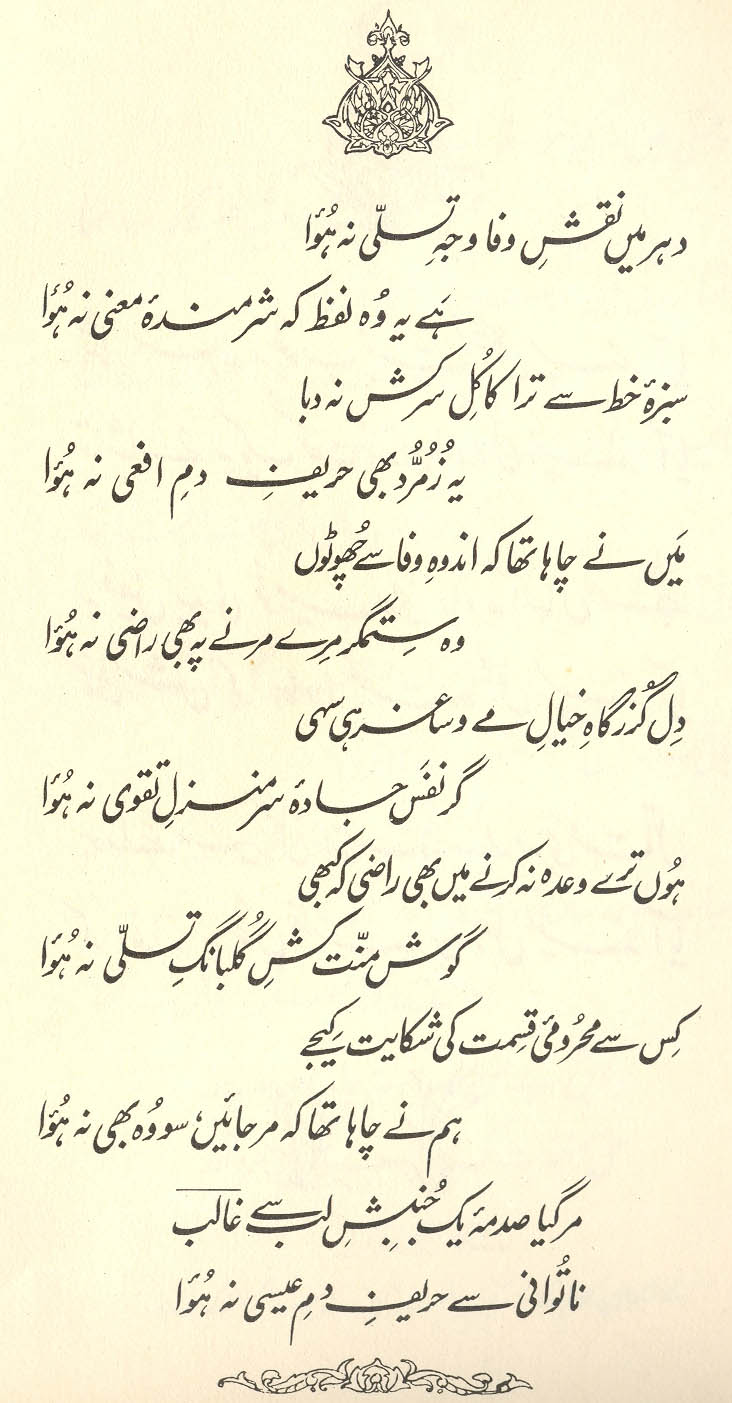
That is, I made my last wish-- that death should come. And I remained deprived even of that. (10)
== Nazm page 10

Urdu text: Vajid 1902 {9}
The inquirers ask what it means for a man to want to die and not be able to die.
1) The Qur'an gives an answer to this ... that is, death will come neither before the preordained time, nor after it.
2) He couldn't die because of the thought that the beloved and all the world would taunt him for being cowardly and thus giving up his life.
3) Out of fear of disgracing the beloved, he couldn't die.
4) Often it can be seen in stories of love, that in the state of separation the lover has taken poison, or in the state of union with the beloved poison has been given to him, and his absorption in passion didn't allow his spirit to accept the effect of the poison. (18)
To ask who can receive and rectify a complaint is a standard rhetorical question. But in this verse it's become re-literalized: if even death is not available, to whom in fact can the speaker complain? God, the ultimate ruler of death and fate, is apparently not listening. And he probably won't listen till Judgment Day, which will not happen till after death-- and the speaker is unable to attain even death. Thus he either has a radically deprived type of destiny, or is so ultimately wretched that he has in effect no destiny-- no 'share/portion' (see the definition above)-- at all.
The little works well here. If we read it as 'even', then the speaker's being deprived even of death is a special outrage, in a class by itself. And if we read it as 'also', then the speaker's being deprived also of death is just one more in a long series of deprivations. It's hard to say which would be worse.
graphics/complaint.jpg