Verse 9x1821iinah hu))aa
G5
In this meter the first long syllable may be replaced by a short; and the next-to-last long syllable may be replaced by two shorts.
1
look at the amplitude of the mercy of God-- that there would be pardoned
2
an infidel like me, who didn't become obligated/indebted to/for sins
'Latitude; amplitude; spaciousness; capacity; space, extent; space covered, area; dimensions; bulk; --convenience, ease; opportunity, leisure'.
'To give, grant, bestow; to forgive, pardon, excuse'.
is a variant form of ; GRAMMAR .
'Who has received a favour, favoured, obliged; grateful, thankful'.
'Acts of disobedience, sins, crimes'.
| References | |
|---|---|
| Arshi, Imtiyaz Ali | Ghazal# 7 |
| Raza, Kalidas Gupta | 321 |
| Nuskhah-e-Hamidiyah | 40 |
| Asi, Abdul Bari | 55-56 |
| Gyan Chand | 62-63 |
| Hamid Ali Khan | Open Image |
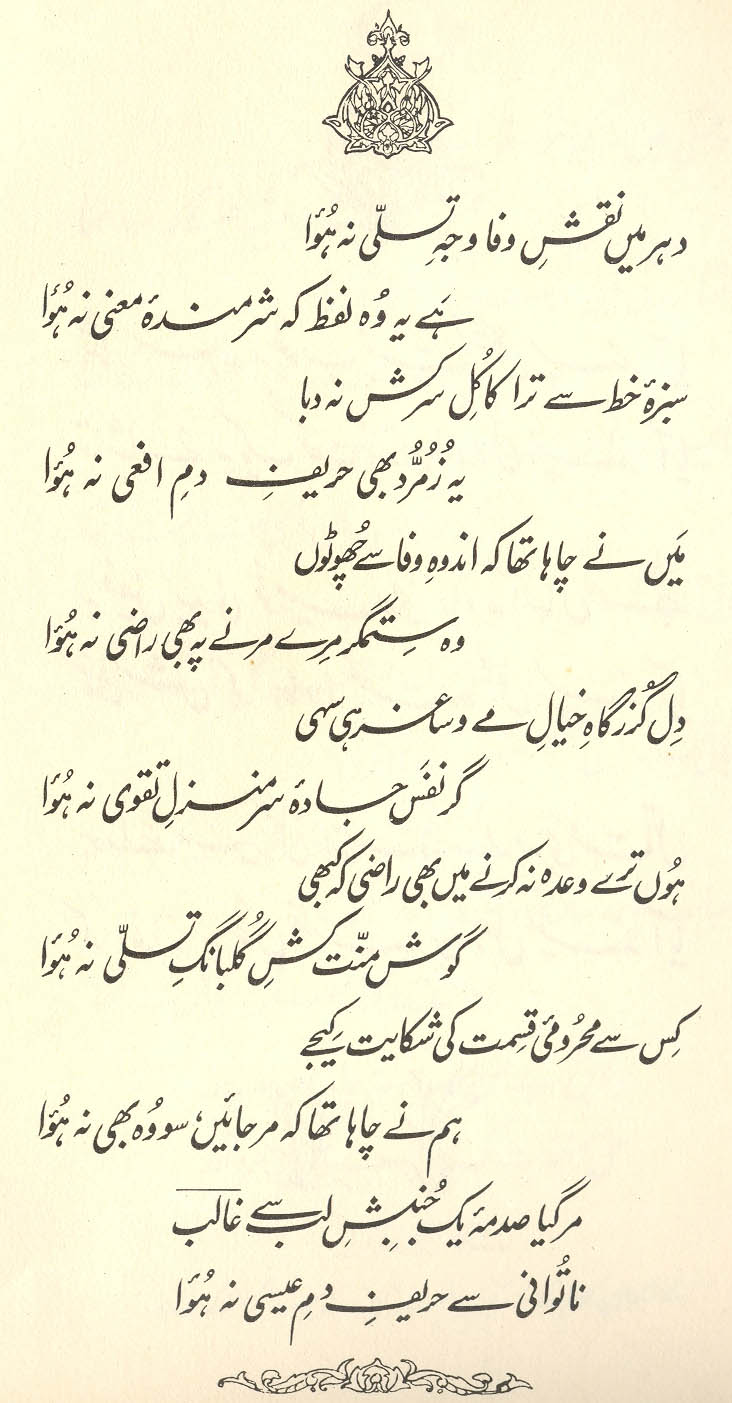
Just look at the breadth of the mercy of that generous one-- that he has pardoned an infidel like me, who was an infidel from all eternity, and did not become an infidel only through the good offices of sins. That is, I was not the kind of infidel whom sins would have made an infidel. No-- rather, I was a temperamental infidel from all eternity.
== Asi, p. 56
In this verse to be is to be repentant for sins; otherwise, it will have no meaning. That is, 'to be indebted to sins' will have the meaning of 'to engage in sins'. Then when he didn't at all engage in sins, he would be declared to be innocent; and when he would be declared innocent, then how is it surprising that he would be pardoned? Beyond this, the bringing together of 'infidel' and 'innocent' will be meaningless.
== Zamin, p. 38
In the second line the idea has been reversed. It must somehow be made straight. The meaning of 'obligated to sins' apparently seems to be 'indebted to sins'; that is, to accept sins, to embark on sinning. But here there's no scope for such an interpretation. Sin was able to do me the kindness of not making me its prey. But I didn't wish to accept this kindness from it, and I myself made myself available as its practice-slate. The Lord's mercy is so ample that he has pardoned a sinful infidel like me.
== Gyan Chand, p. 73
This also means that he was so inconsiderate that he committed no sins, and denied God this opportunity to exercise his benignness. (Marginal note, handwritten in English in my copy of , 1980)
See S. R. Faruqi's choices . This verse is NOT one of his choices; mostly for the sake of completeness, I have added it myself. For more on Ghalib's unpublished verses, see the discussion in 4,8x .
The speaker presents himself as an apparently unique, or at least extraordinary, kind of 'infidel'. But what kind exactly? The flexibility of the , and the usual Ghalibian ambiguities, permit his distinctive 'infidelness' to take various possible forms:
=He didn't become 'obligated to sins', because he didn't take any advantage of them-- that is, he didn't (deign to? bother to? want to?) commit any sins. The possibility of sinning was like a line of (dis)credit that he never used. (My own favorite reading.)
=He didn't become 'obligated to sins', because he didn't accept their offer to refrain from tempting him and causing him to sin; thus he voluntarily became their prey, and sinned (Gyan Chand's reading).
=He didn't become 'obligated [to God] through sins', because he didn't commit any sins; thus he perversely denied God a chance to receive the obligatory penitence and then to show him mercy (Faruqi's reading).
There's thus an element of paradox in this behavior: an 'infidel' is normally expected to sin; an 'infidel' who stubbornly refuses to succumb to sin is-- what? Not a Muslim exactly, because in this case the speaker specifically identifies himself as an 'infidel', one who has been created as such by the remarkable breadth of God's imagination and power. Is he perhaps a strange, hybrid, virtuous infidel? Or maybe a truly perverse infidel?
In any case, the speaker's emphasis on radical independence, on rejecting all outside influence, is one of the few strongly discernible, consistent strands in Ghalib's poetic self-presentation; for discussion and many examples, see 9,1 .
graphics/sins.jpg