Verse 51821iinah hu))aa
G5
In this meter the first long syllable may be replaced by a short; and the next-to-last long syllable may be replaced by two shorts.
1
even/also in your not making a promise/vow, I'm content, for not ever
2
did my ear become {indebted to / humbly pleading for} the auspicious-sound of comfort
'Pleased, well-pleased, content, contented, satisfied, agreed, willing, acquiescent; regarding with good will or favour, liking, approving'.
'The note of the nightingale; warbling; --sound; --fame, rumour; --glad tidings; --a loud shout'.
'Kindness or service done (to); favour, obligation; —grace, courtesy; —entreaty, humble and earnest supplication; —grateful thanks, praise'.
'Under obligation, obliged' .
| References | |
|---|---|
| Arshi, Imtiyaz Ali | Ghazal# 7 |
| Raza, Kalidas Gupta | 321 |
| Nuskhah-e-Hamidiyah | 40 |
| Asi, Abdul Bari | 55-56 |
| Gyan Chand | 62-63 |
| Hamid Ali Khan | Open Image |
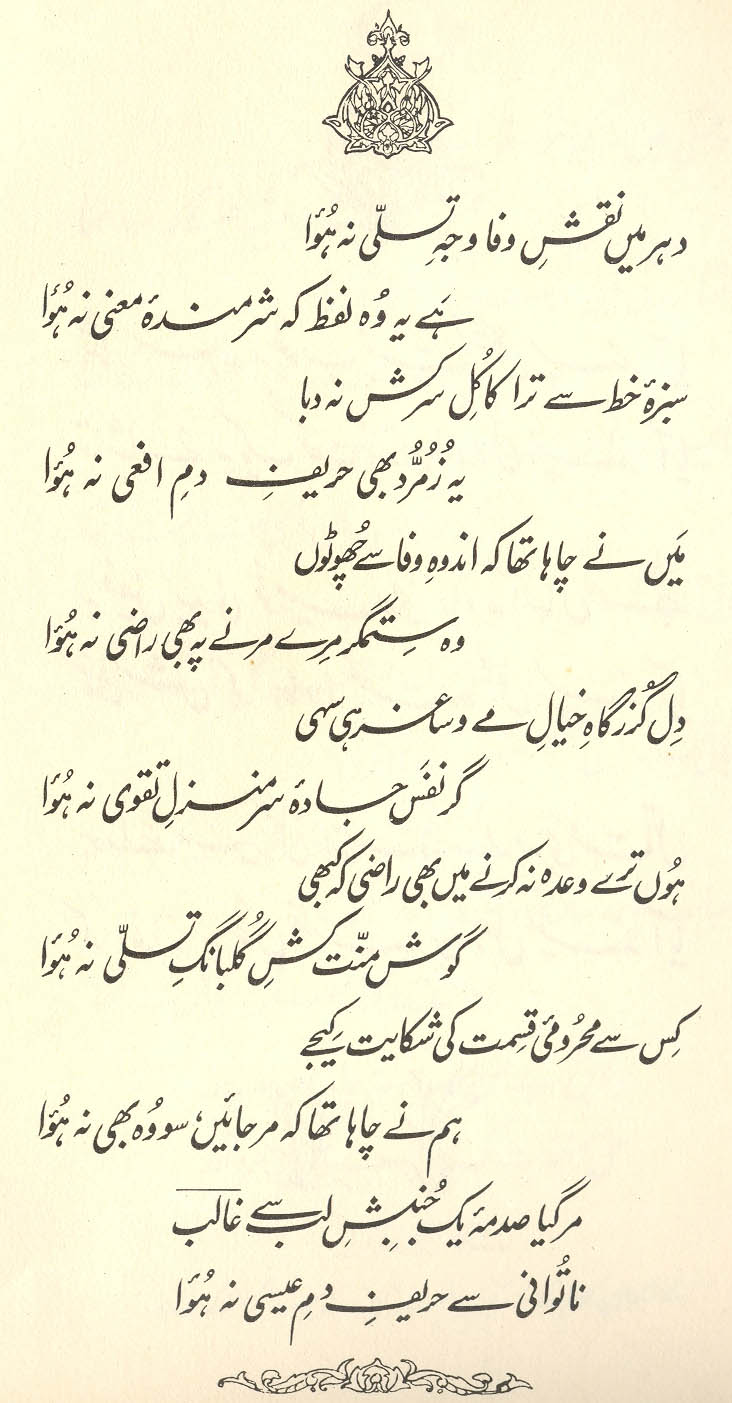
That is, if you had made a promise of union, then in that case I would have been happy, because it was exactly my desire; and since you did not make a promise, I'm happy even with that, because I'm saved from obligation-- and from an obligation that I never could have repaid. (10)
== Nazm page 10

Urdu text: Vajid 1902 {9}
Mirza Naushah does not mean, 'I consider your promise to mean nothing', but rather, 'Your promise is my life, but when you do not want to make a promise, then why would I torment my heart? I am happy, considering that if you had made a promise, then the goal would have been attained. If you did not make a promise then you did well, because my ear did not become indebted to the good news of comfort.' (17)
../apparatus/txt_sets.html There are two ways of reading the second line. First, as Nazm and the other commentators propose: the speaker is glad that his ear never abased itself, begged, flattered the 'good news' (or 'rumor') of comfort.
Second, as a less defiant and more resigned statement: even if she doesn't promise he is content, he accepts it, because after all he's used to it-- never has he heard a single word of encouragement from her anyway. Being under no 'obligation' to comfort (because of never having received any) is his normal state, so why should he repine?
The verse reminds us that , 'doing (or 'a doer of') '-- literally, 'pleading, entreating' or 'gratefully praising' (see the definition above)-- doesn't just convey a neutral-sounding 'under obligation', but rests on a much more vividly humiliating image of humble supplication. The usage is similar to that of in 9,1 . In both cases, the poet plays with conventional metaphors for 'being under obligation, being indebted', and does so in a way that also invokes their original, literal meanings.
graphics/ear.jpg