Verse 31821iinah hu))aa
G5
In this meter the first long syllable may be replaced by a short; and the next-to-last long syllable may be replaced by two shorts.
1
I wanted to escape the sorrow of faithfulness
2 a
that tyrant didn't consent even to my dying
2 b
that tyrant wasn't appeased even by my dying
'Pleased, well-pleased, content, contented, satisfied, agreed, willing, acquiescent; regarding with good will or favour, liking, approving'.
| References | |
|---|---|
| Arshi, Imtiyaz Ali | Ghazal# 7 |
| Raza, Kalidas Gupta | 321 |
| Nuskhah-e-Hamidiyah | 40 |
| Asi, Abdul Bari | 55-56 |
| Gyan Chand | 62-63 |
| Hamid Ali Khan | Open Image |
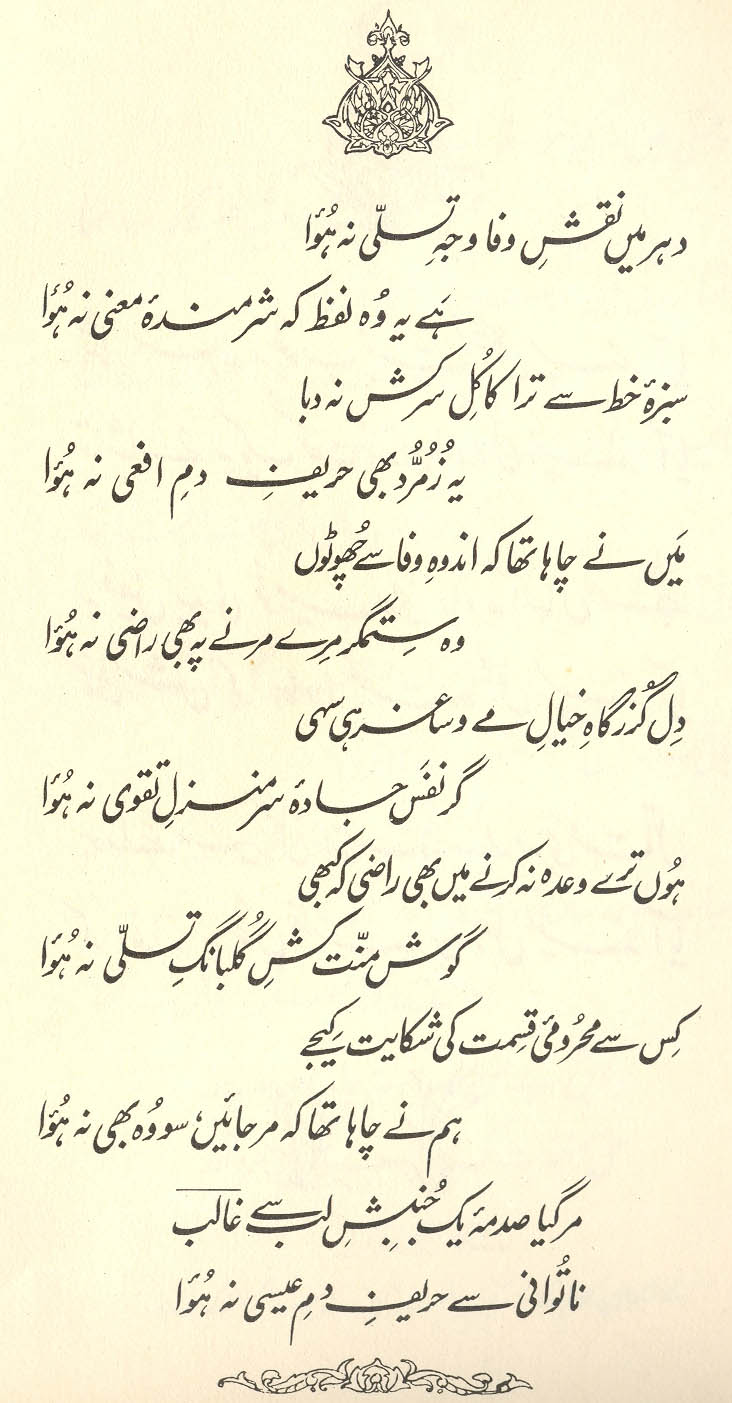
That is, when I wanted to die and escape being pursued by grief, out of fear of disgrace and disrepute she didn't approve even of this. (9)
Urdu text: Vajid 1902 {9}
She considers, 'His death will be a cause of disgrace to me. In addition, my practice of tyranny will be altered. The greatest reason of all to forbid it is, where will I get another such faithful person?'. The beauties of word and meaning in this verse have no end. (22)
I wanted to die, and be saved from the grief of faithfulness. But the beloved is so tyrannical that even after my dying she was not appeased-- for, 'Whom will I torment now?' (17)
The obvious chief point, and main pleasure, of the verse is the elegant double meaning of the second line. The grammar has been carefully contrived so that with immediate plausibility and colloquialness both (2a) and (2b) present themselves at once to the reader. The mind must go back and forth between them.
These two readings set up two different relationships between the lines. If we adopt (2a), then the two lines describe the lover's proposal and the beloved's reaction to the proposal. If we adopt (2b), then the two lines are spoken by the lover after his death (a kind of speech not at all uncommon in the ghazal world; for examples see 57,1 ), so that they explain his motivation for dying, and also report her reaction to his dying. Both readings yield piquant and appropriate glimpses of the 'tyrant' beloved.
The proof that both readings are plausible is that the commentators among themselves see both: Nazm, Vajid, and Bekhud Dihlavi endorse (2a), while Bekhud Mohani relies on (2b). Yet none of them, and none of the other commentators either among the many I've read, point out the cleverness, elegance, and enjoyableness of the verse's creation of two such equally appropriate, equally meaningful readings-- or even the fact that there are two readings. Why they don't is one of the great Mysteries of Life; I have given my best guess in an article .
Note for grammar fans: Of course, the first line literally says 'I wanted that I would be left (behind) by the sorrow of faithfulness'. But that's too clunkily literal even for me.
graphics/death.jpg