Verse 11816angaa;xir
G2
1
the clearness/polish of the amazement of the mirror is the stuff/property of verdigris, finally
2
the change/alteration of stagnant water acquires/finds color, finally
'Clearness, transparency; polish, brightness, cleanness, purity'.
'Perturbation and stupor (of mind), astonishment, amazement, consternation'.
'Changing, alteration (for the worse); change, alienation'.
'Water; water or lustre (in gems); temper (of steel, &c.); ...splendour; elegance; dignity, honour, character, reputation'.
'On the ground; prostrate, quiet; in place; properly placed; true, accurate, right'. (Steingass p.170)
'Left, remaining; --fatigued, tired, weary, languid; ailing, indisposed'.
| References | |
|---|---|
| Arshi, Imtiyaz Ali | Ghazal# 60 |
| Raza, Kalidas Gupta | 182-83 |
| Nuskhah-e-Hamidiyah | 106 |
| Asi, Abdul Bari | 117-118 |
| Gyan Chand | 204-205 |
| Hamid Ali Khan | Open Image |
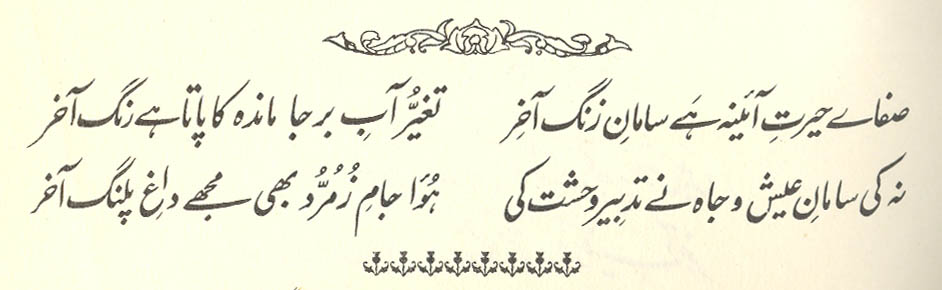
That is, just as the color of stagnant [] water deteriorates and scum forms on it, for amazement too to go beyond limits is not good. In this verse the appearance of verdigris on a mirror has been given as a simile the appearance of scum on water, with the condition of lack of movement as the grounds of similitude. (64)
== Nazm page 64

He says that just as from lying useless and neglected a mirror becomes covered with verdigris, in the same way scum forms on stagnant [] water and makes it discolored and dirty. The meaning of the verse is that the man who is considered most famous and useful remains most liable to disaster and calamity. (111)
The Sufi is obliged to pass through many states and many guises. Amazement too is one of the states. Strive for purity and the manifestation of Divinity, and don't remain in one single state. (144)
Compare 47,1 . (170)
This is one of Ghalib's many 'mirror' verses; on this image see 8,3 . Arshi suggests comparison with 47,1 , and I would add 48,10 . All these verses use metal mirrors, and the greenish verdigris that develops on them, to illustrate abstract philosophical points. In the present verse, the verdigris is proof of the inevitability of decay. The mirror is an image of amazement [] because it resembles a wide-open eye fixed in a perpetual stare. In the ghazal world, amazement in both people and mirrors is conceived of as a form of stupefaction, of frozenness or arrested motion. This state of amazement can have Sufistic meanings too, as Bekhud Mohani notes. For more on such 'amazement', see 51,9x .
As in so many verses, we have two parallel abstract statements in the two lines, with no indication of how they are to be connected. In this case, the two may not quite make it to the formal level of parallelism (for more on this see 22,5 ), but the situations described are suggestively similar. The key word that brings them together is , with its variously appropriate meanings of water, luster (as of a gleaming mirror), and temper (as of a polished metal mirror).
In this verse we experience an elegant double turn. Having started by reading the first line about the metal mirror, we then move on to the second line and realize that it too can describe the mirror's situation, thanks to . But thinking about makes us realize that its primary meaning in the second line is undoubtedly water, because the line is evoking the greenish cast that develops in stagnant water. So when we return to look again at the first line, we realize (as we had no cause to do before) that the 'mirror' can also refer to water, since the process is just the same, and since clear, pure water acts as a fine mirror.
So the two processes 'mirror' each other: when a metal mirror is left alone too long and is not vigorously polished, its clarity is vulnerable to verdigris, its surface turns greenish. And when water is left stagnant, abandoned, unmoving, it is corrupted into 'color', and of course we know that the color of such water is greenish.
The commentators are concerned to derive a moral lesson from the verse, though they don't agree on what exactly it should be. It seems clear that 'amazement' or stagnation-- any prolonged lack of movement-- results finally in corruption or decay. But is that a morally culpable situation, or an inevitable one? The verse gives no hint. We're left to fill in, or invent, the whole point of the verse for ourselves.
The real fascination of the verse is the way the mind oscillates back and forth between the 'clearness/polish of the amazement' [] of the mirror, and the 'fixed-in-place' [] quality of the stagnant water. The former sounds so lofty and ideal and mystical, while the latter is clearly a sign of trouble, as the overtones of make clear. Yet the structure of the verse implicitly analogizes them. So how does the (good?) unmovingness of the amazed mirror, connect to the (bad?) stagnation of water? We feel there's something complex going on here, but our attempts to fathom it are frustrated by the opacity of the imagery. It's like trying to glimpse something shining in an unpolished mirror or a stagnant pond.
Also, the sound effects are lovely in this one-- all those long vowels, and especially the high ratio of to all the others. Perhaps ironically, it's a verse full of flowingness .
graphics/stagnantwater.jpg