Verse 21816angaa;xir
G2
1
the equipment of luxury/enjoyment and dignity/grandeur did not provide a cure for wildness/madness
2
even/also an emerald cup became, to me, 'spots of the leopard', finally
''Life; animal life'; a life of pleasure and enjoyment, pleasure, delight, luxury; gratification of the appetites, sensuality; carnal intercourse'.
'Dignity, rank, high position; grandeur'.
'A mark burnt in, a brand, cautery; mark, spot, speck; stain; stigma; blemish; ...scar, cicatrix; wound, sore; grief, sorrow; misfortune, calamity'.
'A desert, solitude, dreary place; --loneliness, solitariness, dreariness; --sadness, grief, care; --wildness, fierceness, ferocity, savageness....distraction, madness'.
| References | |
|---|---|
| Arshi, Imtiyaz Ali | Ghazal# 60 |
| Raza, Kalidas Gupta | 182-83 |
| Nuskhah-e-Hamidiyah | 106 |
| Asi, Abdul Bari | 117-118 |
| Gyan Chand | 204-205 |
| Hamid Ali Khan | Open Image |
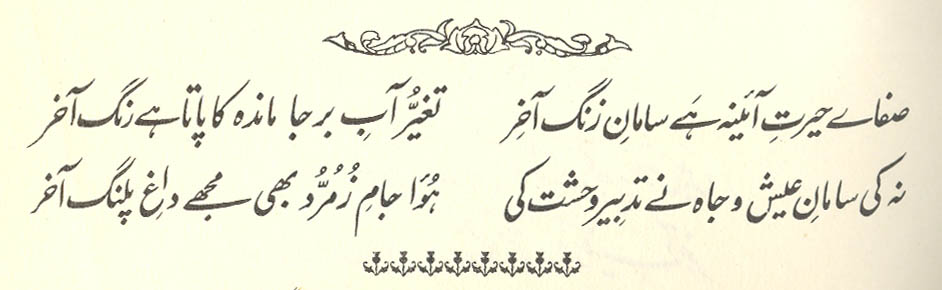
That is, I consider an emerald cup to be a 'spot of the leopard', and madness increases. The theme of the verse is trifling, but the simile has given it life. (64)
== Nazm page 64

He says, my madness of temperament could not be removed even by equipment for pleasure and pomp, and he presents this illustration of it: that even an emerald cup became, in my eyes, a 'spot of the leopard'. (111)
The gist of it is that luxury cannot become a cure for the heart's madness and restlessness. (144)
This verse puzzled me, but S. R. Faruqi explained it (Jan. 2003) as follows:
Emerald was a popular stone for making drinking vessels and even somewhat larger utensils, perhaps because a) it is soft to carve, b) it is a light stone, and c) it invariably has flaws, so an emerald with few or no flaws is extremely precious. Flawed emeralds can be used conveniently for vessel making. The spots on the leopard are supposed to be green because there is no word for 'brown' in Persian. Urdu also has two totally inappropriate words, or . Whereas 'brown' has numerous shades. Hatim's dictionary defines 'brown' as , that is, 'coffee-coloured'. A leopard's spots are best described in English as 'liver-coloured'.
So if the greenish/brownish-spotted emerald cup ultimately reminds the mad lover of a leopard's coat, it becomes only a further sign of his madness/wildness [], rather than of civilization and luxury. The madness/wildness of the lover's heart is as innate and unremovable as the leopard's spots. (There's also a nicely appropriate English proverb: 'A leopard can't change its spots'.) Another verse: 416x,9 .
For an additional example of wordplay involving , see Nasikh's verse cited in 112,9 .
This would have been an excellent mushairah verse; for more on this concept, see 14,9 .
The two constructions in the first line also strike the eye and ear. Although they look the same, the first is the feminine singular perfect of , while the second is the feminine possessive adjective; both are agreeing with . But you could almost read the line as, . That's not of course the intended reading, but it does seem to lurk somewhere on the borderline of awareness.
Two Mughal-period emerald cups:
graphics/emeraldcup2.jpg
graphics/emeraldcup.jpg