Verse 91826aarbhii nahii;N
G3
1
who would not die for/over this simplicity, oh Lord ?!
2 a
she fights-- and not even a sword in her hand!
2 b
we fight-- and not even a sword in our hand!
| References | |
|---|---|
| Arshi, Imtiyaz Ali | Ghazal# 100 |
| Raza, Kalidas Gupta | 364-65 |
| Hamid Ali Khan | Open Image |
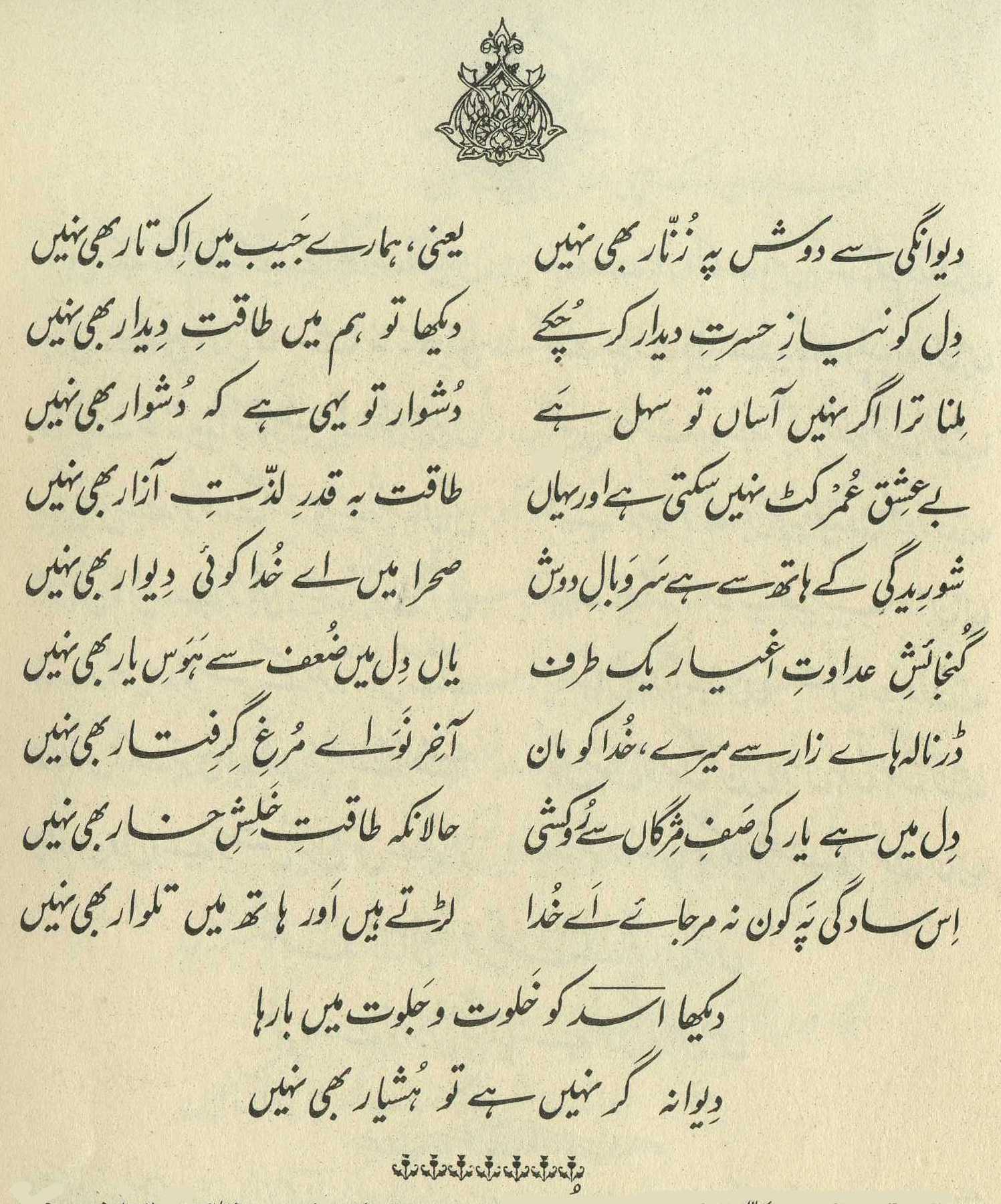
In this verse is contemporarily descriptive []. And in 'fighting' [] is meant the mixing-up of hand-to-hand scuffling. (121)
== Nazm page 121

One wants to give up his life at this simplicity-- she sets out to fight, and empty-handed. The meaning is that she doesn't use airs and graces, which are the attack-weapons of beloveds. That is, this is her glory, this is her murderous innocence. (227)
A questionable interpretation is that in the verse is mention of the 'hand-to-hand scuffling' of the night of union. Nasikh :
[in the night of union, upon the bed,
she scratches like a cheetah]
.... Since in the verse there's no sign of the occasion of union, we'll reject the 'hand-to-hand scuffle' and direct attention to the points below.
1) If the ordinary interpretation would be accepted, then in the second line instead of there should have been . That is, she is so simple of temperament that she fights (=is fighting) but a sword (the means of fighting) is not in her hand. If emphasis is placed on , then we will be forced to say 'not even a sword, only a stick or a wooden dagger'. It's clear that this reading is not intended here. Thus there is certainly some other reason for .
2) If in her hand there's not even a sword (that is, there's nothing at all), then how does she fight?
3) In what does her 'simplicity' lie? Is it simplicity not to make use of equipment, or is it simplicity for the beloved to have confidence that she will strike down the enemy without arrow or sword?
4) If 'fighting' doesn't mean hand-to-hand combat, then what does it mean? Who is the enemy?
The final answer to these questions is that there are two meanings of 'simplicity': (1) to be without; and (2) innocence. Ghalib himself has a verse: 157,1 . About this verse [Nazm] Tabataba'i has very correctly written that by 'simplicity' is meant the renunciation of ornament and adornment. Now if we examine the verse under discussion, it becomes apparent that here too 'simplicity' is used in the meaning of 'to be without'; thus young children are called , since their faces are without lines. Accordingly, the meaning of 'to fight' is not the official one of making war or battle, but rather, is the murder of the lover. The beloved's task is to murder the lover. And the means of the murder is 'to fight'. Ghalib has also used this metaphor in 93,2x . Thus 'sword' too is not real and physical, but rather is metaphorical; that is, self-adornment and ornament and decoration.
Now the situation has developed that the beloved has come before us (=is coming for battle). But she is devoid of self-adornment; that is, she is not arrayed with the equipment for battle. Her not being equipped is her simplicity, in both meanings. That is, that she is devoid of ornament and adornment; and also that she is so innocent that she is unacquainted with the arts of attack and combat. But what is the result? Her simplicity (devoid-ness) itself is deadly. (Or her innocence itself is deadly.) 'Die for' [] is both idiomatic and literal. The beloved's purpose has been fulfilled without attack and combat. As if the beloved's simplicity (that is, devoid-ness) is not due to simple-naturedness or guilelessness, but rather is caused by cleverness [].
== (1989: 186-87) 2006: 208-09
[See also his comments on Mir's M 1506,1 .]
This verse continues the military metaphor from the previous verse, 112,8 . Faruqi has made most of the points that I wanted to make. Since Nasikh's verse quoted in Faruqi's commentary may look too simple, I can't resist pointing out its wonderfully clever wordplay: means not only 'bed', but also 'panther'; see 63,2 for an example.
The beloved is 'simple' because she doesn't carry any weapons, and/or because she doesn't know that she needs them. But then, paradoxically, it turns out that she doesn't need them, since who wouldn't (metaphorically) 'die for' and/or (literally) 'die over' this simplicity? So, as Faruqi asks, isn't her simplicity rather like 'cleverness'? Compare the wonderfully apposite 4,4 , in which 'simplicity' and 'cleverness' are put through all kinds of permutations.
There's also the broader 21,13 , in which everything about her is a 'mortal disaster'-- every word, every gesture, all her airs and graces. And there's 36,9 , another verse of what might be called military technology: does she, or doesn't she, have an arrow in her quiver? But particularly close in its imagery and approach is 157,1 .
Everybody recognizes (2a), and nobody considers (2b). But the masculine plural verb, so suitable for , makes the grammar perfectly possible. If love is a mortal combat, the lover has need of every weapon he can get; in 7,1 , he's specifically required to be a champion of the battlefield. And here the lover enters into 'combat' with the deadly beloved, and in his hands-- nothing; no weapon of either offense or defense. Any observer, or maybe even the Lord himself, might be moved to 'die' of sympathy and compassionate admiration for this heroic, naive folly. If no one else 'dies' because of it, the lover himself certainly will. He'll martyr himself to preserve his own submissive 'simplicity'-- exactly the possibility envisioned in the first line. Why not open the door a little, and enjoy this meaning as well?
Note for script fans: The first word could of course be read as , and the meaning of the verse would hardly change. When in doubt, as a rule of thumb it's better to go for , in view of the general statistical usage of the language. But Arshi makes a point of providing a , and as always I follow his careful textual research.
For another verse, with a picture, see 60,4 . For a thematically similar verse in which is used more complexly, see 36,9 .
Compare Mir 's exploration of the 'simplicity' of the beloved-- or the lover: M 1059,1 . And another wonderful example: M 1457,1 .
graphics/swordless.jpg
