Verse 41833aardekh kar
G3
1
she comes to slay me, but from the ebullition of envy/jealousy
2
I die-- having seen the sword in her hand
'Boiling, ebullition; effervescence; heat, excitement, passion, emotion; lust; fervour, ardour, zeal'.
'A sword'.
| References | |
|---|---|
| Arshi, Imtiyaz Ali | Ghazal# 63 |
| Raza, Kalidas Gupta | 380 |
| Hamid Ali Khan | Open Image |
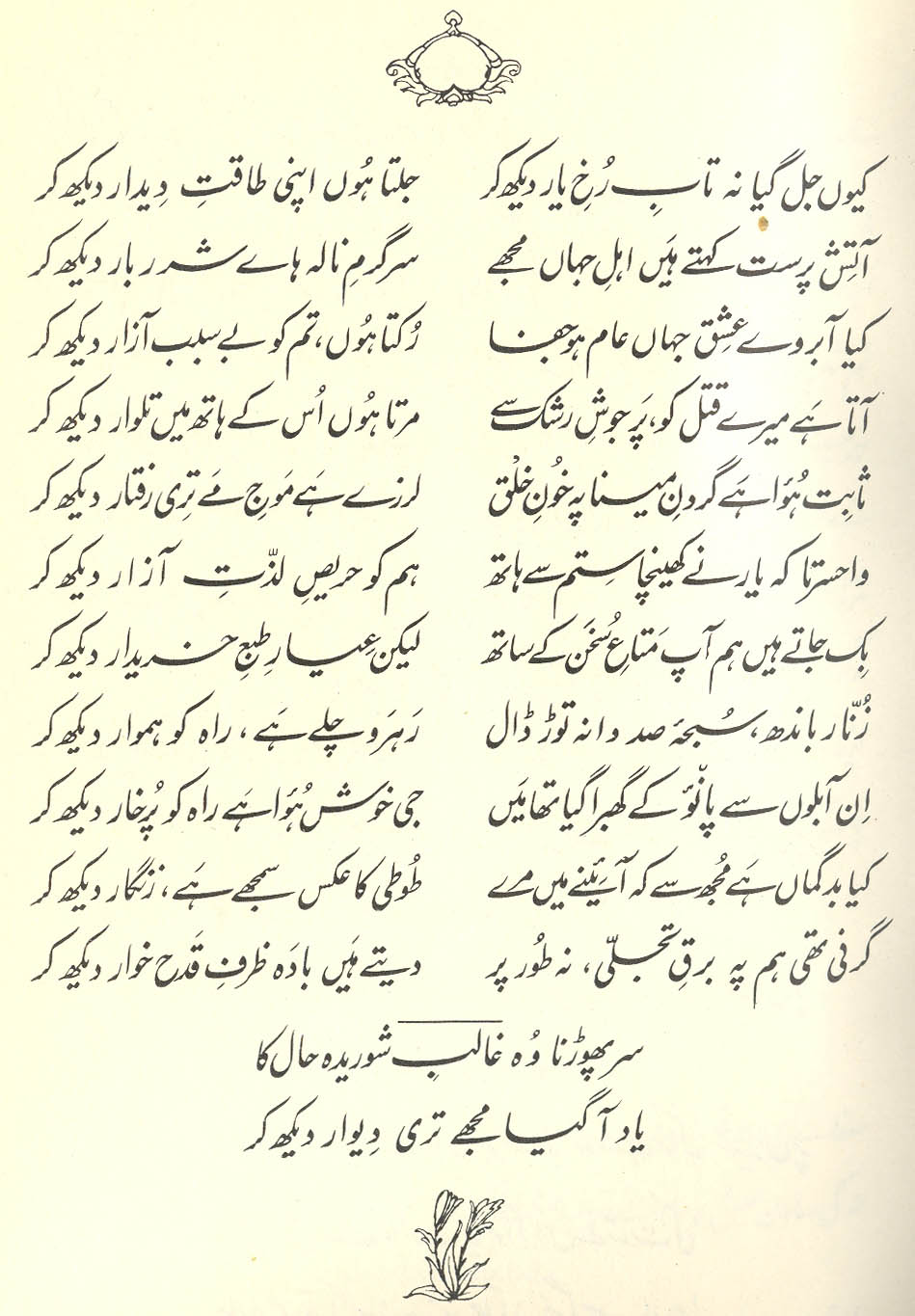
The second line demands the theme that she comes so gracefully to kill me that I die. The late author has brought out so many aspects of the meaning of jealousy that it is impossible to praise them sufficiently. But the rule is that when you express one single meaning time after time, then it becomes over-familiar. For this reason, two verses of this ghazal have remained loose [in structure]. One is this verse; the other is 60,10 . Both actions [described in these verses] are abnormal and not pleasing; and for this reason, the line here has not retained any connection .
In order to find this idea a source of insight, you ought to hear that the verse is created in reverse-- that is, first the poet's task is to devise a rhyme . His second thought is to look at the rhyme he has devised and join to it some adjective [], or related noun [], or some other grammatical form, or some idiom, or some actor, or some recipient of action, so that a line is formed. Or if it is not, then he would take out or put in some word, or change the word order, to complete it. Then the second line has been composed. The great goal is that after composing the second line, he should add a [first] line that would become connected [] as tightly as a hand on a collar. And it's clear that to see something in the beloved's hand and become jealous of it is abnormal. It is only hypothetical and disconnected []....
In short, in composing the second line the poet is constrained to fulfill the relationships of the rhyme and the refrain , and the chief excellence of this line is that he should search out such an aspect that there should be no coincidence and that the line should not clash/compete [] [with any other poet's line]. Indeed, after composing the second line, to add a line is to cross a very wide field in which are hundreds of paths.
And a very helpful and easy method for practicing how to add a line is that if you open the divan of some pleasing poet, then on the right hand will be all the first lines, and toward the left will be all the second lines. You should hide the first lines with a piece of paper, and for every second line think about what theme would be connected [] with it. When a theme comes to mind, then slide the paper down and see what the poet has composed. In short, for the verse to become a magic spell, and the poet to be proved a master, usually depends on the adding of lines. (56-58)
119,7 . For more of Nazm's thoughts on the ghazal, see 167,6 .]]
== Nazm page 56 ; Nazm page 57 ; Nazm page 58


The aspects of jealousy that Mirza has depicted are rightly praised. And it's also correct that using one theme over and over becomes excessive. But when Janab [Nazm] Tabataba'i decides to declare this verse devoid of pleasure and without connection and merely artificial, the state of the verse is entirely the opposite of this opinion. The trouble of the beginning of passion, and the situation in the midst of passion, and the state of the extreme of passion, are different. In addition to this, the master knows these human dispositions-- that temperaments are diverse.... When the emotion of jealousy reaches a limit, then the lover starts to take amiss even the beloved's looking in a mirror to adorn herself. (133)
This is a strange kind of jealousy, which is also contrary to the nature of passion. It prevents the verse from penetrating deep into the heart. (140)
One of the pleasures of working with commentaries is that they contain unexpected little gems, tucked away with seeming arbitrariness in the discussion of particular verses. Nazm's account of how one should learn to write ghazal verses is one such gem. He points out that the second line, with its technical constraints (which also provide inspiration and guidance) is to be composed first; and for practice one can cleverly make use of the second lines in other people's divan s. He emphasizes the centrality of connection and the need to learn how to add a line , which are both strongly grounded technical notions in the traditional poetics of the ghazal.
If the lover dies of envy/jealousy on seeing the sword in the beloved's hand, that implies that he considers it in some sense a rival. Nazm and Josh consider this excessive degree of jealousy to be morbid, implausible, and unsatisfactory. Bekhud Mohani responds that when passion reaches its extreme point in some temperaments, even such limit cases become appropriate, and help to reveal the nature of the feeling involved. After all, the lover-- who is mad, in any case-- is also jealous of the spring breeze, the mirror, and all kinds of other unrivalrous entities. In the first verse, 60,1 , he's apparently even jealous of his own power of vision. It's hard to get much stranger and more 'abnormal' than that, yet Nazm has no difficulties with it. So these objections too seem to be only sporadic and subjective. For more on the complexities of , see 53,4 .
The weakness of this verse is that there's not much going on in it beyond the literal meaning. It's one of Ghalib's rare verses that can be paraphrased in prose with very little loss. Nazm is right that there isn't much connection in it, or much wordplay, or much multivalence, or much of anything. It's the kind of routine verse of which there are thousands in the whole corpus of classical ghazal, but not many at all in the divan .
graphics/talvar.jpg
'A Mughal sword (tulwar) with enamelled hilt and chape. Lucknow, India, late 18th century, the blade Iran, probably 17th century. The curved watered-steel single-edged blade with motto and maker's name inlaid in gold nasta'lia within cusped cartouches, the silver-gilt hilt with hand guard terminating in a dragon's head and disc pommel, decorated with champlevé translucent and opaque enamels in blue, green, yellow, orange and purple, with various birds amidst foliage, with original tassel, now separated, the original wooden scabbard covered in blue velvet, the chape decorated en suite with the hilt, slight loss of gold inlay on blade, also of enamel to the hilt and chape, velvet worn in places. 36in. (91.5cm.) long in scabbard.'