Verse 6after 1816amhu))e
G3
1
we kept on writing the blood-dripping stories of madness
2
{although / however much} in that, our hands became cut/'reed-pens'
'Although, even if, notwithstanding; --how-much-soever; howsoever; as often as'.
'A reed; reed-pen, pen; a pencil; a painter's brush'.
'To cut; to cut off; to prune'.
| References | |
|---|---|
| Arshi, Imtiyaz Ali | Ghazal# 191 |
| Raza, Kalidas Gupta | 302-03 |
| Nuskhah-e-Hamidiyah | 253-254 |
| Hamid Ali Khan | Open Image |
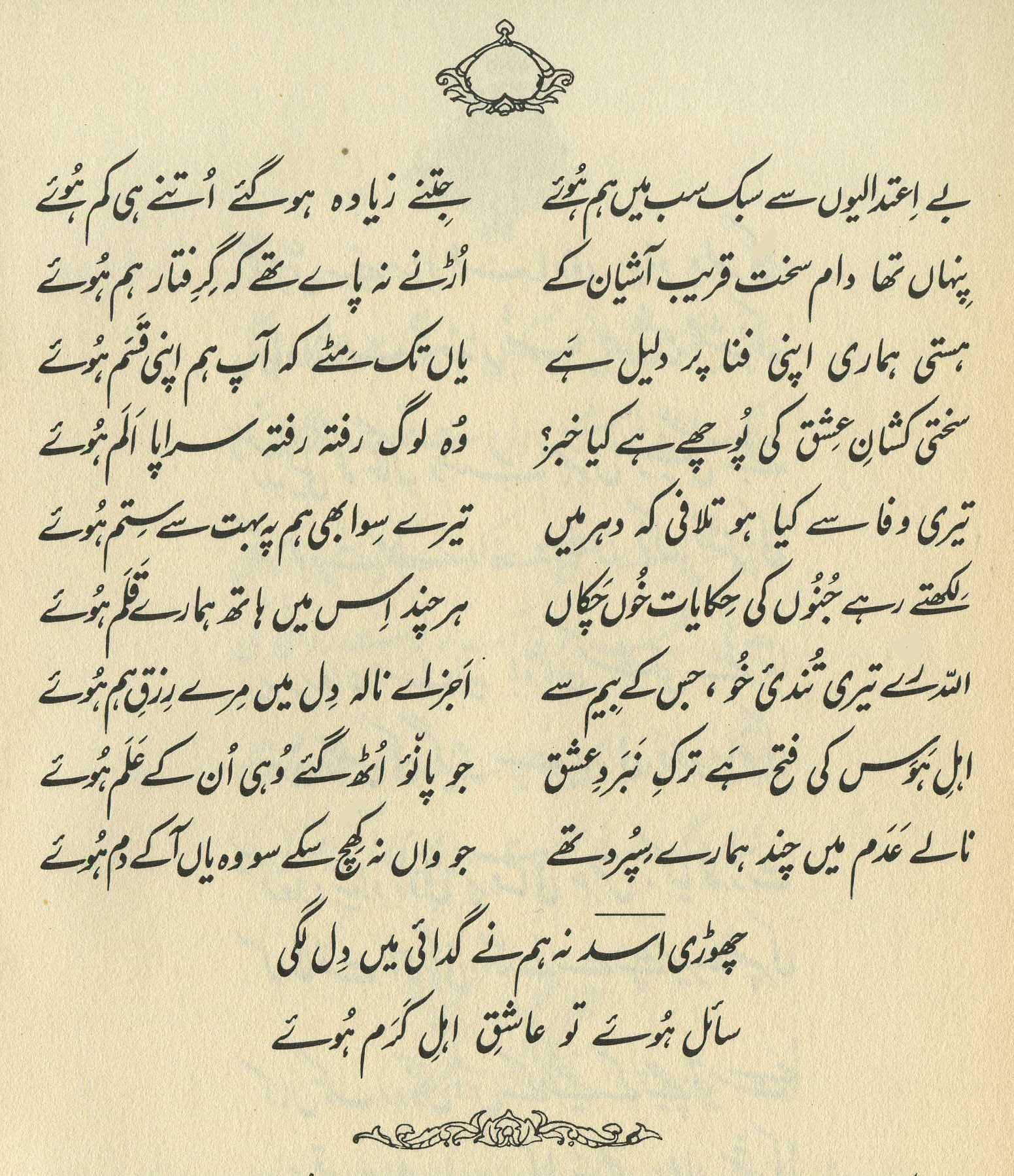
In punishment for some deed, for the hands to be cut off-- this is the theme of the second line. And in the first line the poet's responsibility is that he would mention for what reason the hands were cut off. But there can be many things because of which the hands would be cut off (see the commentary on 60,4 ). In this case this difficulty confronts the ghazal-composer-- out of so many situations, which one would he adopt?
Because in the ode , the masnavi , etc., the poet's purpose is fixed, and he adopts exactly the aspect that is suitable to that purpose. In the ghazal there is no fixity []. One verse has no relationship to another verse. Every verse is an utterance in itself, and is a meaningful expression. The breadth of the ghazal is because with every rhyme and refrain , whatever kind of connection it would accept, you give it exactly that kind of connection. That is, the theme toward which the rhyme and refrain would take you, in exactly that direction you go. In one verse there is the ' description of an affair ' [], in another a mystical [] theme. Somewhere there is a rakish [] tune, in it the mention of the flagon and its gurgling, the burning of the Moth , the tumult of the Nightingale . Then in another verse there is factual statement [], in another is .
The idea is that in this situation the poet intended to versify -- that is, how would there be connection between the rhyme-word and [the refrain] , and what should be made the subject of the verb?.... And in such a situation, where many themes would have connection, the poet is compelled to create a .... for why would he neglect a theme in which there would be a verbal affinity ? Because in the poet's temperament there is naturally a musical sense of affinity. Because of this it's forbidden for him to have an unreasonable prejudice, and beauty of poetry is to pay exactly the amount of attention to that would create connection between the two lines or the two phrases. To be greedy beyond this, spoils the meaning.
A famous characterization by literary experts that has come down to us is that the beloved of Meaning is the life of poetry, and that idiom is her delicate body, and her jewelry is expression [] and rhetoric []. Thus the poet who cannot create meaning, who always practices the carving out of expression and rhetoric alone, who in the bazaar of literature learns the work of the goldsmith.... [the effects he creates] are jewelry on a lifeless body. By contrast, if there is the coquetry of a refined meaning and a simple idiom, then although there would be no simile and metaphor and semantic and verbal device s at all, she is a coquettish beauty in whose very simplicity thousands of adornments emerge; and this poet is the lord of the Doomsday of meaning.
How much contrary to his own style the author has composed in this verse, since he has adopted the form of a ! .... People who dislike the , and consider it a commonplace/contemptible [] device, usually reject the and in such situations adopt the form of a metaphor or simile, which is better.... [extensive further discussion and many examples of 'joining lines' as a way of generating possibilities for shaping a verse] .... Atish 's style of poetry is founded on 'joining lines ' alone, and he influenced the poets of Lucknow toward this practice; otherwise, a number of people with a poetic temperament composed ghazals, but were not aware that the lines lacked connection and were two-part .
Agha Hajju Sharf, may the Lord bless him, used to say, 'Mir Vazir Ali Saba brought a ghazal to show to his Ustad ; at that time I too was present. Saba recited a verse:
[in the spring she says to me, leave the garden
a Hunter never cared for such a wingless one]
Atish, having heard this verse, said, 'You've used , and in 'joining the line' haven't kept this in mind. Write it like this:
[having clipped my wing she says to me, leave the garden
a Hunter never cared for such a wingless one]'
But experience has shown that a number of people have divinely-given temperaments, they compose the whole verse on one single occasion; both lines have the kind of connection of a 'hand and collar'. The ones on whom the Lord has bestowed this ability, have very little need for this kind of practice. And the verse that comes out right, with both lines altogether united in one, has in it the glory of inspiration [], and its informality of expression is such that it is not obtained by 'joining lines'. (181-86)
== Nazm page 181 ; Nazm page 182 ; Nazm page 183 ; Nazm page 184 ; Nazm page 185 ; Nazm page 186


Here, by 'madness' is meant 'passion'. He says, we have kept on writing the blood-dripping narratives of passion in our verses. Although the beloved even caused our hands to be cut off, we didn't cease to versify the past events of love affairs []. One gentleman commentator [=Nazm], to show his ingenuity, has 'joined lines' seventeen times onto this second line of Mirza's. But in the opinion of this humble one [myself], Mirza's first line has achieved preeminence among them all. (242)
In the states of passion and madness, because of which blood used to drip, we always kept on writing. Although the result of this was that our hands became (this too is a state of madness). (325-26)
[See his comments on Mir's M 568,4 .]
For more on , see 59,7 .
This is a verse of simple, punchy wordplay, developed as a classic mushairah verse. The use of in this multivalent way is so common that the word can even be left unstated and merely implied, as in 43,5 .
Moreover the antecedent(s) for 'in that' remain unclear. In what exactly do the speaker's hands achieve this transformed state (of becoming cut off, or becoming pens)? Because of his own madness in itself? Because the blood-drippingness of the narrative requires or invites him to become a participant observer? Because he writes till his fingers are blistered and bloody and ready to fall off? Both senses of are suitable and work well in the verse; if they're both taken at once, they even work well together. For other such tours de force, see 120,3 .
To my surprise, this minor-looking little verse seems to get under Nazm's skin; he writes at more length about this one than, I think, about any other. But he seems to lose track of his own arguments for a while in the middle. He provides no fewer than 17 alternative first lines that Ghalib could have substituted for the present one-- though he doesn't really want to say he should have done so, because although he wants poets to avoid what he sees as the alluring, understandable, but still excessive vulgarity of an uncontrolled -- that is, one without real relevance and connection -- he can't get around the fact that Ghalib makes this one work. His own display of ' joining lines ' 17 times so inspires him that he adds another set of no fewer than 21 alternatives that could be used to combine with an entirely different second line for more 'joining lines', though I can't really see what relevance this has to the matter at hand. He also provides a variety of anecdotes about the corrections made by various Ustad s on various verses. Then he ends up with a rousing tribute to the superiority of a 'natural poetry' style of composition. I've translated enough of his argument to make the general lines clear-- or at least, as clear as I can.
I also asked S. R. Faruqi for his thoughts (Sept. 2005) on this uniquely lengthy commentary:
'As regards [Nazm] Tabataba'i, we know that he is a brilliant commentator, but also misses no opportunity of putting down Ghalib if he can. In the verse in question, Ghalib brilliantly employs (among other things) the , or affinity , of and . Tabataba'i can have nothing against it, so he enters upon a long description of the mechanics of how to write two connected lines. He says that good poets prefer to use metaphor, etc., but when nothing suggests itself, they try . But, he says, can work only when it aids the meaning and the theme. (This statement is questionable.) Anyway, Ghalib used a here contrary to his practice-- this statement is wrong, for Ghalib is very fond of -- but made it work because it agrees so well with the theme and meaning. Tabataba'i then proceeds to give examples of lines that could have worked with Ghalib's first line, though not so well. Then he goes on to give other examples from his experience.'
In any case, Nazm seems to be riding his own hobby-horse, rather than actually commenting on this particular verse.
graphics/fingerpens.jpg