Verse 9after 1816amhu))e
G3
1
in the realm of nonexistence, some laments were [in a state of having been] confided to us
2
those that couldn't get expressed/'drawn' there-- they, having come here, became breaths
'To be drawn, dragged, or pulled, &c.;... to be drawn out, be extended, be stretched; to stretch; to be extracted'.
| References | |
|---|---|
| Arshi, Imtiyaz Ali | Ghazal# 191 |
| Raza, Kalidas Gupta | 302-03 |
| Nuskhah-e-Hamidiyah | 253-254 |
| Hamid Ali Khan | Open Image |
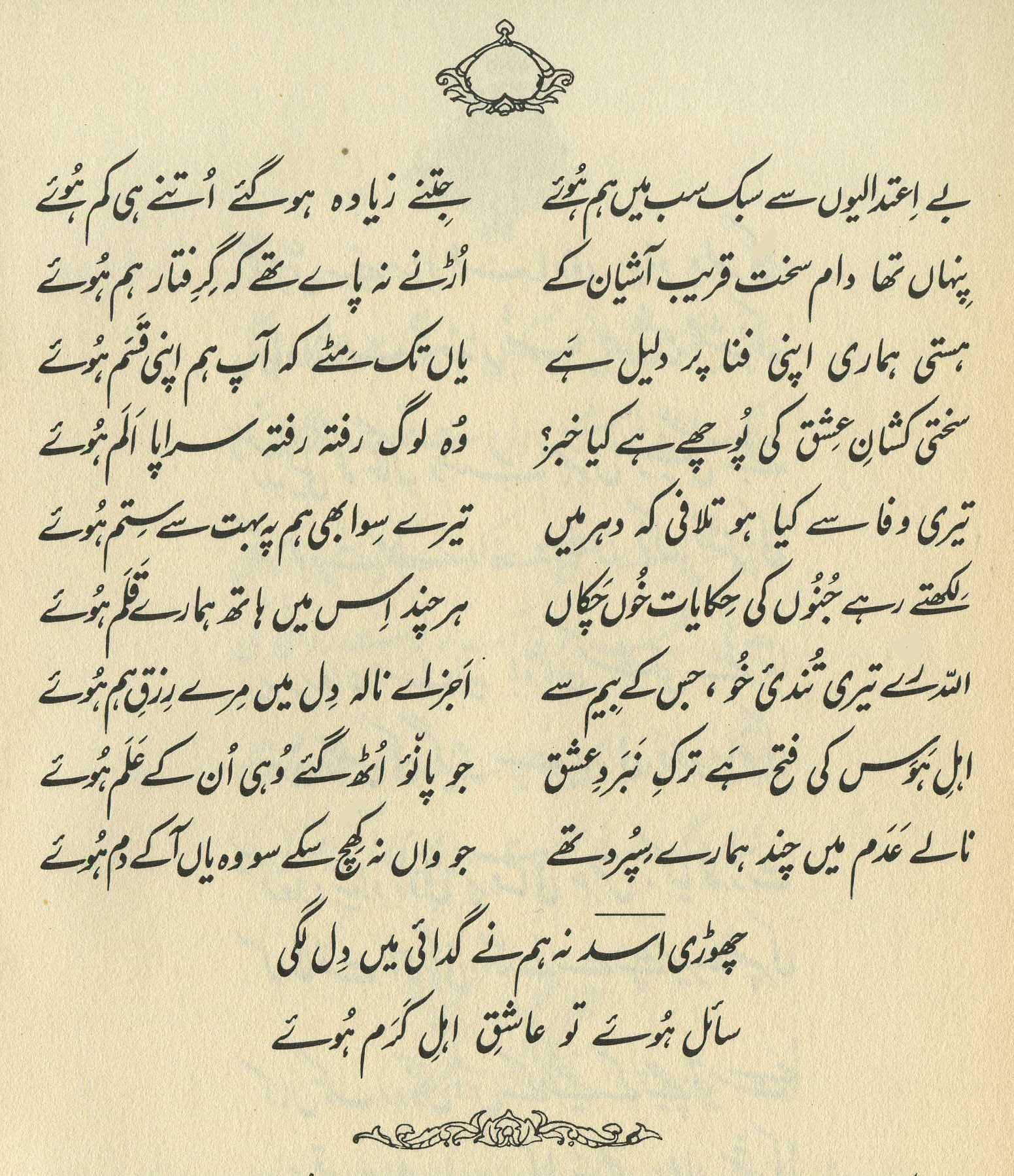
That is, to perform some laments had already been decreed for us from eternity. We were not able to 'draw' them there; having come here, we are drawing those very laments, and the coming and going of the breath is that very lament-drawing. From this verse it is also learned that as with Nasikh, in the author's language in response to it is necessary that there be a . If you remove the from the line, and instead of read , the line remains metrical. And the author's rank is great-- the person who has practice [] in the versifying of words, when he thinks about composing, such matters do not remain hidden from him.
Then though both forms are proper, in fact is more correct than , and than . If the author had rejected , then there would also have been the advantage that in place of , there could have been . But in order to bring in , he chose to accept as well. And the structure gives testimony that this action is deliberate. In this verse is not good, but the theme of the verse is extremely refined/subtle []. (186-87)
== Nazm page 186 ; Nazm page 187


He says, we're predestined to ill-fortune. From all eternity, the responsibility of heaving laments had been bestowed on us. Those laments that didn't get 'drawn' there, remained-- having come into the world, they became breaths for me. The meaning is that neither were we happy in nonexistence, nor were we happy having come here. For us, even a breath has the power of a lament. (243)
Oh heedless one, what you consider to be a breath-- the truth of its nature is that in nonexistence, some laments had been bestowed on us. Some I did there, those that remained have here been named 'breaths'. That is, our lamenting is not of today-- in nonexistence too this was our pursuit. That is, we are ill-fortuned forever. (326)
Like the previous verse, 167,8 , this one rests on a sort of semantic meaning-play and wordplay between two senses of the verb (or ), the intransitive of , 'to draw'. One 'draws' a breath; fortunately we have the same idiom in English. But in Urdu one can also easily and colloquially 'draw', or 'draw out', a lament: utter it, sigh it, heave it, prolong it, drag it forth, etc.
And just as in the previous verse, it's up to us to make this connection: the verse gives us , and we ourselves pair it with , and recognize the enjoyable subtleties thus created. In the wake of this equation come many other implication s adduced by the commentators: that our every breath is a sigh, and so on.
There's also the elegant and suggestive affinity between and .
Note for grammar fans: Nazm's argument is petulant rather than persuasive. Ghalib's use of in this verse cannot, and does not, prove that he considers it an indispensable complement to . 12,2 and 20,9 are only two of the many verses that use but not . In fact, the majority of verses do not use . Nazm must have gotten up on the wrong side of the bed (as my mother used to say) the day he wrote this commentary.
graphics/breaths.jpg