Verse 8after 1816amhu))e
G3
1 a
the victory of the lustful ones is the renunciation of the battle of passion
1 b
the renunciation of the battle of passion is the victory of the lustful ones
2
the feet that rose up-- only/emphatically those became their banners
| References | |
|---|---|
| Arshi, Imtiyaz Ali | Ghazal# 191 |
| Raza, Kalidas Gupta | 302-03 |
| Nuskhah-e-Hamidiyah | 253-254 |
| Hamid Ali Khan | Open Image |
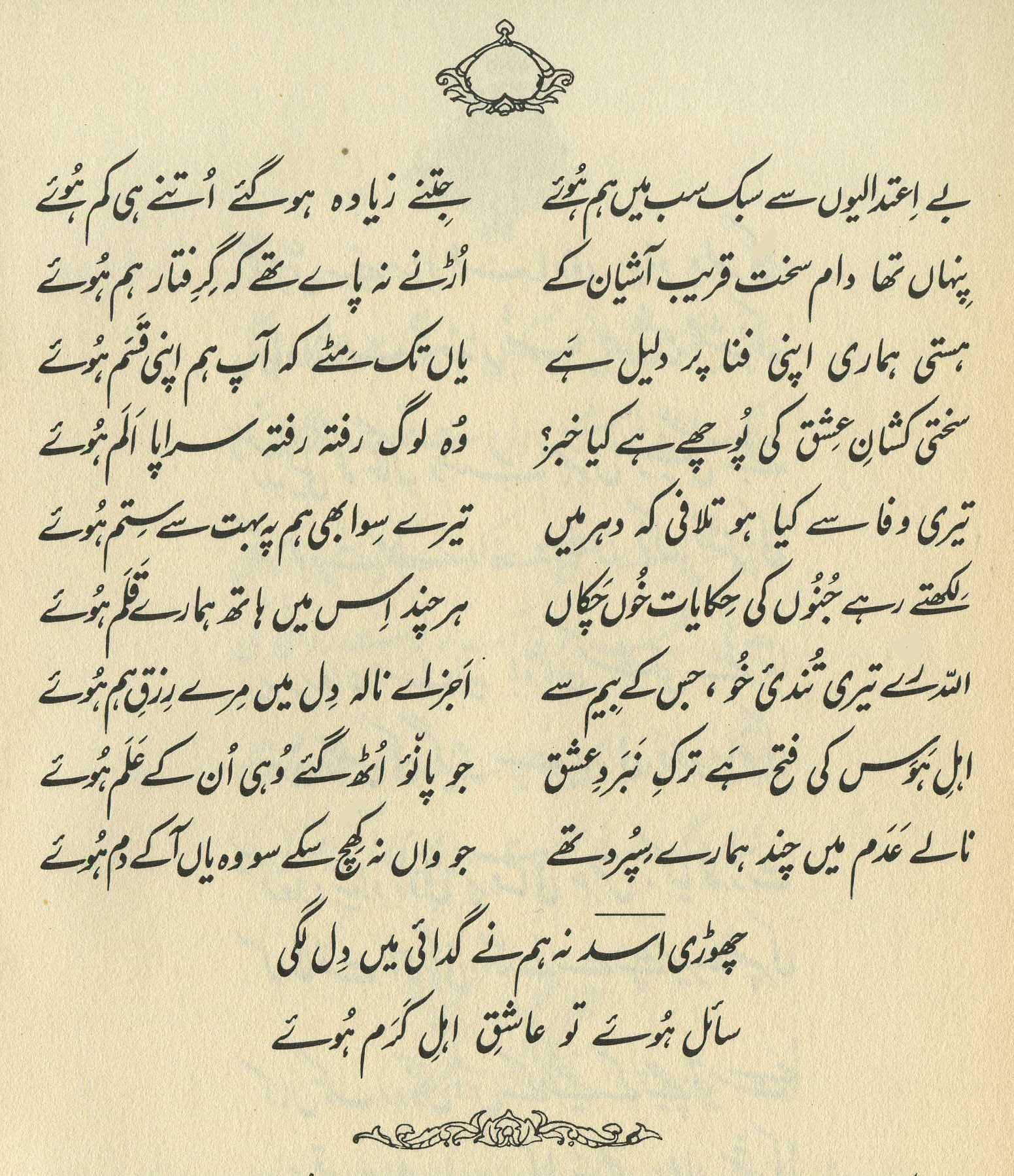
That is, exactly in running away from the battle-field of passion, is the victory of the Rival . Those people's foot had hardly been lifted in this field-- it was as if for them the standard of victory had become raised, and their life was saved. To construct the lifting of the foot as the lifting of a banner is extremely labored/artificial. He ought to have said this theme in this way: [when the hand was lifted [away] from faithfulness, then the standard became elevated]. (186)
== Nazm page 186

He says, the victory of the people of lust is in this-- that they would abandon the field of passion and flee. And those people would consider in their hearts that at the time of fleeing the field, the foot that was lifted, was as if a standard of victory had been raised aloft. 'Saving your life is true riches' []. (242)
[Responding to Nazm:] the inventiveness [] in Ghalib's line is the very same that's in your line. This is an occasion for scorn-- that is, only for 'lifting up'. The word 'lifting up' applies to both a standard and a foot. (326)
There seem to be two ways of reading the first line:
=The lustful ones' 'victory' is really just a successful flight (1a), since they're so cowardly (a sarcastic sneer).
=A successful flight is in fact a victory for the lustful ones (1b), since they'll live to lust another day, and that's what they want (a factual observation).
A parallel thought-experiment: what if there were a Moth who just flew around the candle for a while, but then didn't fly into the flame, and made a discreet exit instead? Such a Moth could be mocked for cowardice, but he might in fact view himself as prudent and intelligent.
As Nazm observes (disapprovingly), the verse is organized around the exploitation in the second line of that fact that 'lifting' [] is appropriate both for a foot in flight (by contrast, heroes plant their feet in the battlefield and resolve never to move them) and for a banner (by contrast, heroes have real banners to lift, not their own flying feet). Another example of this verb-based wordplay appears in the following verse, 167,9 . For more such examples, see 89 . For Ghalib's only other divan use of , see 7,1 .
There's one more small but piquant touch. If we imagine ourselves as hearing this verse in a mushairah , the word 'banner' [] would be indistinguishable from the word , meaning 'pain, anguish, torment; grief, affliction' (Platts p.77). Would we be meant to hear this homonym as a kind of secondary meaning, a kind of echo? Perhaps the lustful don't get off scot-free after all, but suffer their own kind of pain.
graphics/runningaway.jpg