Verse 5after 1816amhu))e
G3
1 a
through your faithfulness, there would hardly be amends/recompense! --for in the world/age
1 b
through your faithfulness, would there be amends/recompense? --for in the world/age
2
even/also besides/beyond you, upon us many tyrannies took place
'Making amends, reparation, compensation, recompense'.
'Time; a long period of time; an age; eternity; fortune, fate; chance, adverse fortune, misfortune, calamity, adversity; danger; —custom, habit, mode, manner; care, solicitude; the world'.
'With the exception (of, ), except, save, but, besides, other than, over and above, further than (e.g. ;xvudaa ke sivaa ... 'with the exception of God,' or 'other than God'); —adj. Additional, more; better'.
| References | |
|---|---|
| Arshi, Imtiyaz Ali | Ghazal# 191 |
| Raza, Kalidas Gupta | 302-03 |
| Nuskhah-e-Hamidiyah | 253-254 |
| Hamid Ali Khan | Open Image |
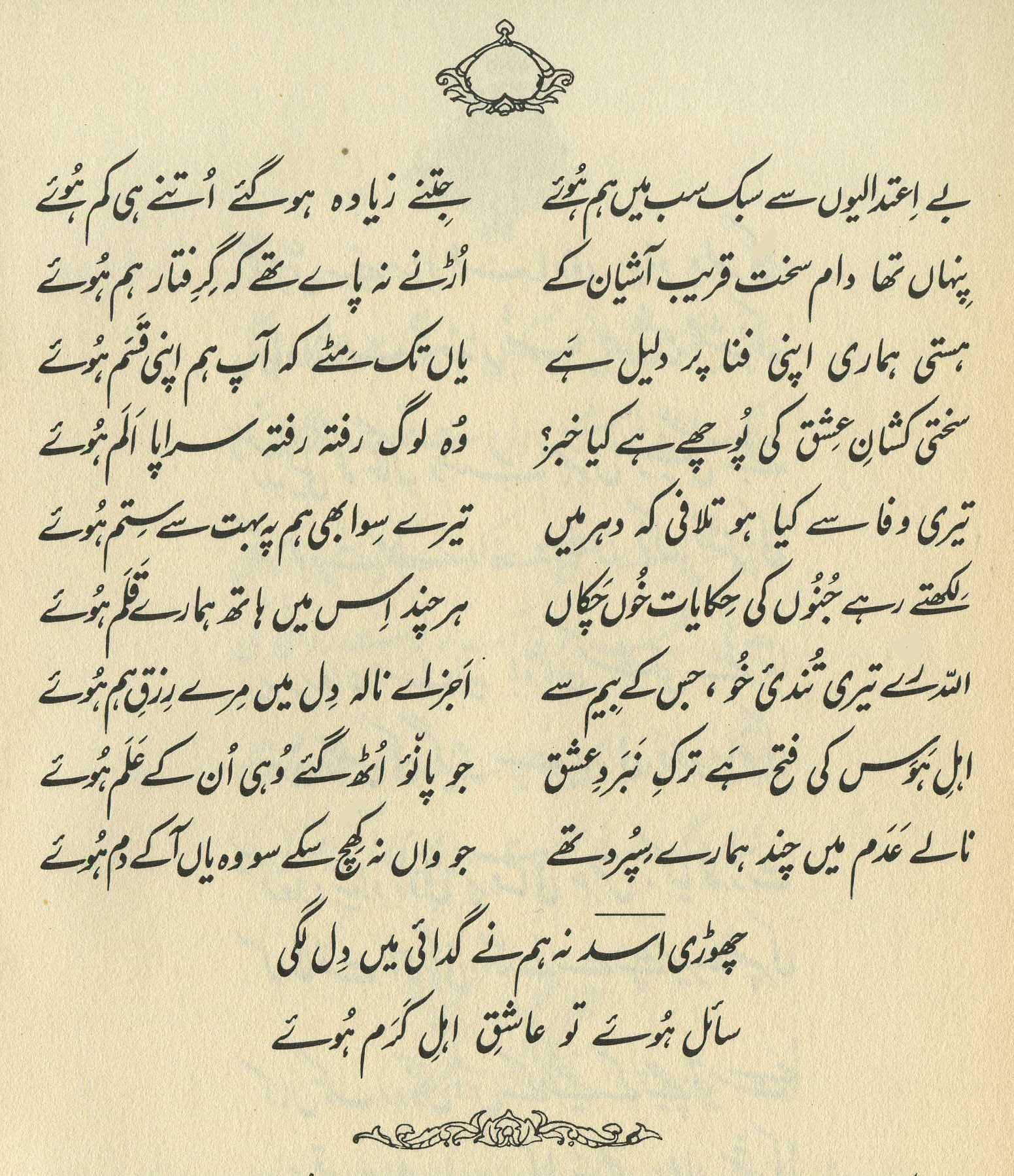
The purport is that your cruelty alone can be recompensed by your faithfulness, and the tyrannies that came upon us besides you-- how can there be recompense for them? Here he has expressed the tyranny of his life so that the beloved would be induced to make amends; he wants her to feel even more compassion. (181)
== Nazm page 181

The meaning is that if you have mercy and make amends for your cruelty, you should do it in such a way that we would have no complaint from a whole lifetime. That is, through you, let there be liberation from the cares of the world as well. Mirza Sahib, finding the beloved well-intentioned, makes further claims. (242)
Oh beloved, I agree that you'll make amends for the cruelties you practiced in the past. But what can I do? In addition to you, other people have inflicted tyranny and violence upon me. How can there be recompense for that? (325)
This verse will surely remind Urdu-lovers of Faiz's famous called , with its pointed declaration: 'There are other sorrows too in the world besides love' []. This sentiment is frequently taken to be part of a radical revision of the ghazal, an introduction into it of deeply untraditional content. Yet the thought isn't entirely new, for we see its direct ancestor in the second line of this verse; Faiz also uses the same 'informative' [] style adopted by Ghalib. And Faiz was a notable Ghalib fan, giving two of his volumes of poetry Ghalibian titles: (1943) from 1,1 , and (1965) from 230,7 ; in fact his itself is called , from 7,3 .
The similarities are striking-- but so are the differences. Faiz follows up the thought in another 'informative' line: 'There are other comforts besides the comfort of union' [], and then the nazm moves on to its conclusion. The context is also broader: Faiz's poem suggests, in other lines, that the sorrows in the world that oppress the lover may not be his alone, but may be those of the wretched of the earth, and of the human condition in general ('The gaze returns to that direction too-- what can be done?' [].
By contrast, Ghalib appends his line to a clause in the first line that's either a question or an exclamation-- in short, a form of speech. Thanks to the magic of , this clause can be read either as a negative rhetorical question or exclamation (how would there be amends?! there would hardly be amends!), as in (1a); or as a genuine yes-or-no question (would there be amends, or not?), as in (1b). In either case, there's no indication that Ghalib's lover feels for the sorrows of others-- either of sufferers, or of people in general-- as Faiz's lover does.
And then, of course, there's the question of tone. Nazm reads the verse as a form of bargaining: the beloved is prepared to offer a certain amount of kindness, and the lover seizes his chance and claims, abjectly or insinuatingly, that some extra kindness is needed. The verse could thus be read in a mischievous, tongue-in-cheek way that would make it highly amusing. Bekhud Mohani seems to take it quite seriously: life is grimmer than even the beloved's kindness can atone for, the lover has suffered damage that not even the beloved can repair.
Ghalib's line is, in short, like an atom, with protons and electrons whirling around all the time, making it impossible for it ever to be 'fixed' once and for all. Faiz's line is like a brick in a wall: laid on other bricks, it supports still more bricks, in a pattern that makes meaning in larger, clearer units. It's possible to say with confidence what message Faiz's lover is conveying to his beloved; it's not possible to know what Ghalib's lover really has in mind. Part of what's going on here is of course explained by the generic differences between ghazal and nazm; on this, see Nazm's commentary on the next verse, 167,6 .
Compare also 215,8 , which takes an even more cosmic approach to the sufferings of human life in the world.
graphics/oppression.jpg