Verse 8after 1847aakare ko))ii
G8
In this meter the first long syllable may be replaced by a short; and the next-to-last long syllable may be replaced by two shorts.
1
who is there who is not needy?
2
whose need would anyone supply?
'Want, need, necessity, exigency, poverty; a thing wanted, an object of want or need, a requirement, a needful or requisite thing, affair or business'.
'To make going; to cause to flow; to supply, render obtainable'.
| References | |
|---|---|
| Arshi, Imtiyaz Ali | Ghazal# 220 |
| Raza, Kalidas Gupta | 405 |
| Hamid Ali Khan | Open Image |
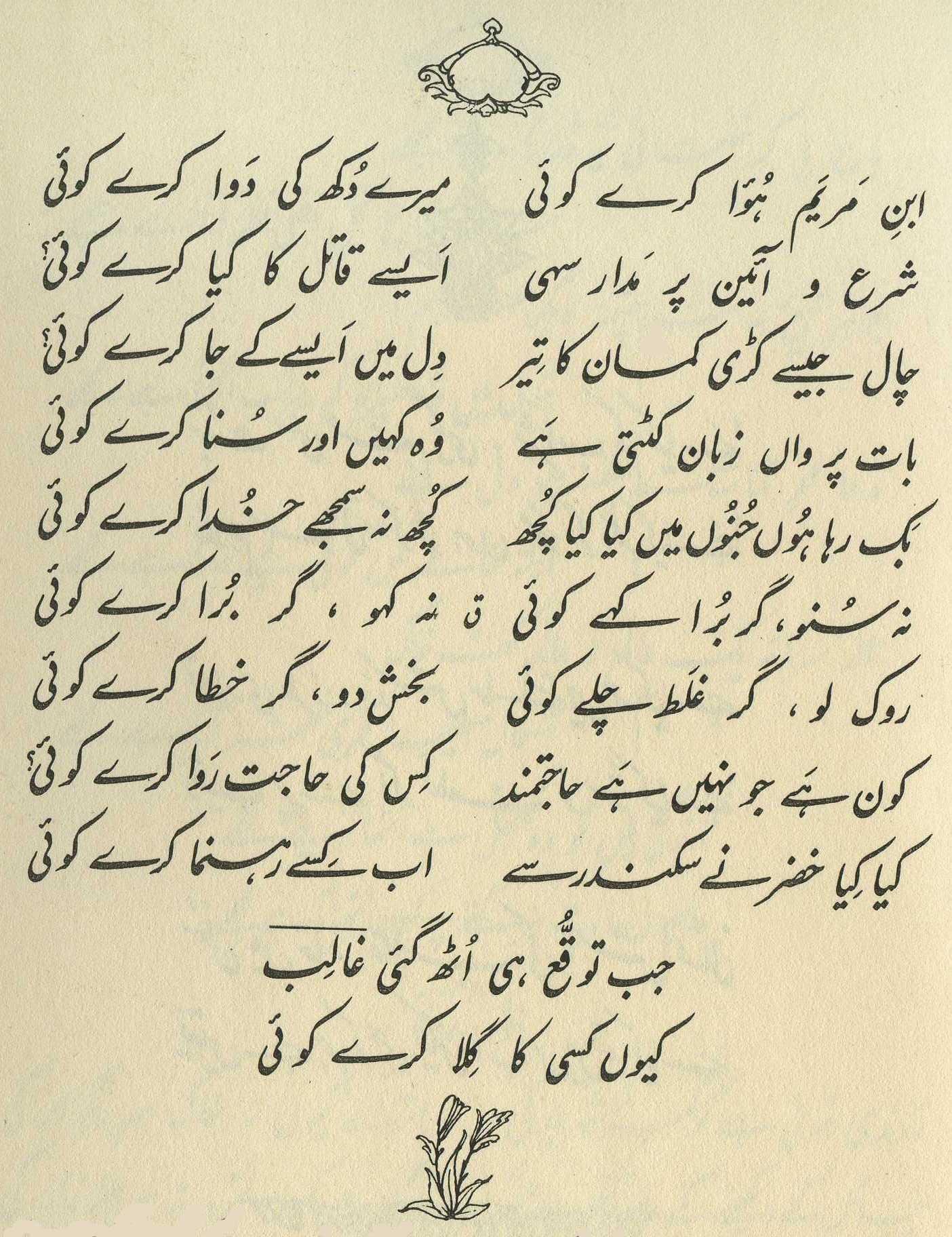
That is, if our desire wouldn't be accomplished, then it's inappropriate to complain of anyone; every person is on his own. Another aspect is that everyone is needy-- whose need will you fulfill? The point should also be remembered, that for a number of aspects [] to be present in poetry is no excellence; rather, it is flabby [] and non-flowing []. Indeed, for there to be much meaning is a great excellence, and between these two matters is a great difference. (245)
== Nazm page 245

He says, in the age/world every person is needy. If no one would be able to come promptly to someone's aid, then one ought not to complain about this; rather, one ought to understand that the other person too, like oneself, must have some necessity. (304)
Some person says that the whole world is a people of neediness-- as if anyone would supply the need of each one! (442)
Progressive-minded people often complain that the classical ghazal has no social conscience; they go on to contrast its mad, solipsistic individualism with the Progressives' compassionate outrage on behalf of the poor and oppressed. Basically, on its own terms this accusation is justified. The lover almost never thinks about social problems, social class, poverty, injustice, and so on. Of course, we ghazal-lovers can respond by saying that that's not an accusation, it's a description; the classical ghazal simply has other fish to fry. It makes no sense to scold a whole genre of poetry for not doing what it doesn't set out to do.
When such questions come up, I always think of this verse (alas, partly for want of anything more apposite). Needless to say, it's not a cry for justice on behalf of the poor-- but perhaps it's a cry for justice (or a cry of despair?) on behalf of all of us. But then again, maybe not. After all, this is another verse that is as as it can possibly be. So it needn't be as philosophical and bleak as the way I'm inclined to read it. It could also, depending on the tone, be an indignant refusal by a rich man to give a coin to a beggar.
The key is the radical vagueness of the second line. Here are some possible ways to interpret it:
=Nobody can supply anybody else's needs, even if he tries, because each would-be need-supplier has too many pressing needs of his own.
=Nobody can supply other people's needs, because there are so many needy people-- which ones should get priority over the rest?
=Should/would anybody worry about other people's needs, when he has so many of his own?
=Should/would anybody worry about other people's needs, or about his own instead?
=Is there anybody who isn't needy? Of course not! So it's absurd to think that anybody could/would supply anybody else's need.
=Everybody is needy, and no one can help anybody else (a melancholy, or even desperate, philosophical reflection (compare 219,7 ).
Consider also 167,5 , which in its own way similarly recognizes the all-too-powerful pressures of worldly suffering, and makes it clear that even faithfulness from the beloved would not be a sufficient 'recompense'. And there's 57,10x , with its vigorous attack on the (worldly) 'lords of hypocrisy'.
Then there's 351x,4 , which asserts the isolation of each human being (while also subtly undercutting it). And there's the moving 387x,1 :
[a gaze at the defectiveness of beggars is the height of discourtesy
for even/also a dry thorn has a claim of garden-lineage]
Compare Mir 's devastating M 1688,4 , which takes the idea of unfulfilled human needs in a much more Blakean direction. There's also Mir's 9,3 , with its threat against the rich oppressor; and the more ambiguous wish to 'wipe away someone's tears', in M 983,3 . And here's Mir's complaint about the evils of poverty: M 1896,9 .
graphics/raniya1816-20.jpg