Verse 10after 1847aakare ko))ii
G8
In this meter the first long syllable may be replaced by a short; and the next-to-last long syllable may be replaced by two shorts.
1
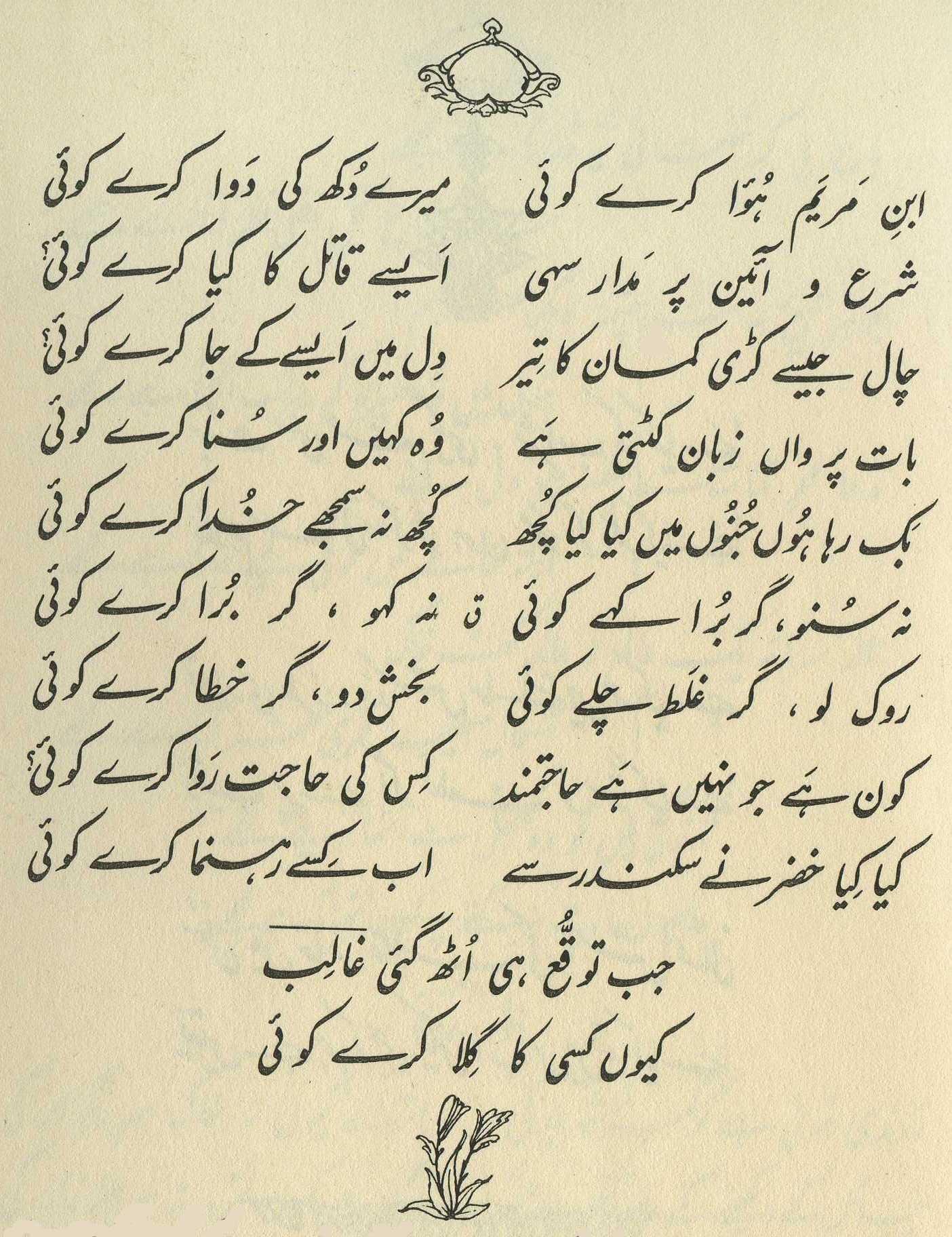
when expectation/hope itself has risen [and departed], Ghalib
2
why would anyone complain about anyone?
'Expectation, hope; trust, reliance; wish, desire; request'.
'To be removed, done away with, abolished; to come to an end, be expended, finished, terminated, settled, &c.; to cease; to remove, quit, go away'.
is spelled as in order to maintain the consistent spelling of the rhyme -syllable.
| References | |
|---|---|
| Arshi, Imtiyaz Ali | Ghazal# 220 |
| Raza, Kalidas Gupta | 405 |
| Hamid Ali Khan | Open Image |
How can anyone praise it [sufficiently] []! It is an extremely lofty theme , that can't be sufficiently praised. The meaning is that the person through whom expectation would have been cut off-- why then would anyone complain about him? Because there won't be any benefit from it, and hatred and enmity will be created. (245)
== Nazm page 245

He says, in a situation of expectation, to complain and lament too, oh Ghalib, is proper; in a situation of hopelessness, why would a complaint be made about anyone? (304)
It is an entirely novel idea. The common rule of the world is that as long as hope of someone remains, people don't complain, for fear that the desire would not be accomplished. But when hopelessness comes about, then they complain about it/him/her. Having departed from the poetic royal road, Mirza has said that as long as there was hope, then if a complaint had been made, that person might have given up his/her negligence and shown mercy. When no hope remained, then what can the result of complaint be, except for revealing one's weakness of spirit and lack of wisdom? (443)
[See his commentary on M 481,2 .]
In the ghazal world, one of the things that the lover complains about is loss and departure: that the beloved might remove herself from his gaze, that she might go away. Well may the lover complain and lament about that! He complains either fearfully, before the dread event happens; or wretchedly, after the terrible loss has occurred. Why should he not, how could he not, complain? What could be worse?
This verse envisions something worse, for the one who has 'departed' is the semi-personified Expectation/Hope itself. The word is feminine, and the use of the idiomatic , with its literal meaning of 'to get up, stand up', can't help but suggest a feminine person who rises in order to leave (see the definition above). Thus we have the piquant reenactment of the beloved's departure-- only this time it's worse, for if the beloved departs then she might just conceivably return. But if Expectation/Hope departs, then by definition the loss is irrevocable, it's the end.
This quasi-personification also yields a more subtle secondary reading of the verse: when Expectation herself has departed, why would one complain about anyone else's departure? Expectation has already set the pattern, and no one else's departure, not even the beloved's, could be as dire-- so why complain about the also-rans?
For another verse that plays on the ultimate bleakness of the loss of hope, see 95,6 .
C. M. Naim has provided (July 2014) a newspaper headline that frames a cultural complaint by using-- and misquoting-- the second line of the verse:
graphics/complaint.jpg