Verse 4after 1847aakare ko))ii
G8
In this meter the first long syllable may be replaced by a short; and the next-to-last long syllable may be replaced by two shorts.
1
on/for a word/idea, there, the tongue is 'cut'
2
she would say/speak-- and let someone always listen!
'To be cut, be clipped; to be reaped; to be cut off, be amputated; to be killed (in fight); --to be retrenched, to be diminished; to be deducted (from); to be spent, to be squandered; to be spent or passed (as time, life, &c.); to cease, to come to an end, be put an end to; to be interrupted; to pass away; to disappear, vanish; to dissolve, melt (as snow, ice, &c.);... --to be ashamed, be abashed; to be consumed with jealousy, &c.'.
| References | |
|---|---|
| Arshi, Imtiyaz Ali | Ghazal# 220 |
| Raza, Kalidas Gupta | 405 |
| Hamid Ali Khan | Open Image |
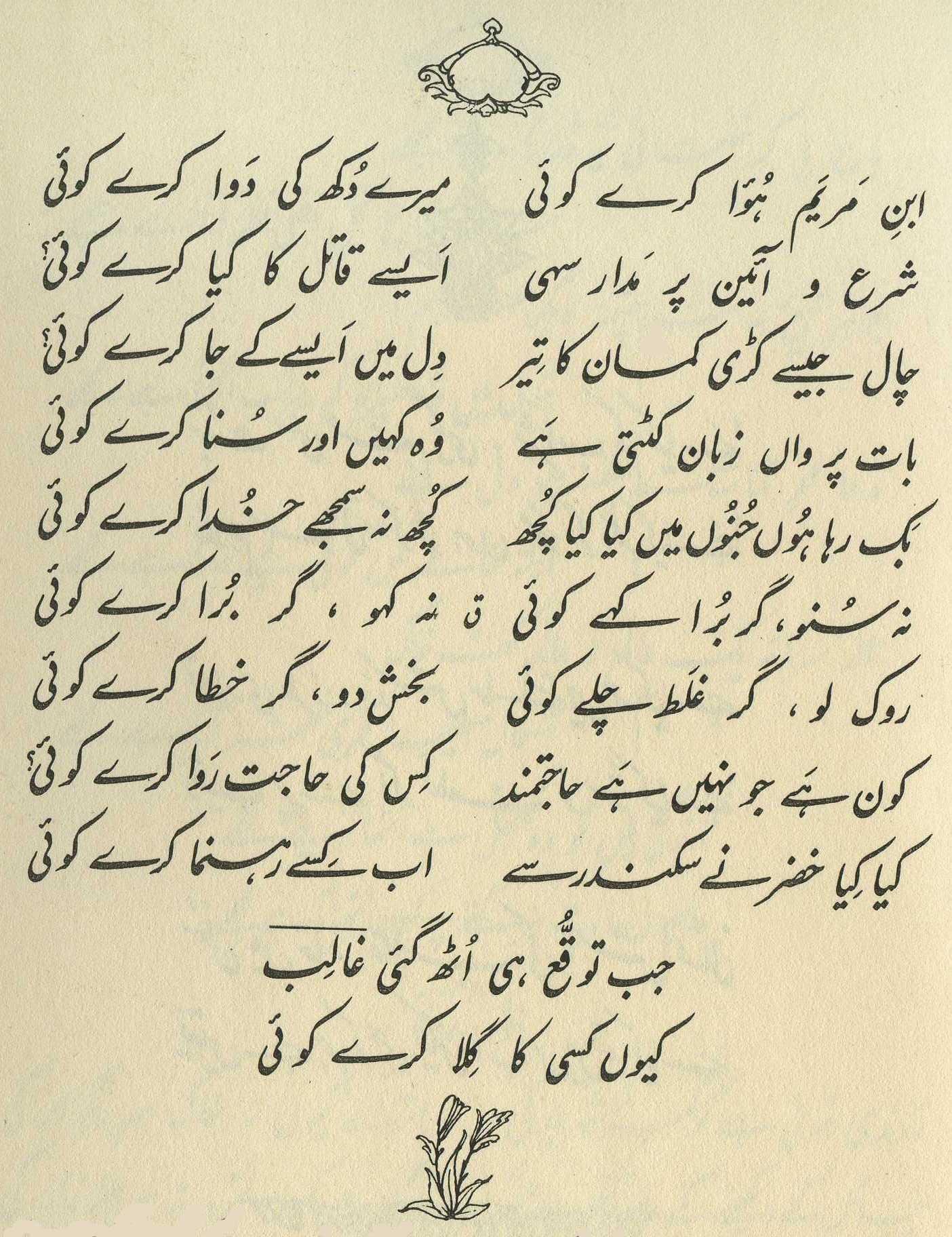
The meaning of is 'to give abuse'. (244)
== Nazm page 244

He says, 'If anything is said against her, then for this crime she cuts off the tongue. Therefore whether her words be correct or incorrect, one is compelled to listen in silence.' No one has the power/strength to say to her, you're wrong to say this. He's composed a peerless verse. (303)
(1) Urdu [] prides itself on the language of this verse.
(2) A picture of a tyrannical darbar begins to move before the eyes.... The state of affairs there is that whatever she wants, she would say. She might give the harshest possible abuses, she might make accusations-- whatever she wants, she would do. (441)
When the lover goes 'there', into the beloved's presence, it's extremely likely that his tongue will be 'cut'. The range of meaning for is wide, and includes 'to be ashamed' and 'to be interrupted' (see the definition above). Since the verb is intransitive, it doesn't indicate any source of action; the commentators generally assume that the beloved will literally cut out the lover's tongue, or order it done, but the verse doesn't push us in this direction in preference to others. The tongue might itself become 'cut' in the sense of embarrassed or ashamed, and thus cease to speak; or its speech might merely be 'cut off' in the sense of being 'interrupted', or might be 'spent' or used up (in vain of course).
And how do we read the eloquent phrase ? For more on , see 59,2 . In the context of the verse, its possibilities are numerous: we don't know whose word(s) or idea(s) are referred to, and whether the refers to instantaneous happening, or to causative agency. Here are some possible conditions in which the speaker's tongue might be 'cut', either by someone else or by himself (or itself):
=if she denounces his insolence
=if she gives a command
=if she speaks
=if there's any charge or accusation
=if he says something that displeases her
=if he says something
=if he begins to say something
=if he opens his mouth to speak
=if he becomes exhausted from speaking
The commentators emphasize the idea that implies abuse or insult. It certainly can, but there's no reason it would have to. The line works perfectly well-- or, in my view, even better-- if we envision her as simply rambling on and on about anything she feels like saying. The second line is a description of the procedure in the beloved's presence. It is , but what's the tone? Rueful? Amused? Abject? Irritated? Despairing? Cautionary (when warning a novice)? This is one of the many verses that permits (and thus requires) us to invent much of its affect (and therefore also effect) as we go along.
Note for grammar fans: On , see 215,1 .
graphics/talking.jpg