Verse 2after 1847iirbhii thaa
G5
In this meter the first long syllable may be replaced by a short; and the next-to-last long syllable may be replaced by two shorts.
1
it's inappropriate, to me-- a complaint to you of my destruction
2
in that, there was even/also some suspicion/mixture/adulteration of the excellence of fortune
'Mixture, adulteration; uncleanness, foulness, pollution, stain; doubt, suspicion'.
'The ordaining of Providence; the Divine decree; predestination; fate, destiny, lot'.
| References | |
|---|---|
| Arshi, Imtiyaz Ali | Ghazal# 41 |
| Raza, Kalidas Gupta | 397 |
| Hamid Ali Khan | Open Image |
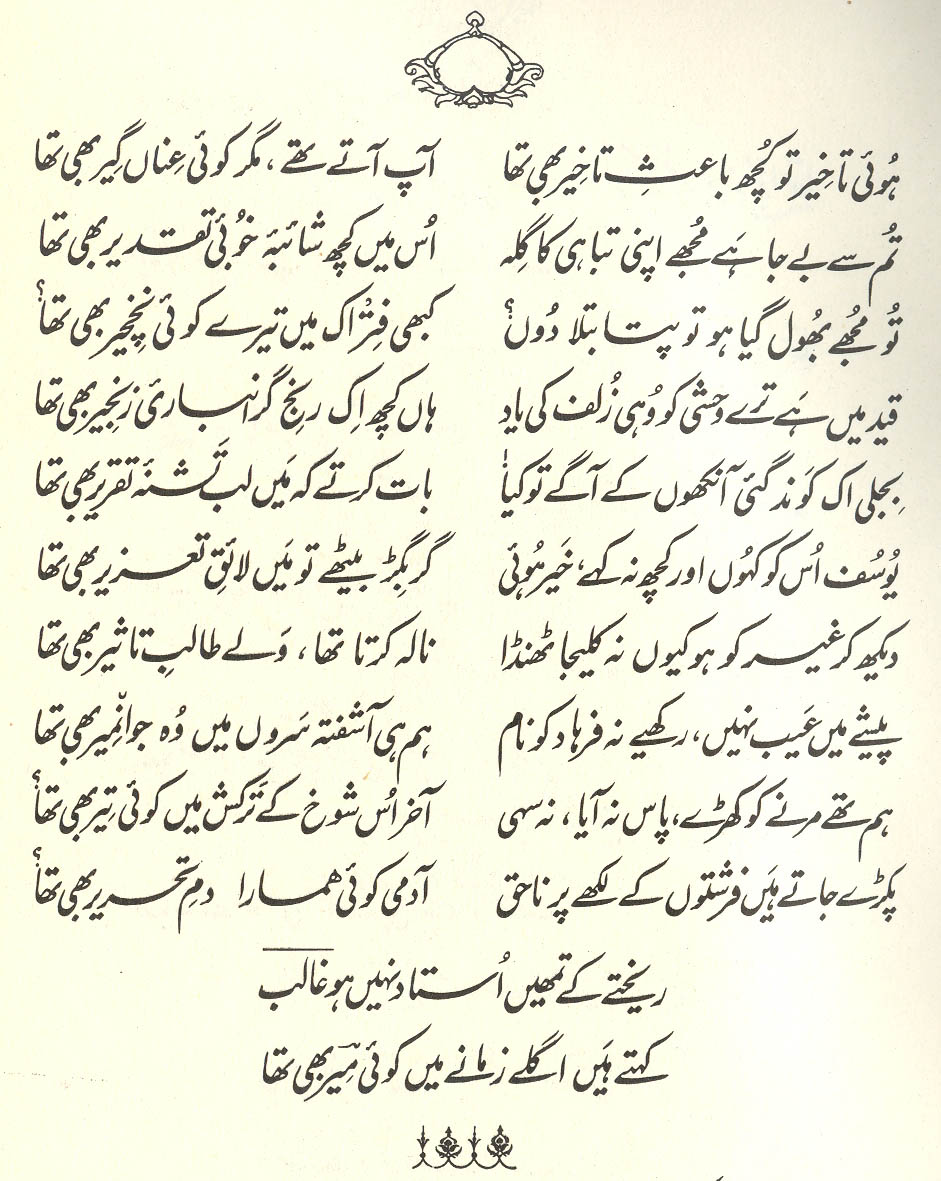
By way of disparagement, he has called the badness of fortune 'excellence of fortune'. (35)
== Nazm page 35

By way of sarcasm, wretchedness of fortune has been called 'excellence of fortune'. He says, it is inappropriate for me to complain to you about my destruction; there was certainly something or other of my own ill-fortune involved in it. Because of great love for the beloved, he hesitates to blame her. (70)
For such a thing to happen is my good fortune. That is, destruction was in my fate, it would have happened anyway. So it was good that it happened at your hands alone. (85)
In accordance with the etiquette-rules [] of passion and love, he has assigned the blame to fate, and considered it inappropriate to complain to the beloved. (103)
This verse, like the previous one, 36,1 , is concerned with assigning blame for the beloved's (apparently bad) behavior. Both verses look exculpatory at first glance; but, as usual, complexities swarm beneath the surface.
Where does the inappropriateness lie? Is it inappropriate-- literally, 'out of place'-- for the lover to complain to her (when he should be blaming his own fortune)? Is it inappropriate, to him, to complain to her (though others might well disagree and think it appropriate)? Is it inappropriate for him to complain to her (when he should be grateful instead)? Is it inappropriate for him to complain to her of his destruction (when he should refer to his fate in some more auspicious manner)? All these possibilities are amply opened up by the first line.
The second line, far from resolving these possibilities, interacts cleverly with any or all of them. For it requires us to ask what , 'in that' or 'in it', refers to. As we apply it to various parts of the first line, the implications shift accordingly. Moreover, we're forced to recognize further ambiguities in the second line as well. These center on the word , and the that follows it. Here are some possible readings of :
='some suspicion/doubt about the excellence of fortune' (Is the fortune really so excellent after all?)
='some mixture/suspicion of the excellence of fortune' (The excellence of fortune appears to have some presence or involvement.)
='some pollution/staining of the excellence of fortune' (The excellence of fortune has been dirtied, sullied, debased.)
Doesn't this verse make you want to say it out loud, and give a heavy ironic emphasis to the second line (and especially the splendidly sarcastic-sounding word )? Despite (or because of) the verse's shifting possibilities, its general rhetorical thrust is irresistible.
Compare Mir 's treatment of the same general theme: M 7,3
graphics/fate.jpg