Verse 10after 1847iirbhii thaa
G5
In this meter the first long syllable may be replaced by a short; and the next-to-last long syllable may be replaced by two shorts.
1
we are seized on the Angels ' written accounts, unjustly!
2
was any man of ours even/also [there], at the moment of writing?
'Written, &c.; what has been (or is) written; a writing, written document'.
'Unjustly, wrongfully; falsely; without ground or cause, without rhyme or reason; --improperly; --needlessly; in vain, to no purpose'.
| References | |
|---|---|
| Arshi, Imtiyaz Ali | Ghazal# 41 |
| Raza, Kalidas Gupta | 397 |
| Hamid Ali Khan | Open Image |
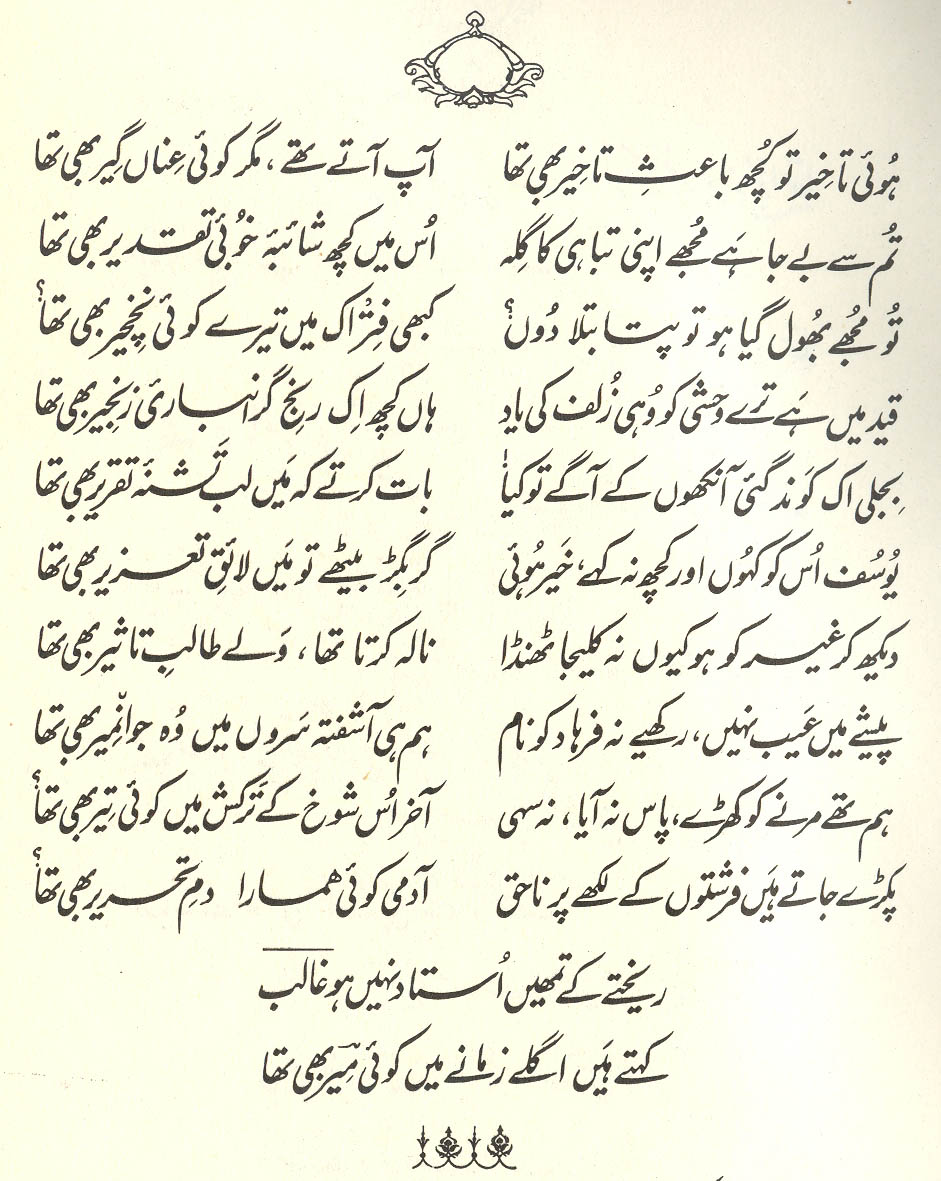
That is to say, in order to prove our guilt, someone's testimony is certainly necessary; merely the Angels' writing is not enough.
==Urdu text: Yadgar-e Ghalib , p. 141
After 'ours', it's culpable to put in 'too' [] as well. But it's a necessity of the verse [for the refrain , so he has put it in at the end. In this verse he has sought merely for wit [] and anecdotalness []. (36)
== Nazm page 36

They are Angels, what feeling do they have for human longings? Whatever thing they wish, they have recorded among the sins. At the time of writing, according to the custom of the world, our man-- that is, some representative of ours-- should have been there. (71)
By Angels are meant those two writers who record men's good and bad deeds. This verse is an example of poetic mischievousness, and has been composed only for amusement. (88)
With regard to mischievousness and wit, he has composed a peerless verse. This is one of those verses such that to explain it is to shed the blood of its meaning. (366)
In Islamic tradition, two Angel s called the 'honorable scribes ' [] sit on people's shoulders and record their good and evil deeds. Their presence is believed to be referred to in Quran 82:10-14. I thank Abida Vaqar Ripley for pointing out (July 2022) these references. There are also two terrifying angels named Munkar and Nakir , who interrogate each person in the grave and torment evil-doers, but they don't seem to be recording angels.
The enjoyableness of the verse lies in the matter-of-fact, confident application of human legal procedure to divine justice. Everybody knows that a mere written statement by one party is insufficient for conviction. Proper form requires that we, the accused, be permitted to have 'our man' present during the proceedings-- normally, our advocate or representative.
But in this case the stress falls not only on 'our' but also on 'man'. Not only was our advocate absent, but there wasn't even anyone of our own kind, an or 'child of Adam' present-- and what can Angels understand of human guilt or innocence, and who knows whether they're trustworthy or not?
The triumphant tone of the second line is especially amusing-- it conveys the sense that we have found a huge hole in the prosecution's case, and are firmly driving a truck through it. This tone arises from the structure of the line, a rhetorical question of the yes-or-no kind with the introductory colloquially omitted.
On the face of it, this line clearly says 'Even/also some man of ours was [there] at the moment of writing'. In the given context, this reading can hardly be applicable to the verse. Thus the verse becomes an extremely unusual, or perhaps almost unique, case in Ghalib's divan : a construction that can meaningfully be read only in a secondary way (by inserting a ), and not in the obvious primary way at all. There are dozens of verses that can be read in multiple ways, with or without an implied ; but I can't think of another case like this one, in which the literal, apparent, 'official' meaning is categorically ruled out. It certainly demonstrates, if demonstration is needed, that Ghalib intended to be a protean, powerful, constantly hovering possibility.
Recently, Mushtaq Fadra has argued in our poetry reading group (July 2016) that the line could be read as an actual assertion-- 'We know that the angels wrote things down unjustly, because we had a 'man' there at the time, checking on them!'. This statement might be a bluff. (Or else the reference could even be to the person whom the Angels were interrogating.) This is an enjoyable reading, and an appropriately 'mischievous' addition to the basic interrogative reading. Maybe God won't accept it, but maybe he'll at least appreciate the chutzpah. This idea is fun to entertain, but doesn't create nearly as tight and enjoyable a ' connection ' between the lines as the primary reading does.
graphics/angels.jpg