Verse 3after 1847iirbhii thaa
G5
In this meter the first long syllable may be replaced by a short; and the next-to-last long syllable may be replaced by two shorts.
1
if you might have forgotten me, then might/should I tell you the address?
2
at one time in your saddle-straps there was even/also some prey/game
'Sign, mark, signal, symptom, token, trace, clue, hint, direction, specification, particular mention; address (of a person), address (or place to which one is directed)'.
'Saddle-straps; cords fixed to a saddle for hanging game to'.
'A wild animal, wild beast; prey, game'.
| References | |
|---|---|
| Arshi, Imtiyaz Ali | Ghazal# 41 |
| Raza, Kalidas Gupta | 397 |
| Hamid Ali Khan | Open Image |
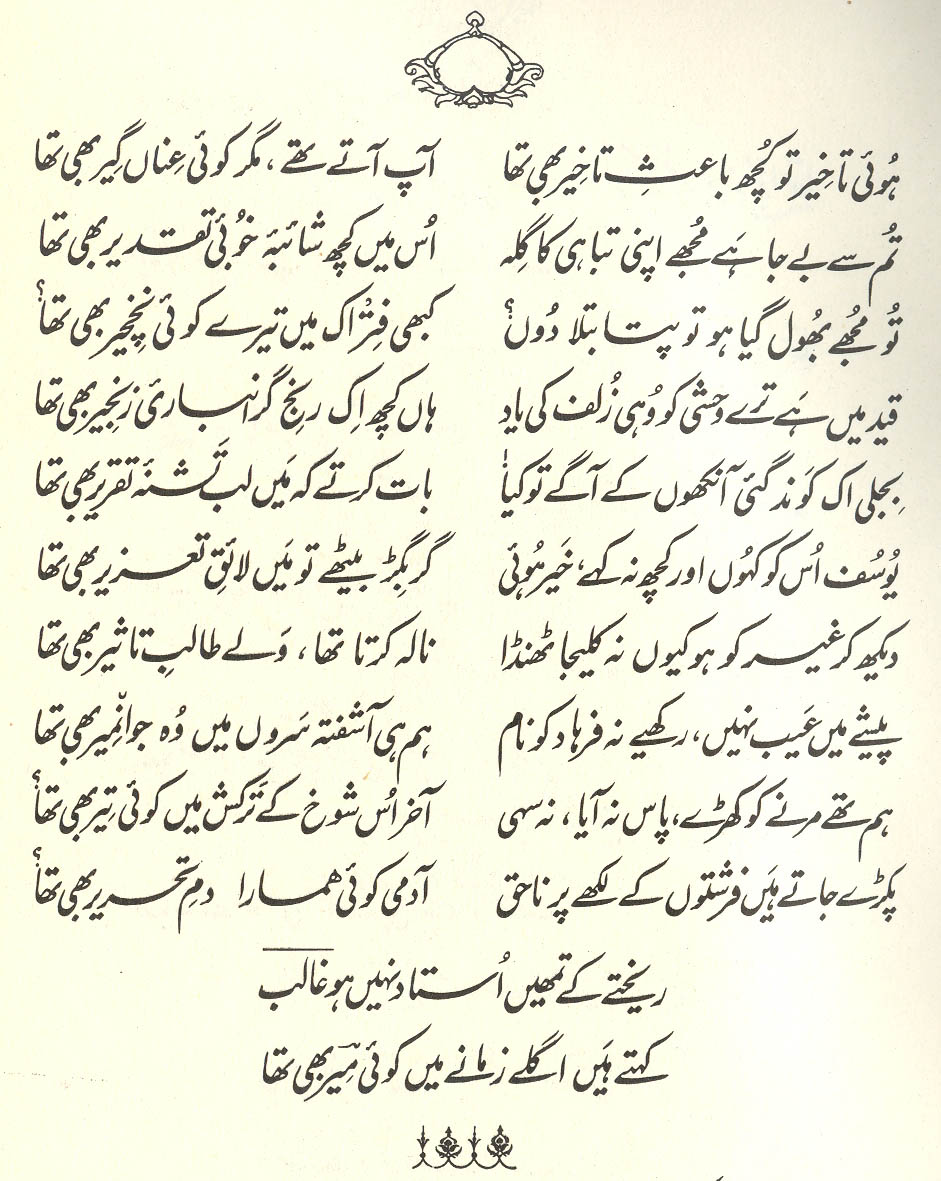
I am that very one [i.e., the prey]. (36)
== Nazm page 36

He says, I am the same prey who had at one time been tied to your horse's saddle straps, and whom you considered to be unworthy, so that you loosened the straps and threw him away. Perhaps you've forgotten me. But to this very day I still consider myself your prey alone. (70)
The poet has expressed his meaning in strangely heart-attracting words.... That is, I was such a lover of yours, whom you used to treat affectionately, and respect for whose love was in your heart. (Beauty of expression sacrifices itself for this style of expression.) (35-36)
What a note of pathos the speaker seems to strike here! And yet with further thought, the matter-of-factness shows itself underneath. The first line is wonderfully colloquial, it might be said by anyone-- anyone politely preparing to refresh a casual acquaintance's memory of a long-ago social encounter. It is courteous, after all, to act as though the person might have forgotten you; this emphasizes your own lowliness and your listener's greater importance. But once you identify yourself, you expect a friendly or at least properly polite reception.
So what does the lover provide by way of status or 'address'? Not a current place of residence or business affiliation. Not even a past one. Only a very delicate and tentative reminder that there was once 'some' prey tied to the addressee's saddle. Only implication tells us that he himself was the prey.
And the further suggestion is of course that he has nothing else to mention about himself-- no home, no work, no identity, nothing current to make clear who he is. He has only that identity of having been once strapped to her saddle. Which means that, in an important sense, he's there still.
Could he even actually be there still? Could it be that she just hasn't bothered to notice her saddle-straps lately? This subtle, courteous, low-key, indirect verse, with its depths of suggestion, captures the poor ignored lover's whole plight.
In this verse the speaker seems to be some small wild creature (since a large prey couldn't be tied to saddle-straps). The most probable guess is a bird, since the lover often speaks as a bird (for examples, see 126,5 ), and never as, say, a rabbit. But it's hard to believe that Ghalib himself ever bothered at all about what kind of 'prey' might be speaking in this verse.
graphics/saddlestraps.jpg