Verse 8after 1847iirbhii thaa
G5
In this meter the first long syllable may be replaced by a short; and the next-to-last long syllable may be replaced by two shorts.
1
in [his/one's] profession/practice is no defect-- don't give Farhad a [bad] name!
2 a
among only/emphatically us disordered-headed ones, he was even/also a young chieftain
2 b
among only/emphatically us disordered-headed ones, was that young chieftain too
''That which is followed'; vocation, profession, craft, trade, business; custom, habit, practice; art, skill'.
'Chief, leader, master, head'.
| References | |
|---|---|
| Arshi, Imtiyaz Ali | Ghazal# 41 |
| Raza, Kalidas Gupta | 397 |
| Hamid Ali Khan | Open Image |
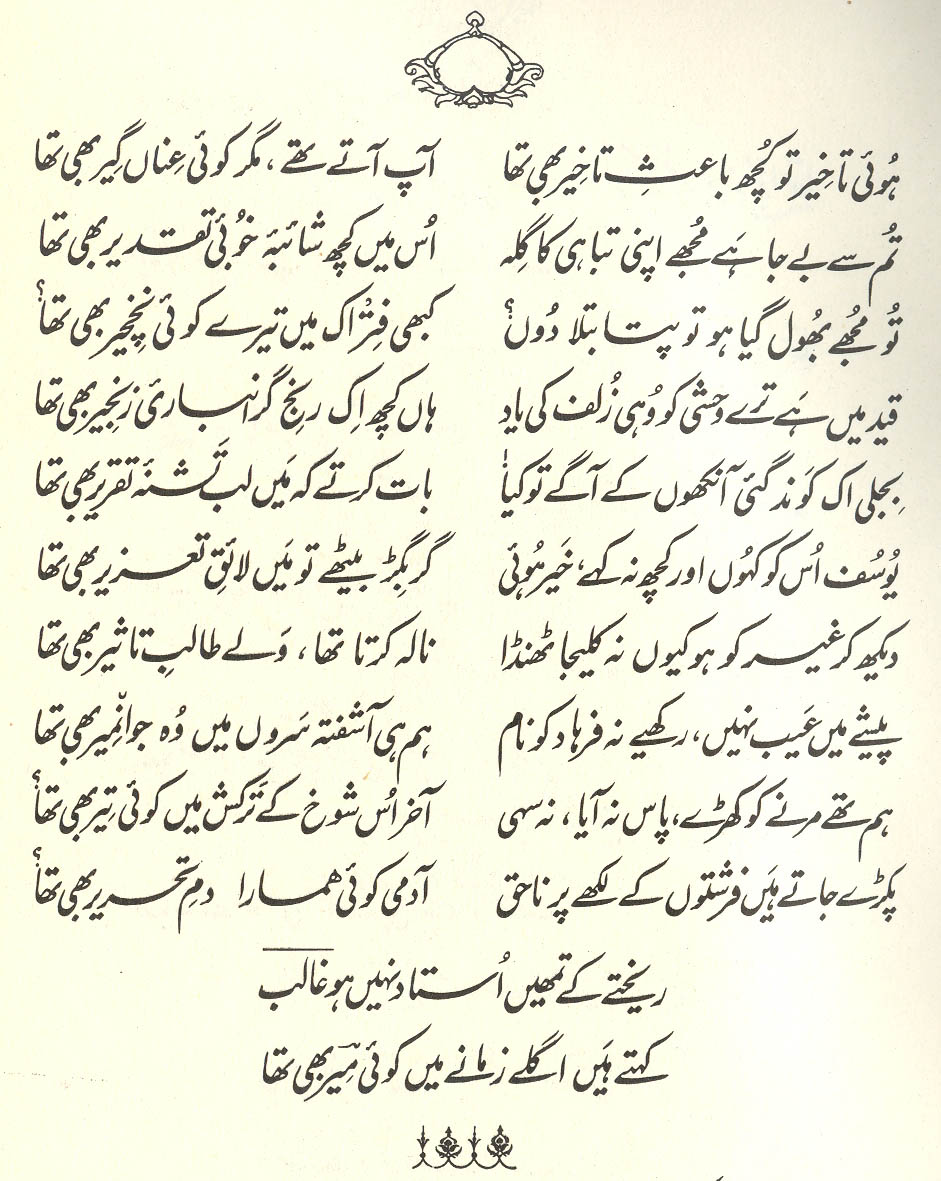
In place of ... now is the idiom. And this speech has departed from its original/true form. (36)
== Nazm page 36

Urdu text: Vajid 1902 {36}
He says, a profession is no defect-- why do you give Farhad a bad name? That is, Farhad too has lived as a passionate lover. We too are a passionate lover, and Mir too was a passionate lover. If the harsh constraints of passion compelled him to take up mountain-digging [], then what's wrong with that? One lover cuts through a mountain, another infatuated one endures [lit. 'cuts through'] days of difficulty, another madman 'cuts through' nights of separation. (71)
= dying at a youthful age. If Farhad was a stone-cutter, then it's no harm. A profession does not remove a person's inborn gentility. Farhad was one of us crazed lovers, one who in his youth played a mortal game with his life. (87)
It's impossible to tell exactly what kind of defense is being made in the first line: is it no defect for one to have a profession, even if it is a humble one? Or is it no defect to be, specifically, a stone-cutter? Or is there no defect in Farhad 's 'practice' or 'vocation' or behavior as a stone-cutter (see the definition of )? Or is there no defect in Farhad's 'practice' or 'vocation' as a lover?
The second line brings us the real punch of the verse: the wonderfully apt phrase , one whose head is disordered, distracted, wretched (see the definition above). 'We disordered-headed ones', and we alone, or at least emphatically we-- as is made clear by the carefully-placed -- constitute the real group of which Farhad was a part. Even the real 'professional' group, perhaps, since the path of passion is construed in the ghazal world as a special vocation that is also a one-way fast-track route to death.
When Farhad heard the (false) news of his beloved Shirin's death, he used his stone-cutting axe to split his own head open. Thus he vindicated his profession(s) as a stone-cutter and a lover; he also demonstrated his kinship with the rest of us 'disordered-headed' ones. For what kind of head could be more disordered, distracted, wretched, than one that has been split in two by an axe? Isn't that the direction in which all true lovers are heading? And isn't the lover's only alternative to 'disorderedness' something like 'insensibility', or a recourse to stone (thus vindicating the work of a stone-cutter)?
As Mir says, if even prison can't settle the mad lover down, the only thing left is stone-- stone to beat the head against: M 11,4 .
For the record, I think that Bekhud Dihlavi misreads when he finds a reference to the poet Mir, and that Bekhud Mohani incorrectly explains (I think he's confusing it with ).
For a less favorable interpretation of Farhad's axemanship, see 3,6 .
Note for meter fans: Here is scanned , to make it fit into the line.
graphics/farhad.jpg