Verse 61821uudthaa
G3
2
he was dizzied/'head-whirled' by the intoxication/hangover of customs and rules
'The head whirling round,' dizzy, vertiginous; stupefied, bewildered, confounded, amazed, astonished; wandering, straying; distressed, humbled, depressed'.
'Intoxication; the effects of intoxication, pain and headache, &c. occasioned by drinking, crapulence, crop-sickness; headache or sickness (arising from want of sleep, &c.); languor'.
| References | |
|---|---|
| Arshi, Imtiyaz Ali | Ghazal# 4 |
| Raza, Kalidas Gupta | 318 |
| Nuskhah-e-Hamidiyah | 29 |
| Asi, Abdul Bari | 51-52 |
| Gyan Chand | 65-67 |
| Hamid Ali Khan | Open Image |
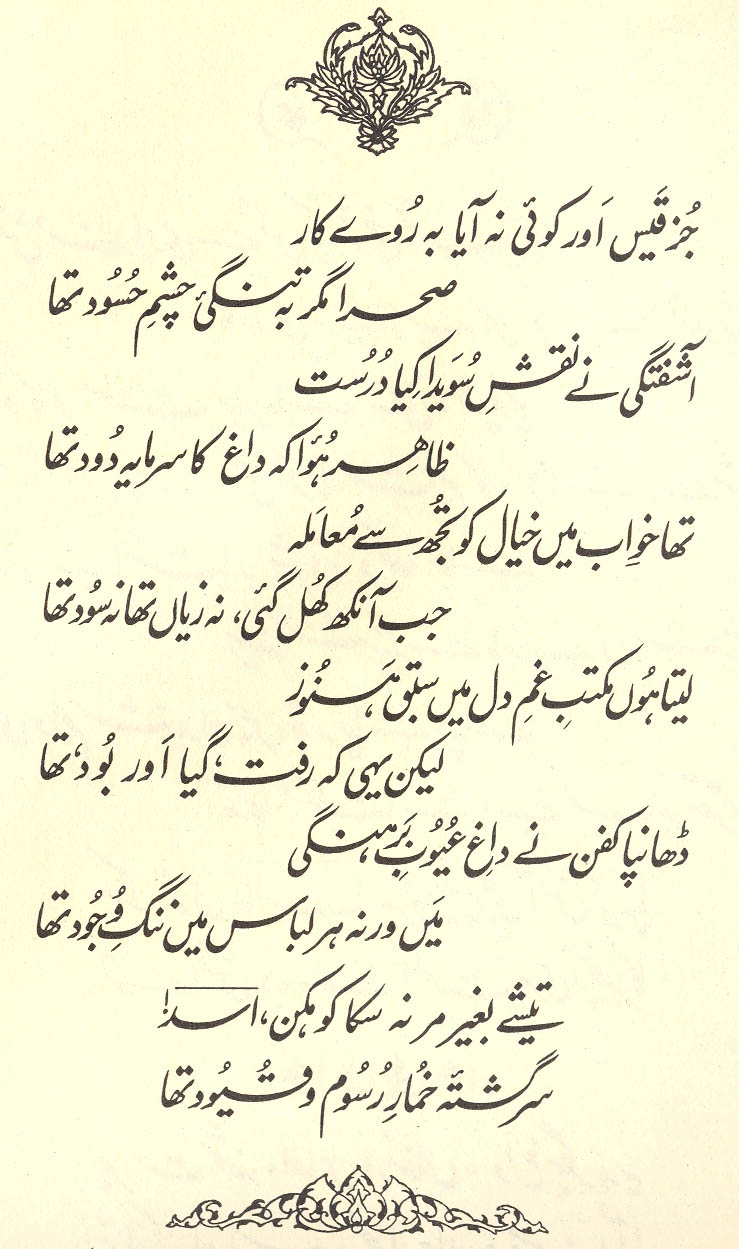
It's a taunt against Kohkan for being so bound to custom and rule, which is contrary to madness and freedom.... If the intoxication of passion had been perfect, he would have died without smashing open his head. (3-4)
== Nazm page 3 ; Nazm page 4


Urdu text: Vajid 1902 {3}
That is, hearing of the death of Shirin, he ought to have heaved a sigh and passed out of this life. But he wasn't able to do this. (12)
In order to show the bondage to customs and rules as contemptible, he has selected the word 'intoxication', and before it he has said 'stupefied'. (7)
For the story of Farhad and Shirin, see 1,2 . Upon hearing (false) news of Shirin's death, Farhad smashed his head in with his own axe. Thus the literal meaning of forms a nice resonance: he smashed his head in because his head was spinning. Usually intoxication is the lover's state; here, it is a miasma of conventions and externals that fogs the lover's brain so badly that he is reduced to using a conventional and external tool like an axe. Even more perfectly, the can be a sort of hangover (see the definition above), something left over after intoxication, something from which the lover would recover in time-- except that in this case there is no more time. For more on , see 12,2 .
For a more charitable interpretation of Farhad's prowess with an axe, see 36,8 . For further discussion of the general motif of snide remarks about earlier lovers, see 100,4 . And in 121,2 , Ghalib even offers a truly affectionate thought about Farhad.
Although everybody knows that officially ghazals are supposed to have an odd number of verses, we don't have to go any further into the divan than three ghazals before we discover that Ghalib doesn't set much store by that rule. More ghazals have an odd number of verses than have an even number, but the 'rule' is only a vague predisposition that the poets don't at all mind ignoring when they so choose.
Note for grammar fans: If you're curious about , see 59,1 for discussion.
graphics/kohkan.jpg