Verse 21821uudthaa
G3
1
distractedness fixed up the shape of the 'suvaida'
2
it became apparent that the property/wealth of the wound/scar was smoke
'(dim. of ): The black part or grain of the heart, the heart's core; --original sin'.
'A mark burnt in, a brand, cautery; mark, spot, speck; stain; stigma; blemish; iron-mould; freckle; pock; scar, cicatrix; wound, sore; grief, sorrow; misfortune, calamity; loss, injury, damage'.
'Principal sum, capital, stock in trade; fund, funds, assets, means, resources; materials'.
| References | |
|---|---|
| Arshi, Imtiyaz Ali | Ghazal# 4 |
| Raza, Kalidas Gupta | 318 |
| Nuskhah-e-Hamidiyah | 29 |
| Asi, Abdul Bari | 51-52 |
| Gyan Chand | 65-67 |
| Hamid Ali Khan | Open Image |
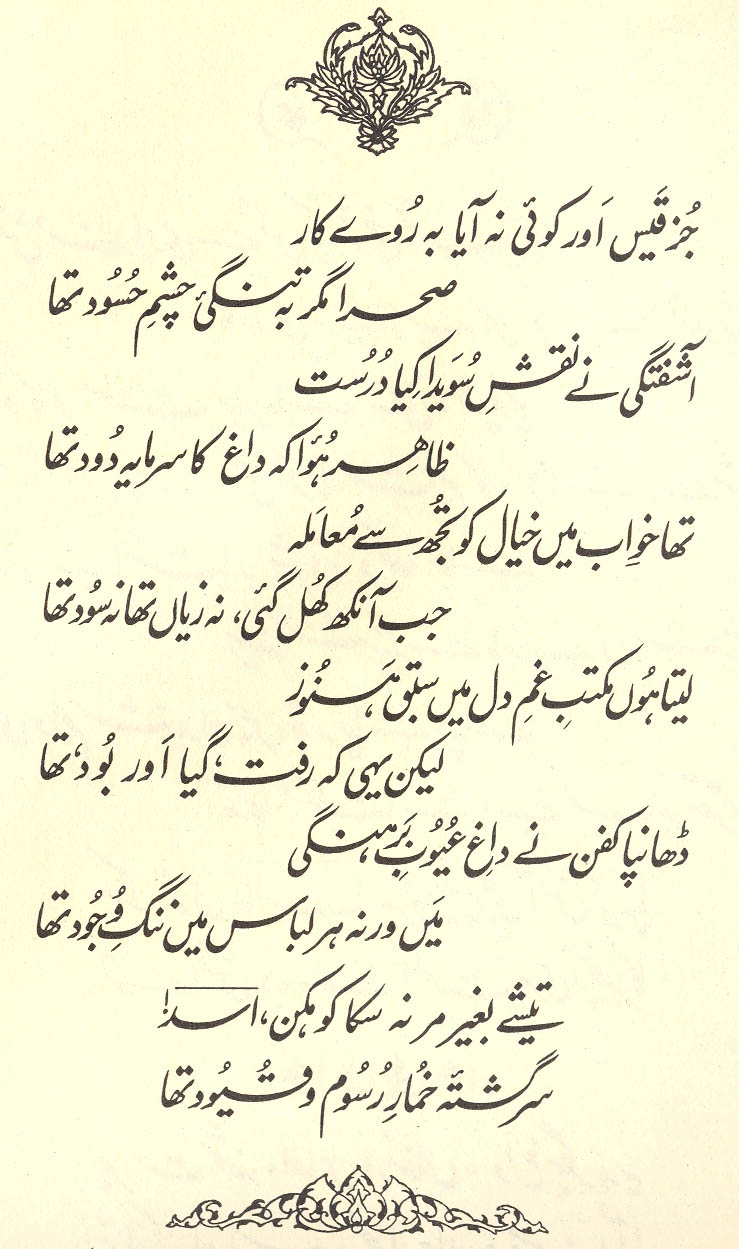
== Nazm page 3

Urdu text: Vajid 1902 {3}
[An extensive discussion of the work of previous commentators, and of his own previous ideas about the verse, all of which he now considers to be flawed.]
Keeping in view all these deficiencies, I have worked out this meaning: (that is, anxiety of temperament) erased from the heart the scar of passion ( ) itself. It became apparent that the state of the wound/scar of passion was only that of a stain of smoke, which becomes clean through scrubbing and scouring.
About this interpretation there were very long discussions, with some opposed and some in favor. In particular, Naiyar Mas'ud has argued in a most learned style against my interpretation. The particular basis of his opposition was that the meaning of is not 'to erase' or 'to clean'. I had said that in Urdu is taken to mean to fix something up, to erase and clean it up, or to use some substance to remove the defect and adorn the spot. Naiyar Mas'ud Sahib's view was that from 'to fix up' or 'to adorn', the meanings 'to erase' and 'to clean' do not emerge.
We have seen above that Shaukat [Merathi, a commentator,] has used and as synonymous. It is true that no Urdu or Persian dictionary defines , as 'to erase' or 'to clean'. The context of all Ghalib's verses rests on the idea that should be taken as 'to erase' or 'to clean'. Two respected commentators-- that is, Shaukat Merathi and Agha Baqir too-- shared this opinion.
Naiyar Mas'ud's own commentary is extremely subtle. According to him, the meaning of the first line is that distractedness shaped and completed the suvaida in the heart. The second line establishes a kind of proof for this: that since distractedness is of the nature of smoke, it's clear that the cause of every wound is smoke. Undoubtedly this commentary is subtle, but in it too is the same difficulty to which I have already pointed: if distractedness only adorned and completed the wound/scar, then smoke (distractedness) cannot be called the property/wealth of the wound/scar. That is, if the wound/scar was already present, then it will not be proper to establish smoke as its property/wealth. In the light of this discussion, it's necessary to say that Ghalib has used with only/emphatically the meaning of 'to erase' or 'to clean'.
The tone of the second line is disdainful and sarcastic: when you look at the wound/scar it seems very solid, but in truth its property is only smoke, it has no substance, it has no stability. When it is said about something that its property/wealth is such-and-such a thing, and that thing is unstable (like smoke), then an aspect of disdain and sarcasm always makes itself felt.
Thus this verse doesn't say only that distractedness made the form of the suvaida (erased it), because this interpretation does not fully accommodate all the possibilities of the 'property/wealth of the wound/scar' in the second line. Ghalib's point is that the wound/scar of passion, or the wound/scar of the smoke of sighs, is a commonplace thing without any stability or necessity. If we reflect on the relationship between the wound/scar of smoke and the smoke of sighs, the meaning of the verse becomes apparent: if the essence of something is smoke, how can it have any stability? Smoke in its nature is something that swiftly diffuses and vanishes, so how can its wound/scar have any substance?
The accomplishment of the verse is that 'distractedness' and 'smoke' have an affinity of meaning [of movement and dispersedness]. In addition to this, Ghalib is saying that distractedness erased the wound/scar. After all, the wound/scar for which he uses distractedness as a metaphor was made by smoke. Here, Ghalib is labelling that very distractedness as a cause of the wound/scar's vanishing. This kind of impossible metaphorical speech is Ghalib's special style.
== (1989: 27-29) 2006: 27-31
ABOUT THE : Ultimately, is a diminutive form of the word (see the definition above), which means literally 'blackness', but in Urdu, metaphorically, 'madness'. In the ghazal world, it takes the form of a small black spot at the center of the heart that can be interpreted almost at the poet's pleasure. The term appears in 6,10x in connection with Majnun 's passion. For a (relatively) straightforward use of , and further discussion, see 93,1 . And then, Ghalib also compares it to a betel-nut; see 95,1 for the amusing evidence. There's a mystical use in 96,2 . In 113,8 , there's an explicit play with its relation to . In 145,10x , it appears as a painter's color-enhancing under-coat. Then 229,2 involves it with a bouquet of flowers, and 379x,5 features the eye of a Pari. There's also its 'turbulence' in 425x,2 ; in 435x,5 , it is linked to the 'glory/appearance of thought'. A Mirian example: M 386,2 . Similarly, the is characterized by a black in its center; on this see 33,1 .
This is one of Ghalib's difficult verses, because it carries abstraction and metaphor to such impenetrable extremes. The commentators' views are all over the map, and some of them express themselves so obscurely that I wasn't even sure that I could have translated their thoughts coherently. (I'm not sure if it was their fault or mine, but probably both.) Faruqi's analysis is the most lucid one that I've found (which in this case isn't saying as much as usual), so I've given it pride of place.
Sometimes I think I understand this verse pretty well, and then I lose my grip on it again. I figure that every commentator is allowed to be at a loss occasionally, so this can just be one of my occasions. At least I can claim the merit of knowing that I don't know!
graphics/smoke.jpg