Verse 11816aahe;N
G13
1
in the pupil of the eye, don't consider these [to be] glances
2
they are, collected in the of the heart of the eye-- sighs
| References | |
|---|---|
| Arshi, Imtiyaz Ali | Ghazal# 97 |
| Raza, Kalidas Gupta | 203-04 |
| Nuskhah-e-Hamidiyah | 149-150 |
| Asi, Abdul Bari | 168-170 |
| Gyan Chand | 272-273 |
| Hamid Ali Khan | Open Image |
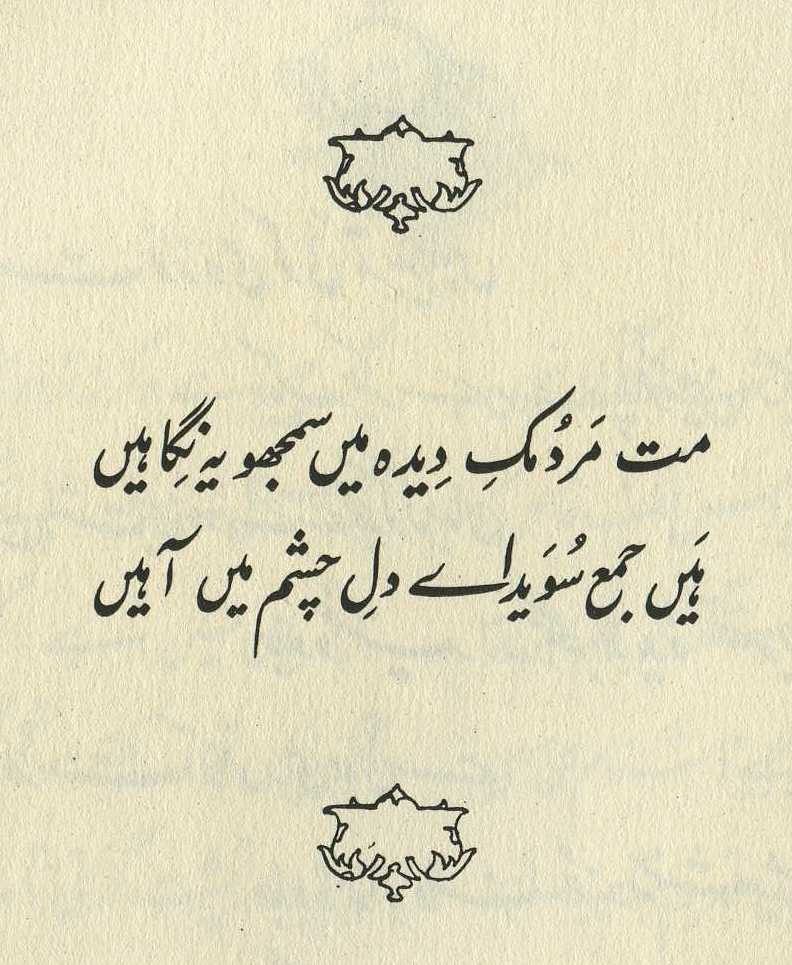
Just as there's a pupil in the eye, in the same way there's a black spot/point [] in the heart that's called . The meaning is that in the pupil of my eye these are not glances, but rather sighs in the heart of the eye. That is, my eye and glances are immersed in longing. In this verse is an extremity of artifice []. And here 'heart' has the meaning of 'middle'. (95-96)
== Nazm page 95 ; Nazm page 96


is the name of that black spot that is on the heart in the form of a mole []. The meaning of the verse is that these are not glances in the pupil of my eye; rather, in the heart of the eye there are sighs. That is, my eyes and glances are both immersed in longing. (145)
[Contrary to what Nazm says,] in this verse there's no trace at all of artifice.... In every situation, the beauty of the beloved makes a claim that from the hearts of those who behold her, and those who don't behold her, a sigh would emerge. Information reaches the heart afterwards. First, the mood of a sigh passes over the eyes. Keeping this in view, the poet ought to receive due praise for his subtlety of vision. If anyone says that emotion is in the heart, not in the eye, then it will be said [in reply] that this is poetry, not history. (189)
The word is a ghazal term so esoteric that Sufi-minded commentators can go on and on about it with impunity-- nobody can disprove what anybody else says, because the whole thing is entirely invented anyway. Other than referring to a small black spot in the heart, it's not clear what it means-- except that it aspires to mystical profundity. Amusingly but understandably, Platts identifies it with the Christian notion of 'original sin' (see the definition above). For a discussion of , see 3,2 .
If we try to analyze this verse, there seems initially to be a straightforward set of metaphorical building blocks, where 'A = B'. The eye is the heart (both are organs vital to life). The pupil of the eye is the in the heart (both are small central dark spots). The natural third step would be for Ghalib to say that the glances in the pupil of the eye are the sighs in the dark spot of the heart (both emerge from the center, and are of central importance to the function of the organ).
But of course, the verse doesn't say that, but denies it: the verse says that those 'glances' are not glances at all, they are 'sighs'. Instead of A = B, we have nothing but B's, and no A on the scene at all, except as an error of understanding that must be emphatically corrected. There are no glances, only sighs. One side of the equation has been pulled out from under us, so we stop in perplexity and try to reimagine the verse.
But it's not easy to do. If there are no glances, but only sighs, does this mean that similarly there is no pupil or eye, but only a black spot and a heart? Or might it mean that the heart sends up its sighs not just to the lips, but to the eyes as well? The fact that the verse speaks of the , the 'black spot of the heart of the eye', opens up plenty of room for possibilities, thanks to clever use of the protean . Is it the 'heart that is an eye', or the 'heart that pertains to the eye'? And if it is the latter, is it just a metaphor-marker, or are we linking the real, bodily heart specifically to the eye? And is it-- another problem-- a '(black spot in the heart) of the eye', or a 'black spot in the (heart of the eye)'?
Nazm apparently sees some of these complexities, so he rejects them by simply asserting that 'heart' here means only 'middle'. But if we don't take this easy, arbitrary way out of the dilemma, we're left with no way to resolve it. We can generate lots of possible heart/eye relationships, but they all remain uncertain, incomplete, and unsatisfying. (Just as they do in the real world, of course, so to accuse Ghalib of 'artifice' may not be entirely legitimate.)
Not for the first time, Ghalib has deftly subverted his own metaphors. He has lured us into a metaphorical quagmire, and then abandoned us there. For more on such sneaky behavior, see 21,10 .
If you are interested in how the young poet's mind was working, check out some of the other unpublished verses from this ghazal (available here, pp. 203-04 ). They include lines like (the first line of the second verse) and (the second line of the final verse).
graphics/eyepupil.jpg