Verse 11826ednahii;N
G11
In this meter the first long syllable may be replaced by a short; and the next-to-last long syllable may be replaced by two shorts.
1
passion is not hopeless/despairing of effect
2 a
life-surrendering is not a willow tree
2 b
a life is a betel-nut, not a willow tree [reading ]
'The making an impression; impression, effect; operation; penetration'.
'Resigning, committing (to another; --used as last member of compounds)'.
'Betel-nut, the nut of Areca catechu'.
'Willow; cane, ratan, Calamus rotang'.
| References | |
|---|---|
| Arshi, Imtiyaz Ali | Ghazal# 98 |
| Raza, Kalidas Gupta | 364 |
| Hamid Ali Khan | Open Image |
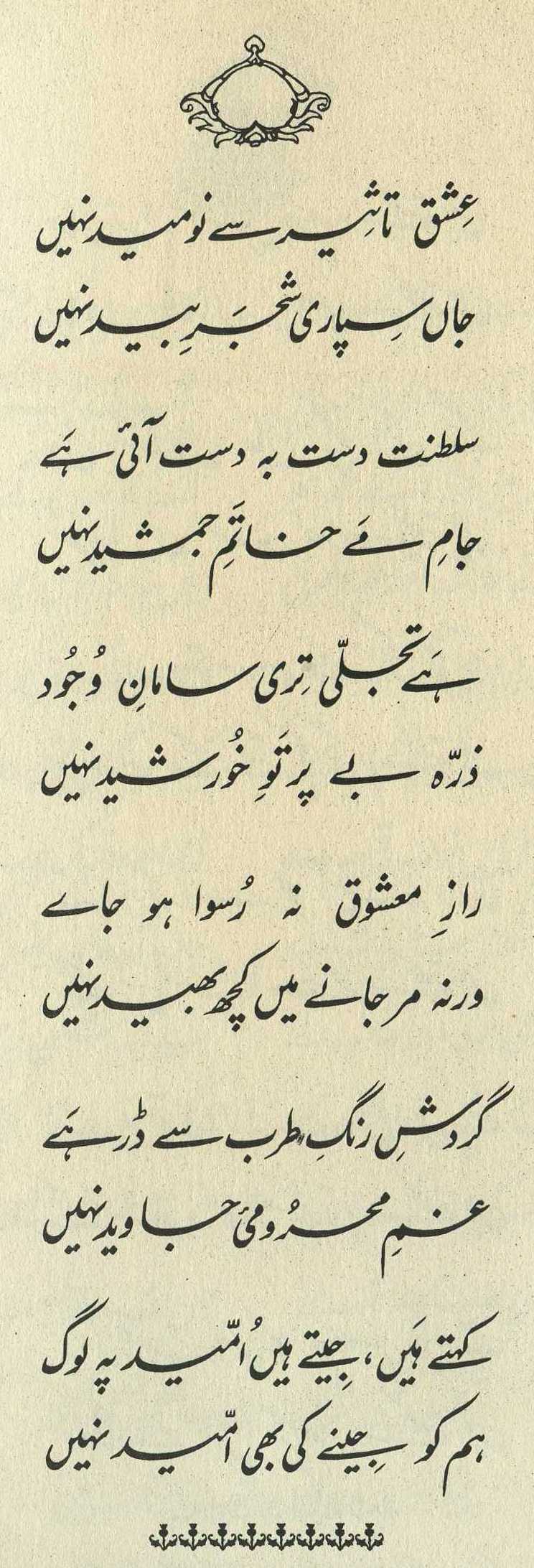
[1858, to Saqib:] I have one verse-set in this meter that I had composed in Calcutta [in 1826]. The occasion for it was that in a gathering [], Maulvi Karam Husain, a friend of mine, placed on the palm of his hand a betel nut of very good quality, without any fiber, and asked me, 'Let some simile s be versified about this'. While sitting there, I composed a verse-set of nine or ten verses and gave it to him, and as a reward I took that betel nut from him. Now I am thinking-- those verses that keep coming to mind, I will keep writing down. [The italicized verses are those he published in his divan , but didn't include in this letter.] The verse-set:
this glossy betel-nut that is in the Sahib's hand
however much you praise it, it is suitable for it (1)
the pen has its finger against its teeth [in amazement]: how to write of it?
Speech has its head in its collar [in deep thought]: how to speak of it? (2)
write of it as the seal on the letter of revered and beloved ones
speak of it as the amulet on the arm of self-adorning beautiful ones (3)
[[write of it as the cosmetic [missii]-stained finger-tip of beautiful ones
speak of it as the wound on the side of the liver of mad lovers (4)]]
Solomon
speak of it as resembling the tips of the breasts of a Parizad (5)]]
connect it to the burnt-out star [of bad fortune] of Qais
speak of it as the musky beauty-spot on the heart-attracting face of Laila (6)
suppose it to be the black stone of the wall of the Ka'bah
speak of it as the navel of the musk-deer of the desert of Khitan (7)
[[if in style you suppose it to be the qaaf in tiryaaq [opium]
in color, speak of it as the newly-sprung greenery of the Messiah (8)]]
if in a prayer-cell you declare it to be the 'seal of prayer' [the forehead-mark that results from much prostration]
in a winehouse, speak of it as the plug ['brick'] of the cask of wine (9)
write of it as the cosmetic [ ; see 417x,2 ]-stained finger-tip of beautiful ones
speak of it as resembling the tips of the breasts of a Parizad (4,5)
[[why would you write of it as the lock on the door of the treasury of love?
why would you speak of it as the [point of the] drawing-compass of longing? (10)]]
Anqa ? (11)]]
Laila ?
why would you speak of it as the foot-print of the camel of Salma? (12)]]
In short, there are twenty or twenty-two amusing comparisons []. How could I remember all the verses? The final verse [] is this:
suppose the palm of the Servant-protector's hand to be a heart
and call this glossy betel-nut [] the [Sufistic] 'black spot' on the heart [] (13)
==Urdu letter text: Khaliq Anjum vol. 2, pp. 714-15
==Azad's version: Pritchett and Faruqi , pp. 501-02 [somewhat modified toward literalness]
==full Urdu text of the poem itself (13 verses): Arshi pp. 131-32
==full Urdu text of the poem itself (13 verses): Hamid pp. 207-08

In 1871, when the late Navab Ziya ul-Din Ahmad Khan had gone to Calcutta, the late Maulvi Muhammad Alam, who was an elderly Calcutta scholar, told the Navab Sahib:
When Mirza Sahib had come here [to Calcutta ], in a gathering [] where Mirza was present and I too was in attendance, a discussion of poets was in progress. In the course of conversation one gentleman greatly praised Faizi. Mirza said, 'Faizi was not [in excellence] what people consider him to be'. Over this, a controversy arose. That person said, 'When Faizi met Akbar for the very first time, he composed extemporaneously, and recited at that very moment, an ode of 250 verses'. Mirza said, 'Even now there are present servants of God who can compose, if not three or four hundred, then three or four impromptu verses on any occasion'. The speaker drew from his pocket a single glossy betel-nut, placed it on the palm of his hand, and requested Mirza, 'Let something be commanded on this betel-nut'. Mirza at once composed a verse-set of eleven verses and recited it. It is present in his divan of Rekhtah , and its first verse is [the first verse given above].
../nazm/nazm096.jpg ==Urdu text: Yadgar-e Ghalib , pp. 35-36

That is, lover-ship and life-riskingness [] are hardly a willow tree, that they would remain deprived of effect and fruit! (96)
== Nazm page 96
He says that passion is not hopeless of effect, because life-riskingness [] and life-surrenderingness [] are not a willow tree, which will never have fruit. The meaning is that in passion, life-riskingness and life-throwingawayness [] will certainly have an effect sometime or other. (83)
= to sacrifice [] one's life. A willow-tree bears no fruit. In passion there is effect. Life-surrenderingness [] is not a willow tree. That is, it is impossible that passion would not have an effect. (190)
The rhyme -words in this ghazal are all of course intended to end with the same vowel sound; this sound is usually taken to be . But in some cases this makes for truly odd effects. Here are some thoughts on the subject from Pasha Mohamad Khan (Apr. 2008):
'The as-yet-unwritten history of the vowel shift in Persian from ( o , e ) to ( ) is weird and meandering -- unfortunately one can't always identify the classical pronunciation of a Persian word with its modern South Asian pronunciation. This ghazal is to my mind an indication that Ghalib meant for to be pronounced , which is possible in classical Persian. Personally I'm quite convinced that the rhyme words in the ghazal must be pronounced , rather than . It is valid to read these as having vowels; in the case of , I've never heard it pronounced as in Urdu. Basically, it makes more sense to use the endings, which are attested in Steingass, than to turn into . This indicates that either these vowels hadn't yet become in Ghalib's time, or that Ghalib used the pronunciation of and for poetic reasons.'
I find this argument very plausible, and so I've opted for Pasha's suggested readings of the rhyme-words. There's also the fact that is a purely Indic word (and the only such word on the list), so to convert it into on entirely Persian-specific grounds would be a stretch.
This is a 'short meter' [] ghazal, so there's less room in each line for complex effects. As usual, the commentators seem to be satisfied with no effects at all, just a prosy paraphrase. As usual, I look for more. And in this case, the 'more' leaps to the eye-- the wordplay and 'script-play' of , which in its normal written form, without short vowel markers, looks exactly like (see the definitions above). (For more on such 'script-plays', see 33,7 .)
Lest I be thought frivolous, note that Ghalib could easily have put the far more common or or in exactly the same metrical space. (The latter would fit if it were given a full .) These are the words that the commentators use to explain (and in one case, actually to define) , a word they obviously think may be unfamiliar to their readers. (When the word is used once more, in 164,7 , it's clearly there because it can form a rhyme -word.)
Yet Ghalib chose instead to use , and to plant (sorry, sorry!) the name of this tree-grown nut exactly beside the name of a tree that doesn't grow nuts-- in a line that could also be read as declaring that one's life is a (useful, enjoyable) , not a (fruitless) willow-tree. (And what has more 'effect' than betel-nut , the vital ingredient in ?) Ghalib again sneers at the tree for its fruitlessness in 95,7x ; see that verse for further discussion.
It might be argued that Ghalib had a lofty mind, and wouldn't even have noticed such a mere low-class frivolous pun in the first place. To which I say, Hah! How probable is it that someone like me, a latecomer who started studying Hindi at the age of 20, and Urdu even later, could easily notice a bit of wordplay that would remain invisible to Ghalib? Ghalib could hardly have failed to see it (even if he didn't put it in on purpose, as I'm sure he did). If he didn't want his readers to experience it as part of the verse, he could easily have replaced it with one of the commentators' preferred synonyms. Compare a similar effect in 230,11 .
As further evidence (if any is needed) of Ghalib's irreverence and sense of humor, consider his whole impromptu ode addressed to a betel-nut. (I'm glad to have an excuse to drag it in!) It pulls out all the stops of ghazal rhetoric. We find Majnun, Laila, the Ka'bah, the desert, the wine-cask, the Pari s, the beloved, and even the wildly abstract itself (on this term see 3,2 ), all pressed into service to praise this particular betel-nut-- which was a fine one, of course, with no fiber. So why can't the present verse be allowed a touch of that same uninhibited sense of fun?
(As a fringe benefit, and further evidence of Ghalib's sense of humor, right after the betel-nut ode in his divan comes a little two-verse verse-set :
don't ask about its rank-- that which his Exalted Highness
has sent me, a roghni roti made of besan-flour
he wouldn't have eaten wheat, he wouldn't have emerged from Paradise
if Hazrat Adam had eaten this besan-flour roti.)
While working on Mir , I've just come upon another interesting case, cited by Faruqi in connection with M 420,7 . It is a verse by Siraj Aurangabadi that plays Ghalib's trick in reverse:
[life, betel-nut; wound, catechu; lime, the eye of waiting
for the sake of the guest Grief, the heart is a bira of paan]
Here Siraj is definitely using , because the line specifically equates the lover's life with a betel-nut (in a line full of the ingredients of paan). But in such an amusing verse, surely he must have enjoyed setting up his audience to hear or read at the beginning of the first line the more expectable -- only to provide them not with lofty notions of the martyrdom of love, but with the makings of a paan!
Here is a nice descriptive tribute to paan, by Rakhshanda Jalil .
graphics/supari.jpg