Verse 51826ednahii;N
G11
In this meter the first long syllable may be replaced by a short; and the next-to-last long syllable may be replaced by two shorts.
1
there is fear of the revolving/turning/change of the style/'color' of joy
2 a
there is no grief of perpetual/eternal deprivation
2 b
it's not the grief of perpetual/eternal deprivation!
'Going round, turning round, revolution; circulation; roll; course; period; turn, change; vicissitude; reversion; --adverse fortune, adversity; --wandering about, vagrancy'.
'Colour, colouring matter, pigment, paint, dye; colour, tint, hue, complexion; beauty, bloom; expression, countenance, appearance, aspect; fashion, style; character, nature; mood, mode, manner, method; kind, sort; state, condition'.
tarab>> : 'Emotion, joyous excitement, joy, mirth, cheerfulness, hilarity'.
'Prohibition; exclusion (fr. friends and well-wishers, &c.); disappointment, frustration; deprival; privation, loss'. (Platts p.1008
| References | |
|---|---|
| Arshi, Imtiyaz Ali | Ghazal# 98 |
| Raza, Kalidas Gupta | 364 |
| Hamid Ali Khan | Open Image |
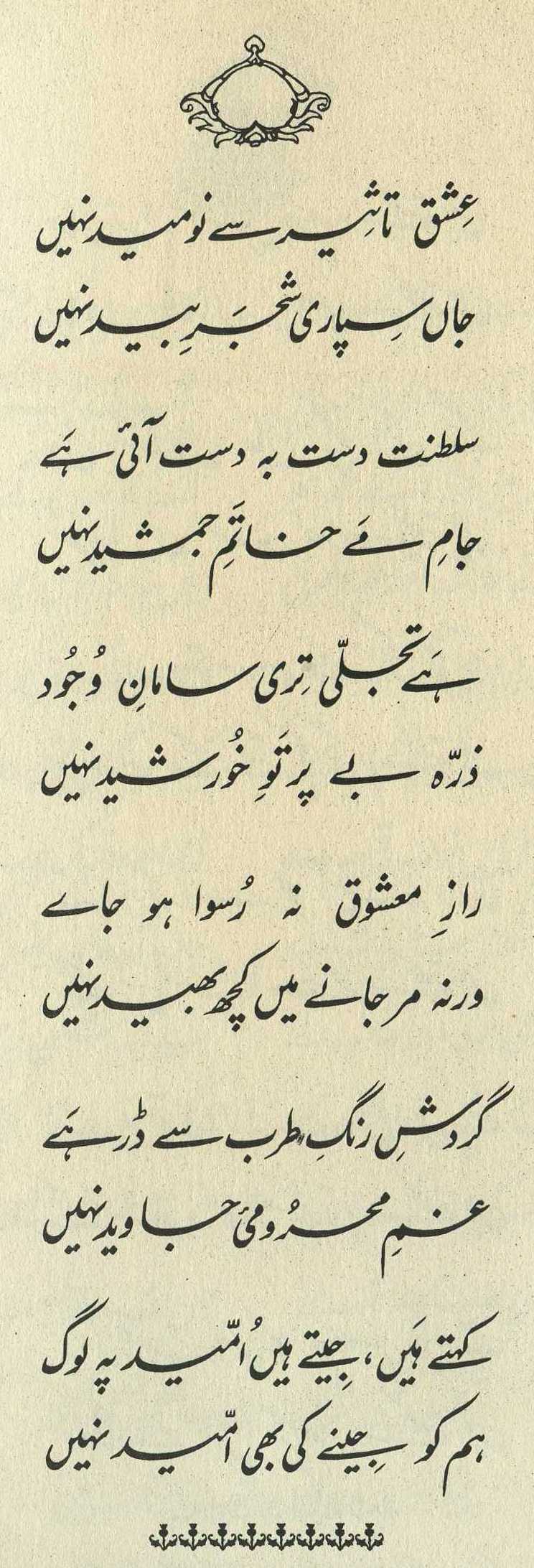
In this verse 'for me' [] or 'for you' [] is omitted . If we consider to be omitted, then the meaning is that after the attainment of joy, the decline of joy is so deadly that perpetual deprivation is better than it. And if we take to be omitted, then the meaning is that you fear the decline of the fleeting pleasures that are available in the world, and give no thought to the perpetual deprivation that is finally to come. This verse is an illustration of how supporting two meanings, or more than that, is no cause of excellence for the verse. Excellence is born from abundance of meaning []; don't consider it to consist in bearing a number of interpretations []. (97)
== Nazm page 97

We don't grieve over perpetual deprivation, because this is better than joy-- in which the fear of the revolving of color/style is always present. That is, since after ease, sorrow is extremely life-destroying, in this connection perpetual deprivation is better. (83)
I don't fear eternal deprivation or ill-fortune. Indeed, I fear the changing of the color/style of enjoyment-- that is, whatever state there might be, let it be for always! Why should it be one thing today, another thing tomorrow?
[Or:] It's easy to endure eternal deprivation. But to endure suffering after enjoyment deprives one of life.
[Or:] He gives advice: alas that you fear that the enjoyment of today might be erased, and don't grieve that in place of that enjoyment, in the Lord's house you will remain deprived of all mercies and pleasures.
[Or:] You fear some disturbance in your enjoyment. But people who are deprived forever-- who are poor/strangers, who are in need-- you never think about. (191)
On the pronunciation of the rhyme -words in this ghazal, see the discussion in 95,1 .
The first line introduces the wonderful (see the definition above), with its 'going round' set of meanings that evoke the wheel of fortune . The revolving of this wheel inexorably brings sorrow to the joyful, and drags the fortunate down into the dust.
But can't we comfort ourselves a bit, when we're down at the bottom, with the thought that what goes down must come up? Sooner or later isn't the 'going round' of the wheel bound to bring us up again for another chance at joy? It would seem so, but somehow that's never on the lover's horizon. (Probably he knows he can't last that long.)
The first line is unspecific; we can't tell who fears the 'revolving'. It could be people in general, or it could be the lover himself. When we come to the second line, the 'revolving' is markedly contrasted with the 'deprivation'-- but it's up to us, as usual, to decide exactly how. The commentators prefer the reading (2a), which indeed doesn't specify for whom there is no grief of perpetual deprivation. (This is the first part-- and the only coherent part-- of Nazm's really bizarre complaint.) Broadly speaking, the commentators get two meanings out of (2a):
(1) People fear the 'revolving', they don't fear the 'deprivation' (it's no cause for grief). And based on human experience, this is quite proper and natural; the speaker is merely offering a sage observation about the nature of life.
(2) People fear the 'revolving', and they don't fear the eternal 'deprivation'? This is folly on their part-- they should (piously, or mystically) fear the latter, and not the former.
But the third meaning, which relies on (2b), is my favorite.
(3) People rightfully fear the 'revolving'-- it's not just something minor like the 'deprivation'! In other words, these two are superficially similar, but so different in degree that they are incommensurable. This kind of phrase has a vigorous colloquial punch: 'Watch out for that mastiff-- it's not a lapdog!' or 'Be careful with that rifle-- it's not a BB gun!'.
On this reading, the amusing part is that the dismissive second term, 'grief of perpetual/eternal deprivation', is in fact something so terrible-sounding that anybody would quail at the very thought of it. But the lover is so much at home with it that he actually uses it as a throwaway term to get across the much greater severity of the real threat. The rhetorical pleasure of this kind of verse would of course be enhanced by the delay in hearing the second line that would be part of mushairah performance conventions.
Compare 240x,5 , in which ineffective sighs result in a changeless 'springtime that has no autumn'.
graphics/joycolors.jpg