Verse 41826ednahii;N
G11
In this meter the first long syllable may be replaced by a short; and the next-to-last long syllable may be replaced by two shorts.
1
may the secret of the beloved not become notorious/revealed!
2
otherwise, there {is / would be} no secret/mystery/difference in dying
'Dishonoured, disgraced, infamous, ignominious; humiliated; open, notorious; accused; one held up to public view, as an example to deter'. (Steingass, p. 576)
'Breaking, separation, disunion, difference, disagreement, interruption, disturbance; betrayal; breach, rupture, fracture; fissure, chasm, cleft; separation, difference, distinction, peculiarity; discrimination, discernment; kind, sort, species, variety; device; secrecy, secret, mystery; secret or hidden virtues or resources (of)'.
| References | |
|---|---|
| Arshi, Imtiyaz Ali | Ghazal# 98 |
| Raza, Kalidas Gupta | 364 |
| Hamid Ali Khan | Open Image |
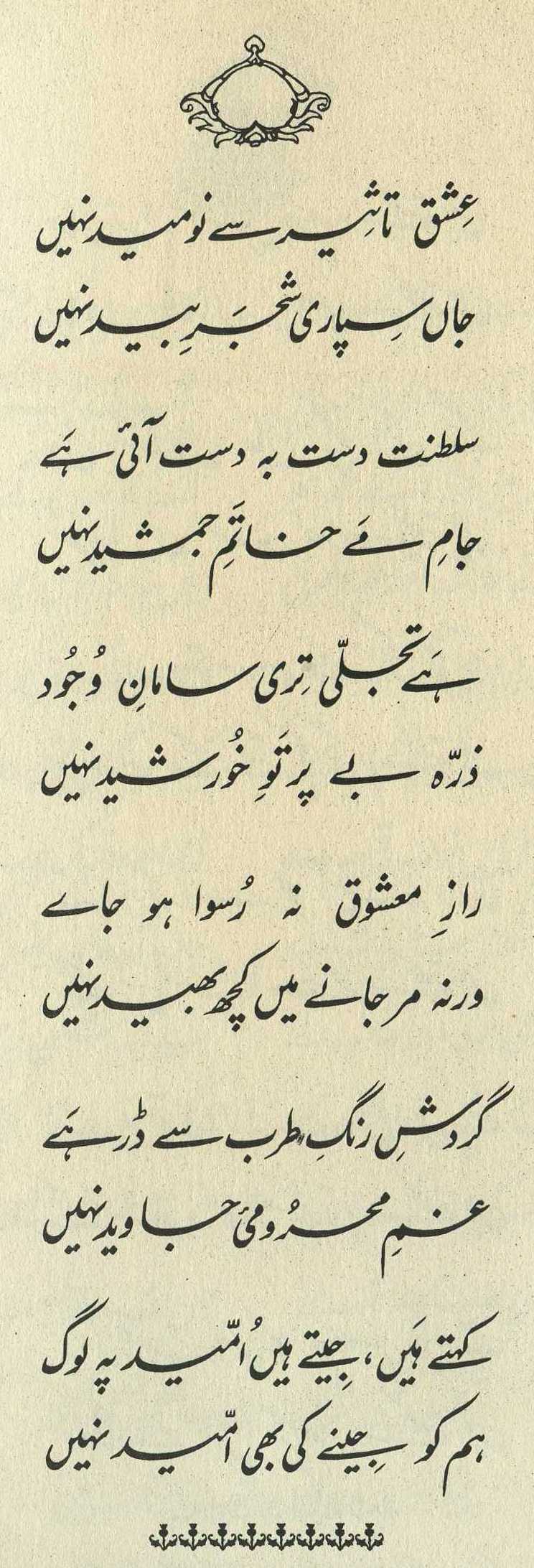
means something hidden, whether it be something beneficial or harmful. Here something harmful is meant. If in place of there had been , then the meaning of would have become something beneficial.
==Urdu text: Yadgar-e Ghalib , p. 147
That is, in dying, there's no further trouble about keeping the secret. But there's a concern that the beloved's secret might be revealed. Because usually the lover's giving up his life is a cause of the beloved's disgrace. (96)
== Nazm page 96

There's no other hesitation about dying-- it's only because the secret of passion might then be revealed. May the beloved not become disreputable!
[Or:] In death there's only this secret: that the secret of the True Beloved might not be revealed-- that is, that the human soul and the divine essence are not separate. But death has been decreed to be necessary for the human body because if there were no death, then mankind too would have been established, like the Lord, as undying, and the secret that had remained hiddened because of death, would be revealed. (The secret, that is, of the human spirit's oneness with the Divine Essence.) (191)
On the pronunciation of the rhyme -words in this ghazal, see the discussion in 95,1 .
How richly the verse uses the great old Indic word (see the definition above), taking advantage of all its multiplicity of relevant meanings! (And this key word has also been saved, in true mushairah performance style, till the last possible moment.) Because of the , we already have two possible readings of the second line, present and contrafactual (though the presence of rather than goes more toward the present). So if we take only the present as an illustration, just consider some of the possibilities for the second line:
=Otherwise, there is no special difficulty or 'rupture' in dying-- the lover would do it gladly, to escape his torment! He's only deterred by fear of her secret becoming known.
=Otherwise, there's no difference in dying-- no difference from the kind of wretched life he now leads-- except that her secret might become known.
=Otherwise, there's no betrayal or disagreement in dying-- she doesn't care if he lives or dies, she would think it was a fine idea for him to die, except for the risk of disgrace to her.
=Otherwise, there's no discernment or virtue in dying-- the important thing is not to die (because anyone can do that), but to die in such a way as to keep the beloved's secret from being known.
=Otherwise, there's no secrecy or mystery about dying-- the lover would gladly reveal his passion through a public death, except that then her secret would become known.
Isn't that a remarkable feat? Almost every meaning of is beautifully apposite and perfectly suited to the environment of the verse.
graphics/secret.jpg