Verse 81816anme;N
G2
1
the turmoil of the madness of passion gave me all the thousands of hearts
2
having become black, it became a 'suvaida'-- every drop of blood in my body
'(dim. of )... The black part or grain of the heart, the heart's core; --original sin.
'The black bile (one of the four humours of the body);... melancholy; hypochondria; frenzy, madness, insanity; love'.
| References | |
|---|---|
| Arshi, Imtiyaz Ali | Ghazal# 91 |
| Raza, Kalidas Gupta | 209-210 |
| Nuskhah-e-Hamidiyah | 158-159 |
| Asi, Abdul Bari | 166 |
| Gyan Chand | 268-269 |
| Hamid Ali Khan | Open Image |
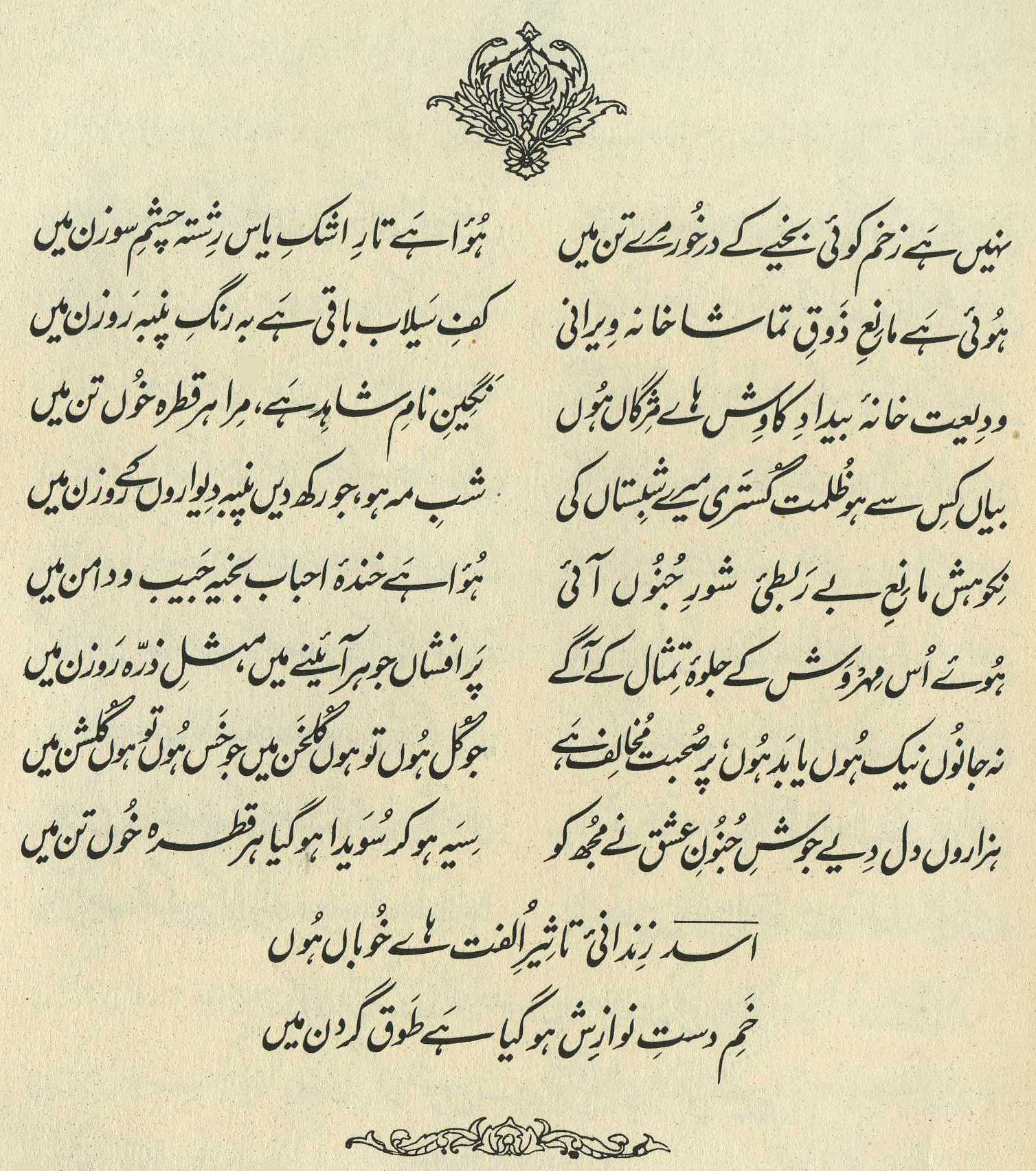
Every drop of blood became a ; and since the is in the heart, then it's as if thanks to the turmoil of madness, I've received all the thousands of hearts. (122)
== Nazm page 122

He says, the turmoil of madness has bestowed upon us all the thousands of hearts. That is, since because of madness the blood became black, every drop of it has become a . The is always a black spot in the heart. (172)
Every drop of blood, because of the turmoil of madness [], turned black and became a . And the is in the heart. So it's as if every drop of my blood is a heart, which is filled with the madness [] of passion. (230)
For general discussion and examples of , see 3,2 .
Despite (or perhaps because of) the traditional location of the in the very center of the heart, Ghalib enjoys moving it around: in 93,1 there's a , in the 'heart of the eye'. And in 96,2 , the the 'beauty-spot at the corner of the mouth', has its own . In the present verse, as a sort of limit case, every drop of blood in the speaker's body turns into a .
How? By first turning into black bile [], as a symptom of madness or melancholia. In the classical Greek medical system , when this humour is dominant one suffers from 'melancholy' (literally, 'black bile'). In Urdu, however, the chief meaning of this (Arabic-derived) is 'madness'. (There's another , from the Persian, that has to do with mercantile activity; that's entirely separate and has no connection with the Arabic sense.)
So once every drop of blood has become 'black' from the madness of passion, the lover's body is full of tiny black spots, each of which can be construed as a , with presumably its accompanying heart. The use of (rather than merely ) emphasizes the totality of the transformation. The microscopic scale of the transformation seems to remove any sense of grotesquerie.
graphics/melancholy.jpg