Verse 21816anme;N
G2
1
house-desolation has become a forbidder of the relish for spectacle
2
the foam of the flood endures, with the color/aspect of cotton, in the crevice-work
| References | |
|---|---|
| Arshi, Imtiyaz Ali | Ghazal# 91 |
| Raza, Kalidas Gupta | 209-210 |
| Nuskhah-e-Hamidiyah | 158-159 |
| Asi, Abdul Bari | 166 |
| Gyan Chand | 268-269 |
| Hamid Ali Khan | Open Image |
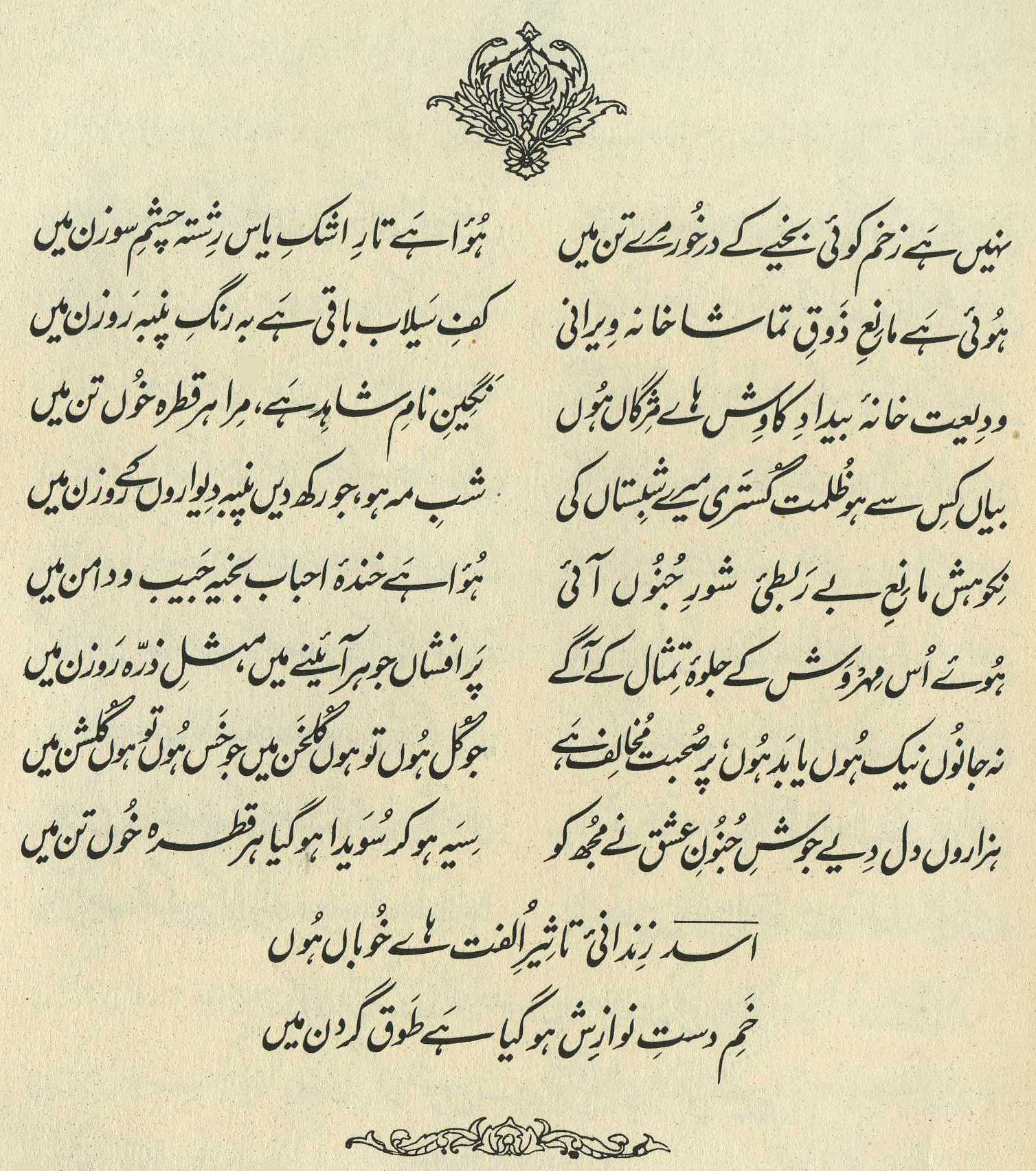
The existence of cotton in the crevice-work forbids the glance. And this cotton is the foam of that flood through which the house became desolate. For this reason, house-desolation is a forbidder of spectacle. That is, he has declared an effect to be a cause. And the eloquent often do such things. (121)
== Nazm page 121

1) The destruction of my house doesn't even let me look around my house at my leisure, because the foam of the flood has remained in the crevice-work, because of which it is closed up.
2) If some wayfarer even wants to look at the condition (destruction) of my house, then how can he see it? The foam of the flood has become cotton in the crevice-work....
From the 'relish for spectacle' it is learned that despite this destruction, the 'relish for spectacle' remains. And from the second line it can be seen to what extent the flood was, and to where the water had risen, that the foam of the flood has become cotton in the crevice-work. And from this it's clear that the house in which such a flood had come-- how to describe its destruction? Another pleasure too is that his love of the house, or the compulsion of the homeowner, becomes clear, since even in such a state he can't abandon his house. (228)
In truth all these problems [with the disconnectedness and vagueness of the conventional interpretation] arise from taking the word in its dictionary sense. It's not necessary to suppose that means 'house'. By the desolation of a prison cell can also be meant. It's clear that for a madman (that is, one imprisoned for madness) his prison cell itself is a house. Another point is that can also be taken to mean merely 'flood'; it's not necessary to restrict it to a 'flood of tears'.
In the light of these points the commentary on the verse can be as follows: I am imprisoned in a cell without windows or doors, such that there's not even any crevice-work. Or else say that I'm in a prison, and all the doors and windows are closed. There's not even any crevice-work, through which I would be able to behold the scene outside-- not to speak of coming out of the cell. So how would I have satisfied my relish for spectacle? Thus I let fall a flood of tears, so that the walls would fall, or at least some openings in them would be created. (Or, it was my good fortune that a flood overtook the prison cell. I had hopes that now the walls would fall, or would open up here and there.) And in this way I would be able to satisfy my relish for spectacle. But just look at my ill-fortune: the very flood that was the cause of became a cause for the forbidding of spectacle. That is, because of the flood, crevice-work was certainly created in the walls, but the foam of the flood remained in that crevice-work, so that seeing the spectacle outside could not be possible.
For a flood to be mottled with foam is a common observation, especially when the water of the flood has come through grass and straw. In comparison to the flood water, the foam is also slower-moving, and has the characteristic of congealing here and there. The image is not only eloquent [], but also founded on everyday observation.
== (1989: 189-90) 2006: 210-12
This verse feels like one of the 'worst of all worlds' kind. Just consider the state of things. The speaker's house (or prison cell?) has endured the hugest possible flood. (That flood may well have been caused by his weeping, which would add an extra layer of prior misery to the scenario.) The proof of the magnitude of this flood is that the waters reached up as high as the 'crevice-work'; for privacy and improved ventilation, crevice-work is normally located up near the ceiling. (Or, the flood may have been so devastating as to create its own 'crevice-work' openings in the wall.) On the nature of the , 'crevice-work', see 64,4 ; on the use of cotton ( ) in crevice-work, see 87,4 .
A flood so destructive ought to have had at least the 'advantage' of clearing away all obstacles (like intact walls) that hindered a free view. Surely now, amidst the ruins, the speaker will be able to indulge his 'relish for spectacle'? Alas, no-- he is so peculiarly ill-fortuned that congealed, left-over foam from the flood has blocked the openings in the walls, so that he can't even have the satisfaction of sight. The foam has blocked the openings the way cotton does; Naiyar Masud observes in 87,4 that cotton was used to block the holes in the crevice-work in order to create a darkened, inaccessible chamber. The speaker's complaint is not of the wreckage and desolation itself, but only of this thwarting of the 'relish for spectacle'. (For a manifesto about the importance of vision, see 48,9 .)
When Ghalib thinks of crevice-work, he seems to think of it repeatedly (with his mind also prodded by the rhyming elements): in this ghazal we have the present verse, and 113,4 , and 113,6 , ending with 'in the crevice-work'; see also 87,3 and 87,4 , ending with 'not in the crevice-work'.
Is the speaker detached and philosophical, and thus seeking to take a larger view? Is he numb with shock, and trying to reorient himself? Is he indifferent to the fate of his house or cell, and interested only in the possible sight of the beloved in the world outside? Does he actively enjoy the spectacle of ruin and devastation, since it makes the outer world resemble his own heart? Any or all of these, of course, with other possibilities as well.
This verse reminds me of 111,12 , in which the speaker's obsessive worry about an extremely minor aspect of an awful situation creates a genuinely humorous effect. Here the effect is not so much humorous as-- well, opaque. We lack information. We can't really gauge the speaker's mood. We see the verse as though we were trying to look at some 'spectacle' through a screen of cottony foam.
graphics/whitefoam.jpg