Verse 4after 1826anme;N nahii;N
G1
1
what can I say-- the darkness of the cell of grief is gloom/violence/oppression!
2
in the crevice-work of which, cotton is not less than the light of dawn
'Darkness, gloom; violence, outrage, wrong, injustice, iniquity; tyranny, oppression'.
| References | |
|---|---|
| Arshi, Imtiyaz Ali | Ghazal# 102 |
| Raza, Kalidas Gupta | 370-71 |
| Hamid Ali Khan | Open Image |
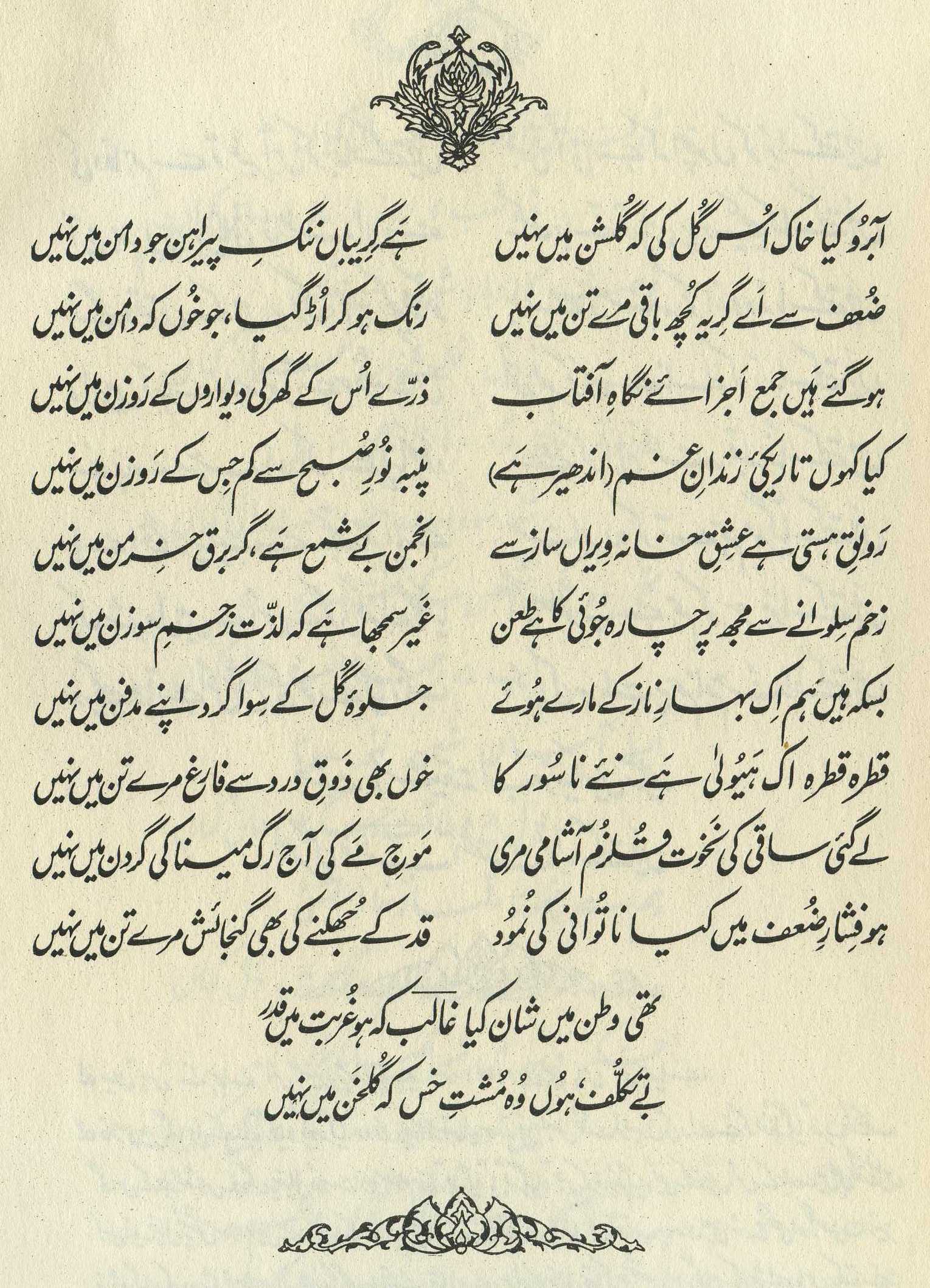
Where the darkness is great, even a very little bit of light seems to be a lot. From this we should understand how great would be the darkness in a cell in which cotton in the crevice-work resembles the whiteness of dawn. (86)
== Nazm page 86

In the extremity of grief, the world looks dark.... The darkness of the prison-cell of grief is a Doomsday! If cotton is put in its crevice-work, then it seems that the sun has come out. Where cotton would seem to be the sun, who can express the darkness of that place? (178)
Compare 113,4 . (221, 227)
[This verse resembles 113,4 ]. In both verses there's mention of a house, darkness, cotton, and crevice-work, and in both verses the cotton is the cause of light.... In both of them the state of darkness has not been expressed straightforwardly (for example, 'you can't see your hand in front of your face', etc.) but rather, by contrasting light with darkness, one has been caused to guess the degree of darkness.... In both verses, the cotton acts in a way contrary to its normal action-- that is, instead of preventing light, it is the cause of light....
[The phrase] has not come in only for wordplay with 'darkness', or to convey the intensity of darkness. By saying , Ghalib has gestured toward the difficulty of expressing reality.
The is that in the cell of grief, even cotton is not less than the light of dawn. That is, the glow of the cotton removes the darkness of the cell of grief. So how can it be conveyed that the cell of grief is very dark? Cotton is put into the crevice-work in order to prevent the outside light from coming inside. That is, if the cotton is removed from the crevice-work, even then the state of affairs will remain the same, because compared to the darkness of the cell of grief, the atmosphere outside is bright, and from the removal of the cotton the outside brightness will come into the cell of grief. Even so, the darkness of the cell of grief will not have been able to be expressed. This is more .
== ( 1973: 169-75 )
On the nature of the , 'crevice-work', see 64,4 ; the word is also used in the previous verse, 87,3 .
ABOUT the : Why would people put cotton into such 'crevice-work'? The only commentator who explains is Naiyar Mas'ud: 'Cotton is put into the crevice-work in order to prevent the outside light from coming inside'. (I would have guessed that it would be to protect against wind or rain, or to block the entry of small birds.) In any case, it seems to be assumed that rather large wads of raw cotton-- perhaps of the kind meant for stuffing pillows and quilts-- would be readily available in the household. (In 15,2 , a cotton pillow appears; in 211,8x , a weaving reference, and cotton in the ears; there's also 372x,2 , with a cotton stopper for a wine-bottle; and 383x,6 , in which that cotton stopper is used as an earplug.) Other verses that link crevice-work with cotton: 33,8x ; 113,2 ; 113,4 ; 195,3x // 266x,2 .
What exactly might be the relationship(s) between the cotton and the light of dawn? There seem to be three main possibilities: either (1) the white cotton impersonates the dawn; or (2) the white cotton rivals the light of day; or else (3) the cotton is as radically dark as the outside world.
(1) It is night outside, but in the cell of grief it is much blacker. So black that even the tiniest bit of whiteness looks exaggeratedly bright. If cotton is put in the crevice-work, even some tiny glimmer it might pick up from the ambient moonlight and starlight outside would make it look as bright as the white light of dawn that the sufferer awaits with such longing. (And in fact, to such darkness dawn may never come at all, so perhaps the cotton in fact is the sufferer's dawn-- all the dawn he'll ever get; on 'crack of dawn' imagery, see 67,1 .)
(2) It is morning, and there's light outside, but in the cell of grief this light remains merely notional. So little of it penetrates the dimness of the cell that it hardly makes any difference whether the crevice-work is blocked with cotton or not. The cotton seems to give a feeble, false, unhelpful glimmer-- and so does the morning sun. In fact, it's impossible to distinguish the wretched amount of 'light' that each of them provides.
(3) Night and day, the cell of grief is perpetually black; it generates its own darkness, and can never receive any 'light of dawn'. No moonlight or sunlight can penetrate into it, so the light of dawn has no effect on it whatsoever. It's so black that if you put cotton into the crevice-work-- which would normally prevent the dawn light from coming in-- it would make no difference at all, because the dawn light can't come in anyway. The light-blocking cotton is no darker than the equally dark dawn; both are powerless against the cruel, oppressive darkness of the cell of grief.
As the commentators point out, 113,4 is a useful comparative case study. And the word is of course perfectly chosen-- an altogether powerful and suitable word, full of affinity with other words and thoughts in the verse. For another example of the same kind of wordplay, see 164,10 .
graphics/humayun.jpg