Verse 9after 1826anme;N nahii;N
G1
1 a
my 'Red Sea'-drinking took away the Cupbearer 's pride
1 b
the Cupbearer 's pride took away my 'Red Sea'-drinking
2
today the vein of the wave of wine is not in the neck of the flagon
'Pride, haughtiness; consequential airs; pomp, magnificence'.
'(for ), the Red Sea'.
| References | |
|---|---|
| Arshi, Imtiyaz Ali | Ghazal# 102 |
| Raza, Kalidas Gupta | 370-71 |
| Hamid Ali Khan | Open Image |
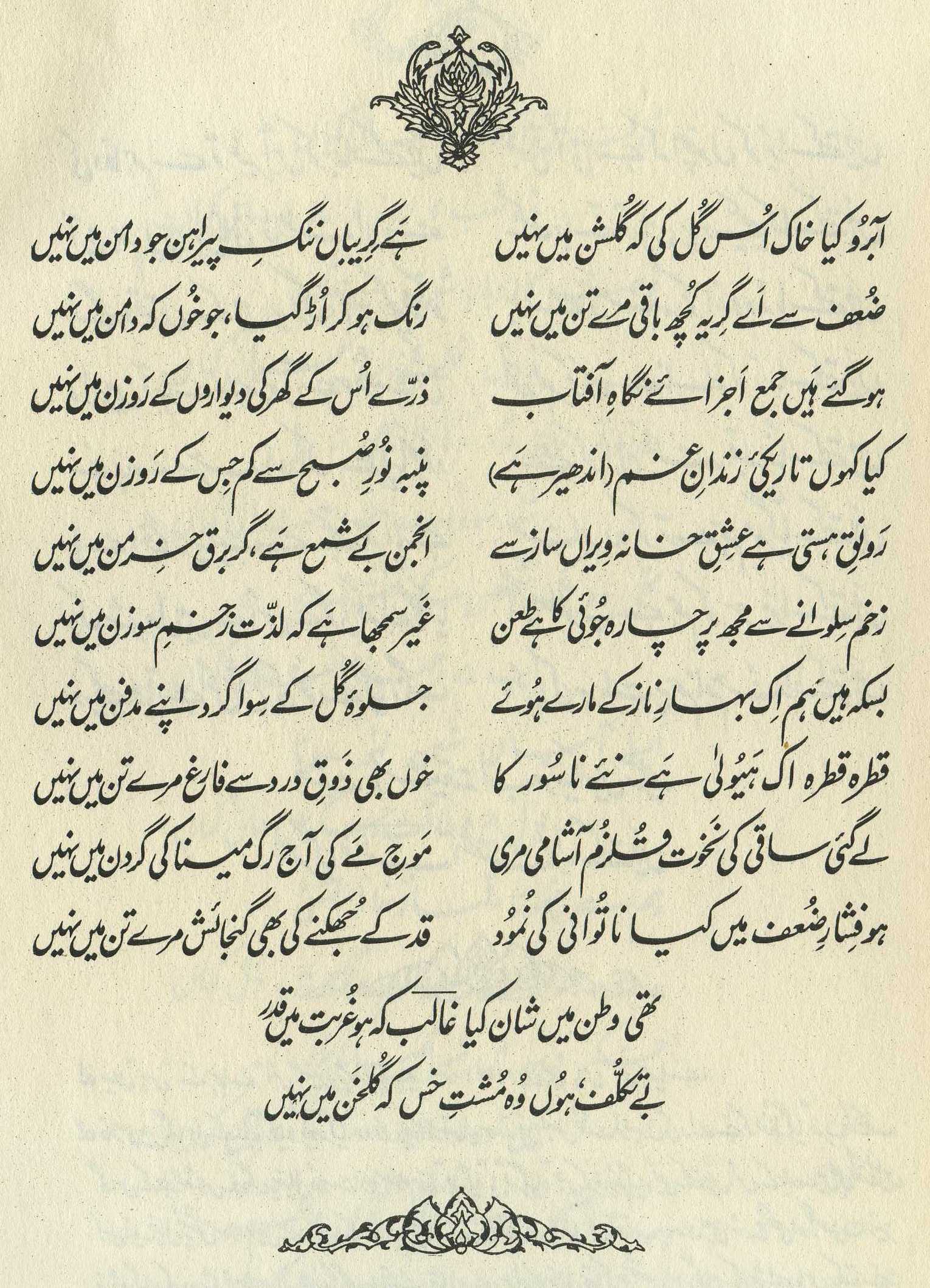
He constructs pride as the neck-vein, and in this construction there is a synecdoche []. He says, as long as there was wine in the glass, the Cupbearer was very arrogant, but my ocean-drinkingness-- that is, my heavy wine-drinking-- erased all his pride. Now the neck-vein of the flagon is on the verge of vanishing-- that is, no wave of wine has remained in any glass. (87)
== Nazm page 87

The Cupbearer used to show great arrogance in pouring out the wine, and was proud of it. But I was such an ocean-drinker that my devastating drinking erased the Cupbearer's pride, and all the wine in the glass was finished. (78)
The Cupbearer greatedly prided himself on the amount of wine in his wine-house. Wherever there was a flagon, in it the wave of wine had become a neck-vein and was expressing arrogance. Now there's no flagon in which a neck-vein can be detected-- that is, I emptied out the whole entire wine-house. There wasn't even a drop left in any bottle....
From the word 'today', the force of the verse has increased. And the narrative doesn't seem to be a mere story or long-ago tale-- rather, the mind of the listener becomes more attentive. The ruined wine-house and the empty glass begin to appear before the gaze. Just as Mirza has created more pleasure from the word in this verse: 60,9 . (179-80)
Well, here's another clear-cut case. All the commentators that I've looked at are willing to recognize only (1a). But just look at the structure of the first line-- a feminine singular verb, followed by two feminine singular nouns, and , each of which is capable of acting on the other. In view of the much greater flexibility of word order in Urdu (even in prose, not to speak of the classical ghazal), how is it possible that Ghalib wouldn't have wanted us to examine both 'A took away B' and 'B took away A'?
And once we do examine them, we immediately see how cleverly the second line is framed to connect to both readings. The commentators explain (1a): the speaker's ocean-drinking has destroyed the Cupbearer's pride so thoroughly that even the wine-flagons share his humiliation, for the vein of the wave of wine is not in the neck of the flagon. This of course means that the flagons are empty. But Nazm and Bekhud Mohani also maintain that since the flagons shared the Cupbearer's arrogance, now their emptied necks show that they share his humiliation as well. (A number of Urdu idioms depict pride as 'high-headedness'.) It makes for a nice example of wordplay.
And now consider (1b). Today the Cupbearer is being (irresistibly, coquettishly) petulant and cruel; For some reason he is cross with the speaker. In his arrogance the Cupbearer has stamped his little foot and denied the speaker his usual oceanic flow of wine. For the Cupbearer to be derelict in his duty is not all that unusual; see for example 21,6 ; or 30,1 ; or 97,5 .
Because today, on either reading, the Cupbearer is not constantly serving wine to the speaker, we should imagine the flagons as not being constantly tilted over and poured into glasses. The idea of a 'wave of wine' suggests redness, flow, and movement, like the idea of a 'neck-vein'. And when is the 'neck' of a flagon fuller of ruby-red 'blood' than when the wave of blood-red wine is being rapidly poured out? This pattern of imagery suggests that the life of a flagon is a brief one, and that the flagon never has more vitality, or a richer flow of arterial blood (thus the 'Red Sea' image), than when it is in the act of being poured out-- or pouring itself out, if we credit the flagon with agency.
Wouldn't the verse be sadly limited, if we only considered (1a)?
Here is a look at the real Red Sea:
graphics/redsea.jpg