Verse 11after 1826anme;N nahii;N
G1
1
what glory was there in the homeland, Ghalib, that there would be esteem abroad?
2
{without formality / 'to tell the truth'}, I am that handful of straw that is not in the stove
'Without ceremony, unceremonious, frank'.
'A fire-place (in a bath, &c.); a stove; a furnace'.
| References | |
|---|---|
| Arshi, Imtiyaz Ali | Ghazal# 102 |
| Raza, Kalidas Gupta | 370-71 |
| Hamid Ali Khan | Open Image |
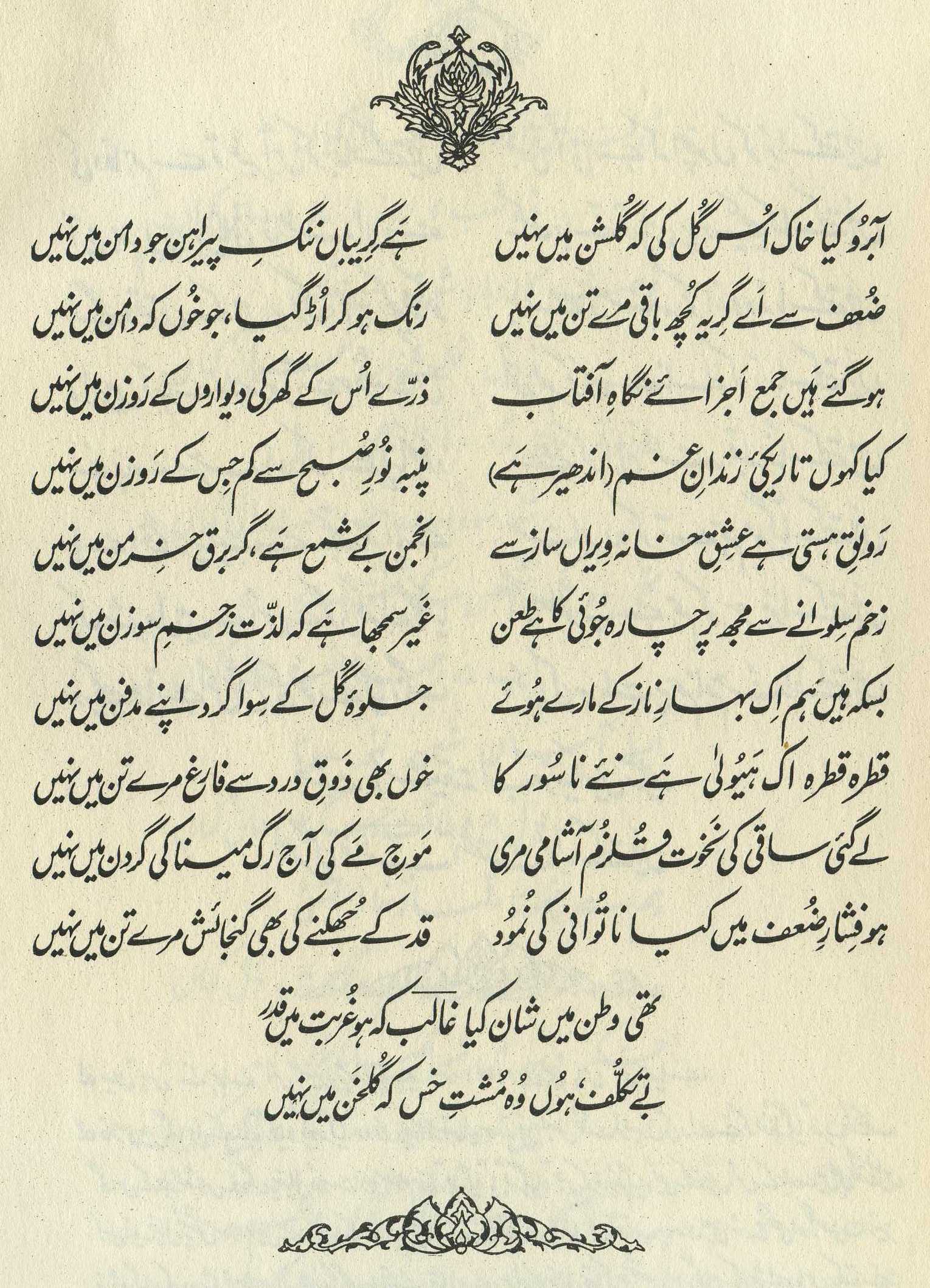
He has given as a simile for himself straw (that is, dried grass, etc.); and for his homeland, the stove. That is, the way when a straw is in the stove it burns, and when it is not in the stove it receives no honor-- that’s exactly my situation: when I was at home I burned, and now when abroad I receive no honor.
==Urdu text: Yadgar-e Ghalib , pp. 145-46
At home, vileness confronts him; and abroad, disgrace. For him, if there's radiance and glory, then it's in the stove. [There are complex mystical implications in this verse.] In this verse, the word is not devoid of [=care, elaborateness, taking pains]. (87)
== Nazm page 87

Compare 64,5 . (228)
Since Ghalib has used the theme of straw and furnace in another verse, 113,7 , it's undeniable that there's some connection of meaning too between the two verses.
[Most commentarial readings have the problem that a stove can't be called the 'homeland' of a handful of straw, but only its execution-ground.] It's clear that there's not the same relationship between a handful of straw and the furnace, as there is between a rose and the garden.
Let's assume that it would be said like this: 'Since in the homeland I received no honor, then abroad who will care about me? If only I were a handful of straw that would be thrown into the stove and lit! Now I'm like the handful of straw that people kick aside as they pass by.' As if in the first line he has not considered himself a 'handful of straw', but rather in his individual capacity has said 'I receive no honor'. Then in the second line he has longed to be a handful of straw. In this way the interpretation emerges properly, but the images of 'handful of straw' and 'stove' don't seem indispensable-- rather, they seem artificial and and contrived. It feels as though instead of a handful of straw and the stove, something else, such as a leaf and the tree, a sand-grain and the desert, could also have been said.
If the word is taken in the sense not of 'stove, fireplace, grate', but of 'rubbish-heap' [], then the matter at once becomes clear, and the second line too becomes absolutely indispensable. The original and proper place of a bit of rubbish is the rubbish-heap; that is its homeland. A handful of straw receives no honor in the rubbish-heap, but at least it lives in its homeland. [Outside, it receives no honor either, but only ill-treatment.] It's as if I was a handful of straw; I was without esteem, cheap, vile, in the rubbish-hea;-- but I was at least in my home. Now I am abroad-- that is, since I am outside the rubbish-heap, not even that much honor has remained.
== (1989: 109-11) 2004: 132-33
Faruqi takes the verse purely negatively: the speaker is disdained at home and receives no respect abroad, so he's like a handful of straw that is mere ignored rubbish when it's at home in the rubbish-heap, and also mere kicked-aside rubbish when it's anywhere else. For Faruqi, the advantage of this reading is that it gets over the problem present in Hali and other commentators: that they say the 'homeland' [ , with usually the sense of 'native land' or 'birthplace'] of a handful of straw is in the stove; but this is wrong, for only its death takes place there. But his own reading has the same problem: a rubbish-heap is not the native 'homeland' of a handful of straw either, for the straw was after all 'born' in a grassy field.
To bolster his reading, Faruqi specifically enjoins us to understand by not its normal meaning in both Persian and Urdu of 'stove' (or furnace, or fireplace, or grate), but the purely metaphorical meaning of 'rubbish-heap'. I don't see any objection to such a metaphorical leap, but surely it should remain secondary; it shouldn't be allowed to supplant the primary meaning of an important and well-known word like .
As usual, our best source of interpretive material consists of other examples of Ghalib's use of flame and straw. In 21,5 the of a flame in straw is described as brief, but the very word makes the flame a source of 'illumination, light, brightness, splendour; flame; --glory, fame, honour'. In 64,5 , the of the fortune of wood-chips depends on the . In the verse that Faruqi himself cites, 113,7 , it's made clear that the straw belongs in the exactly the way the rose belongs in the garden (that is, each is alienated when outside its proper environment). To reject the clear implication in of burning as a glorious destiny, or at least as a moment of brilliant release from a life of humiliation, seems unduly arbitrary. After all, a stove may be a metaphorical rubbish-heap, but it's also far more clearly a stove, and Ghalib often presents it as such.
So how might we put the verse together? Everybody agrees on the wryness and negativity of the first line: the speaker had no honor in the homeland, why would he have any honor abroad? (That is to say, he doesn't, of course.) He is out of place, alienated, dishonored everywhere. No matter where he goes, he is like a handful of straw that is not in the stove. In the stove, the handful of straw receives perhaps a kind of grudging 'honor' for its usefulness as kindling, but more to the point, it receives a glorious, furiously flaming death (like that of the Moth ), a in its fortune that is far more desirable than a continuation of its alienated, despised, useless life. The thought of the is part of what makes life everywhere else so intolerable.
As Nazm points out, the word is not devoid of . Idiomatically, when introducing a sentence, it means something like 'to tell you the truth', or 'just between you and me', or 'not to mince words'. (For more on the complexities of , see 25,1 .) So it's appropriate for introducing a line in which the speaker claims to be a handful of straw. But also, technically the word is an adverb, and nothing is more , more devoid of formality, ceremony, elegance, than the treatment of a handful of straw. It either burns in the stove, or else it gets trodden upon by every passerby until it finally rots away. These are the choices of a handful of straw, and how much better are they than the lover's own? (Remember 20,7 .)
graphics/straw.jpg