Verse 3after 1826anme;N nahii;N
G1
1
they have become consolidated/settled-- the parts of the gaze of the sun
2 a
those are not dust-grains in the crevice-work of the walls of her house
2 b
there are no dust-grains in the crevice-work of the walls of her house
'To be collected, combined, or united; to consolidate; ... to be firmly placed, be settled, be located, be seated; to cohere, adhere, stick, cling together; to stand fast, be rooted (to a spot, &c.)'.
| References | |
|---|---|
| Arshi, Imtiyaz Ali | Ghazal# 102 |
| Raza, Kalidas Gupta | 370-71 |
| Hamid Ali Khan | Open Image |
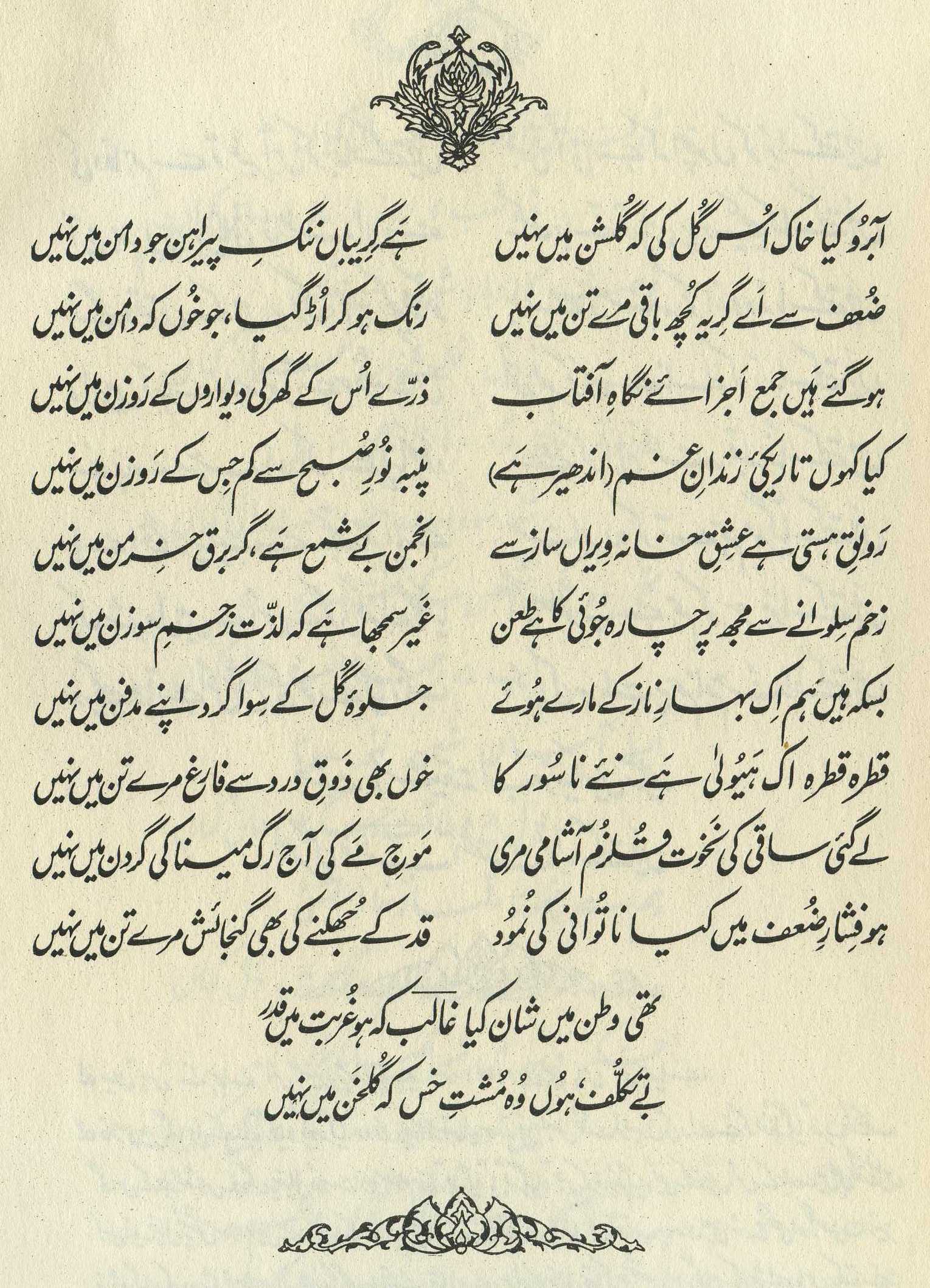
That is, even the sun has an ardor for staring at her. (86)
== Nazm page 86

About the many dust-grains that can be seen in the light of the sun-rays that enter the beloved's house through the crevice-work in the wall, he says it's as if they are pieces of the sun's gaze that are ardent for a pilgrimage to the beloved's face. (78)
In the crevice-work of the beloved's walls, these are not glittering dust-grains; rather, they are pieces of the glance of the sun. That is, the sun wanted to look at the beloved's face, but his glances remained scattered, and he could not summon the strength for vision. The pleasure is that worldly people's gaze can't behold the sun, and becomes scattered. But the beloved is so beautiful that the sun's glances become scattered. As Ghalib says, 158,7 .
It is also worth noticing that Mirza did not say 'wall of the house', but rather 'crevice-work of the walls of the house'. From this the sun's ardor for sight is manifest: wherever there was a hope of seeing her radiance/appearance, there the sun's rays, in their ardor for sight, arrived. (178)
A theme of just this kind is present in a verse of Hazrat Dagh . But the world of expression is absolutely different. He says:
[the pupil of the eye of some ardent one has settled there--
I won't agree that on your cheek is a beauty-spot]
The theme of too is used with just such supremacy as in Mirza's verse. (176)
On the nature of the , 'crevice-work', see 64,4 ; the word is also used in the next verse, 87,4 .
The idea that vision happens when the beholder's eye emits beams that fall on the object beheld, is called the ' emission theory '; it goes back to the Greeks, and finds believers even today (though it is scientifically incorrect). I thank David Lelyveld for pointing this out (Dec. 2020).
The possibilities of this verse hinge on the subtleties of negation in the second line. Since (by no coincidence, of course) we can't tell whether it lacks a subject and verb, as in (2a), or only a verb, as in (2b), both readings are possible:
(2a) Those things that are visible in the crevice-work of the walls of her house are not dust-motes. There may seem to be dust-motes dancing in the shafts of sunlight coming in through the crevice-work, but what they really are is fragments of the sun's gaze that have all gathered there.
(2b) There are no dust-motes in the crevice-work of the walls of her house. No dust-motes are visible in the shafts of sunlight coming in through the crevice-work, because all those bits of earthly dross have been burned away or otherwise displaced by the sun's concentrated gaze, which will brook not even the smallest interference. Or: no dust-motes can be seen because those small glittering points of light have now come together as a pure concentrated solar gaze.
graphics/sundust.jpg