Verse 10after 1826anme;N nahii;N
G1
1 a
in the pressure of weakness, what a display of feebleness there would be!
1 b
in the pressure of weakness, what-- would there be a display of feebleness?!
1 c
in the pressure of weakness, would there be a display of feebleness?
1 d
in the pressure of weakness, what display of feebleness would there be?
2
in my body there’s not capacity/scope even/also for the stature to bend/bow
'Squeezing, pressing (with the hand); compression, constriction; --a scattering; diffusion'.
'The being or becoming apparent, visibleness; appearance; --prominence, conspicuousness; --show; --affectation; -- display; --pomp'.
'Holding, containing; room, capacity; room to contain, stowage'.
| References | |
|---|---|
| Arshi, Imtiyaz Ali | Ghazal# 102 |
| Raza, Kalidas Gupta | 370-71 |
| Hamid Ali Khan | Open Image |
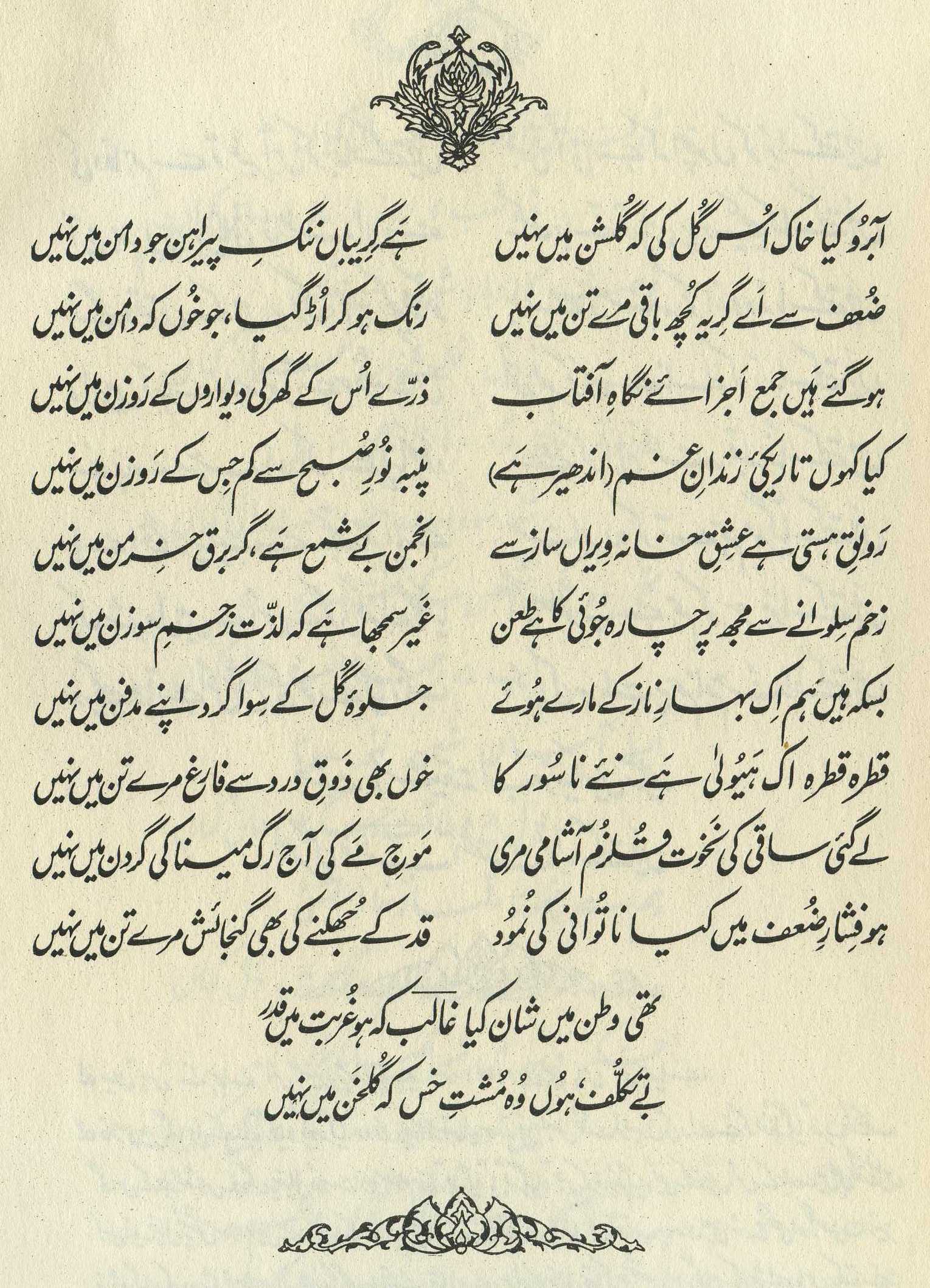
The meaning is that weakness grinds me down from all directions-- if my stature is to be bowed/bent, then how is it to be so, and in which direction would it bend? (87)
== Nazm page 87

On the theme of weakness, a number of poets have made use of themes with extremely delicate and refined rhetorical taste. Momin says:
[now even to die is difficult for your sick one
because of weakness, how can one move on from the world?] (78-79)
He says, weakness is so wringing me out that I don't even get an occasion for the expression of feebleness. That is, the bowing/bending of the stature is a symbol of weakness, but weakness has crushed me from all directions. Now there's not even scope left for the bowing/bending of my stature in any direction. (138)
This is a verse that takes excellent advantage of the rhetorical possibilities of . Whichever reading of the first line we adopt, it goes wittily and cleverly with the second line:
(1a) In the pressure of weakness, what a display of feebleness there would be! Why, there would be the astonishing spectacle of someone who was so utterly and symmetrically oppressed by weakness that his body, equally pushed from all sides, wouldn't even be able to become bent or stooped (in any one direction)! What greater display of feebleness could be imagined? (This is the meaning the commentators generally provide.)
(1b) In the pressure of weakness, what-- would there be a display of feebleness?! Why of course not, there's not the slightest chance of it! (This is a negative rhetorical question.) Everybody knows that being bent or stooped is the classic sign of bodily feebleness. The speaker's feebleness is so extreme that it can't even be displayed, because since weakness pressures him so omnidirectionally, his body can't even bend. So how can there be such a 'display'? There can't, of course!
(1c) In the pressure of weakness, would there be a display of feebleness, or not? (This is a yes-or-no question.) The speaker reflects on the matter judiciously, looking at the question from both sides, and finds it hard to decide. He appeals for information from anybody with special insight. After all, it's not an easy question to answer. If the body isn't visibly bent or bowed, what does that mean?
(1d) In the pressure of weakness, what kind of display of feebleness would there be? (This reading treats as adjectival.) The speaker wonders what form a display of feebleness might take.
My own favorite reading is (1c), the least showy and dramatic of the four. It's the one that invites us to consider the nature of the question itself. If a 'display' (or show, or manifestation) is normally something apparent, a visible sign, can there be a 'display' that takes the form of the absence of such a tangible sign? The question reminds me of Sherlock Holmes's observation of the 'curious incident of the dog in the night-time '.
What's really at issue here is the nature of . It's part of Ghalib's genius to be able to take perfectly simple traditional ingredients, and apparently straightforward traditional grammatical patterns, and make of them thorny, indigestible, astonishing little things that you can reflect about for the rest of your life.
graphics/bentback.jpg