Verse 71816anme;N
G2
1
I wouldn't know, am I virtuous or am I evil, but the company [around me] is contrary--
2
if I'm a rose, then I'm in the furnace; if I'm straw/rubbish, then I'm in the garden
'Companionship, society, company; an assembly, meeting, association; a fair; discourse, conversation, intercourse'.
'Contrary, opposite, adverse; unfavourable, unsuitable, uncongenial; repugnant, dissentient [=dissenting]; contradictory'.
'A fire-place (in a bath, &c.); a stove; a furnace'.
'Any useless herb or stick, rubbish of sticks or thorns'.
| References | |
|---|---|
| Arshi, Imtiyaz Ali | Ghazal# 91 |
| Raza, Kalidas Gupta | 209-210 |
| Nuskhah-e-Hamidiyah | 158-159 |
| Asi, Abdul Bari | 166 |
| Gyan Chand | 268-269 |
| Hamid Ali Khan | Open Image |
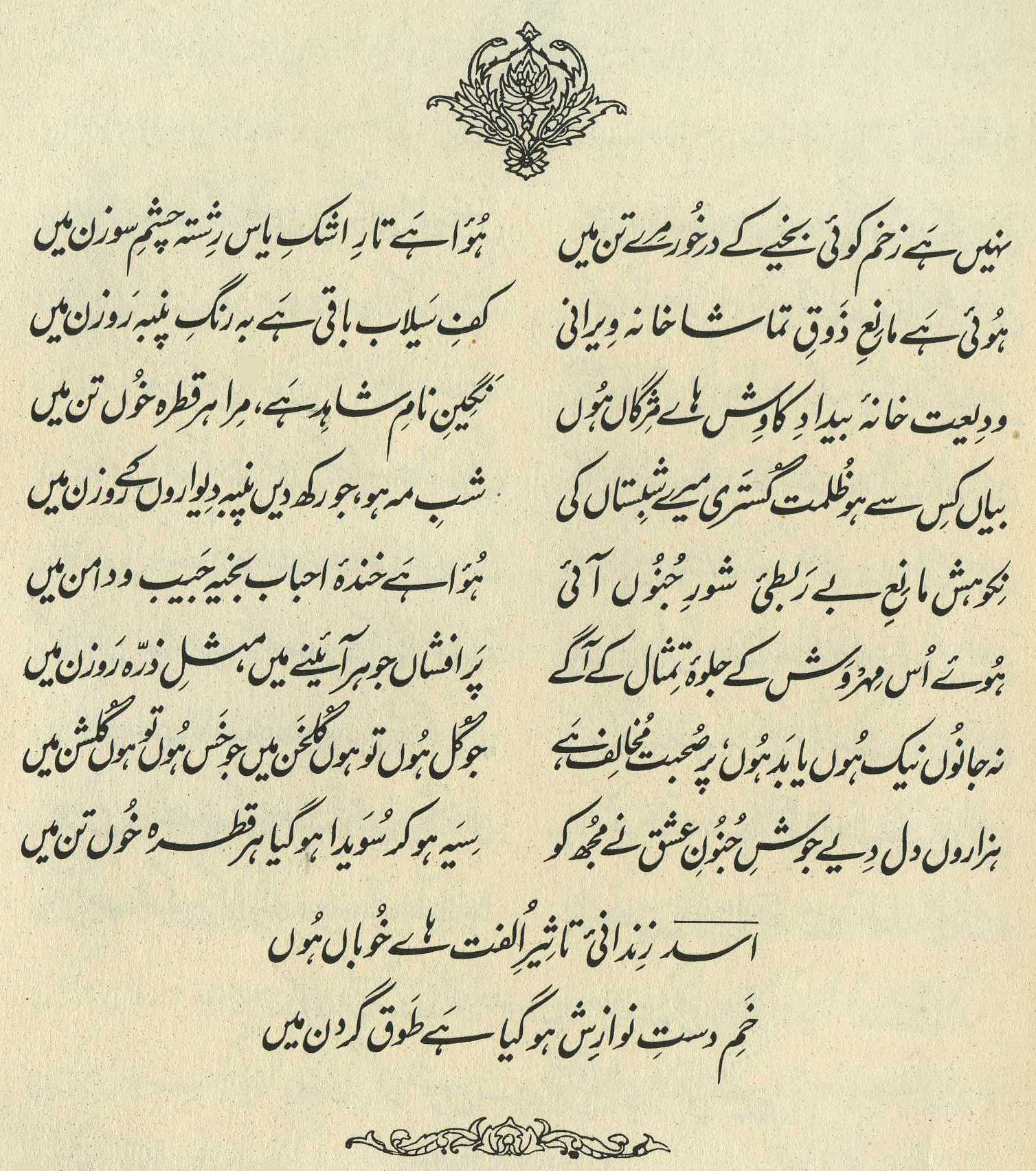
The rose finds its springtime by remaining in the garden, and the straw finds its show of glory in the furnace. If the rose is in the furnace, then it's useless; and if the straw is in the garden, then it's a burden. And my state too is that of 'contrary company'. (122)
== Nazm page 122

He says, 'I can't tell at all whether I'm good or bad, but I've been destined for the company of contrary men. That is, if I'm a flower, then I'm in the oven; and if I'm dry grass, then I'm in the garden.' (172)
It wouldn't be strange if Mirza had composed this verse in Calcutta, when he was quarreling with Qatil's pupils ....
I don't know whether in the eyes of God I'm good or bad, but I certainly know that if I'm good, then this world is a hell for me... and if I'm bad, then this world to me is Paradise. Because in comparison to the pain of Hell, the pain of the world is better than the repose of Paradise. (230)
[See the reference in 87,11 .]
Bekhud Mohani makes a stab at a biographical explanation, but unfortunately for his intuitions, the verse dates from more than ten years earlier than the Calcutta trip. (These problems are common with such well-meant but unhelpful attempts to take a 'natural poetry' approach to the classical ghazal.) For a brief survey of the Calcutta trip and the quarrels over Qatil, see Russell and Islam , pp. 45-50.
In fact, Ghalib has a number of verses expressing alienation from his surroundings; see 62,2 for a prominent example.
But surely the real charm of this verse is its lovely wordplay. It offers us: and , and , the obviously spectacular set and , and even and . And all these resonances are achieved with what seems to be an effortless simplicity.
Moreover, if we consider the larger structure of the verse, it's clearly framed to be repetitive, rhythmic, and also reflective of a kind of confusion. The first line sets up a radical uncertainty-- the speaker claims not to know whether he's good or bad. The only thing he's really certain about is that he's in the wrong place. Then, in true mushairah style, we have to wait to hear more about this intriguing notion.
In the second line, we find the speaker's situation presented with the plodding explicitness of somebody trying to make sense of a riddle. The line falls into two parallel halves with identical grammatical structures. And what structures! Ghalib has contrived to use 'am' [] no fewer than four times in the second line, and twice in the first line, although he could easily have reduced the number. This occurrence of the same word six times in a single verse is surely a record. The effect of all this repetition is laborious and, paradoxically, uncertain. The speaker doesn't at all know what he is (good? bad? rose? straw?), or where (furnace? garden?), and the more he tries to explain his dilemma, the more confused he sounds.
He almost sounds like someone with amnesia, or someone awakening from a coma. Everything around him is confusing, and he feels thoroughly bewildered. The only thing that emerges with clarity, and that only needs to be firmly stated once, is that he's in the wrong place, the wrong company-- everybody around him is hostile and/or repugnant and/or 'contrary' (see the definition above). He finds himself in a kind of nightmare society. Is it his fault (is he 'evil'?), or theirs? Is he better than they, or worse? It hardly matters. Either way, in such society he'll always be alone.
Compare Mir 's evocation of his own out-of-place existence: M 1679,9 .
graphics/rosefire.jpg