Verse 61816anme;N
G2
1
before that sun-faced one's glory/appearance of resemblance
2
the polish-lines in the mirror became wing-fluttering, like/resembling dust-motes in crevice-work
'Resemblance, likeness, picture, portrait, image, effigy'.
'Essence, matter, substance, constituent, material part (opp. to accident), absolute or essential property; skill, knowledge, accomplishment, art; excellence, worth, merit, virtue; secret nature; defects, vices; — the diversified wavy marks, streaks, or grain of a well-tempered sword'.
| References | |
|---|---|
| Arshi, Imtiyaz Ali | Ghazal# 91 |
| Raza, Kalidas Gupta | 209-210 |
| Nuskhah-e-Hamidiyah | 158-159 |
| Asi, Abdul Bari | 166 |
| Gyan Chand | 268-269 |
| Hamid Ali Khan | Open Image |
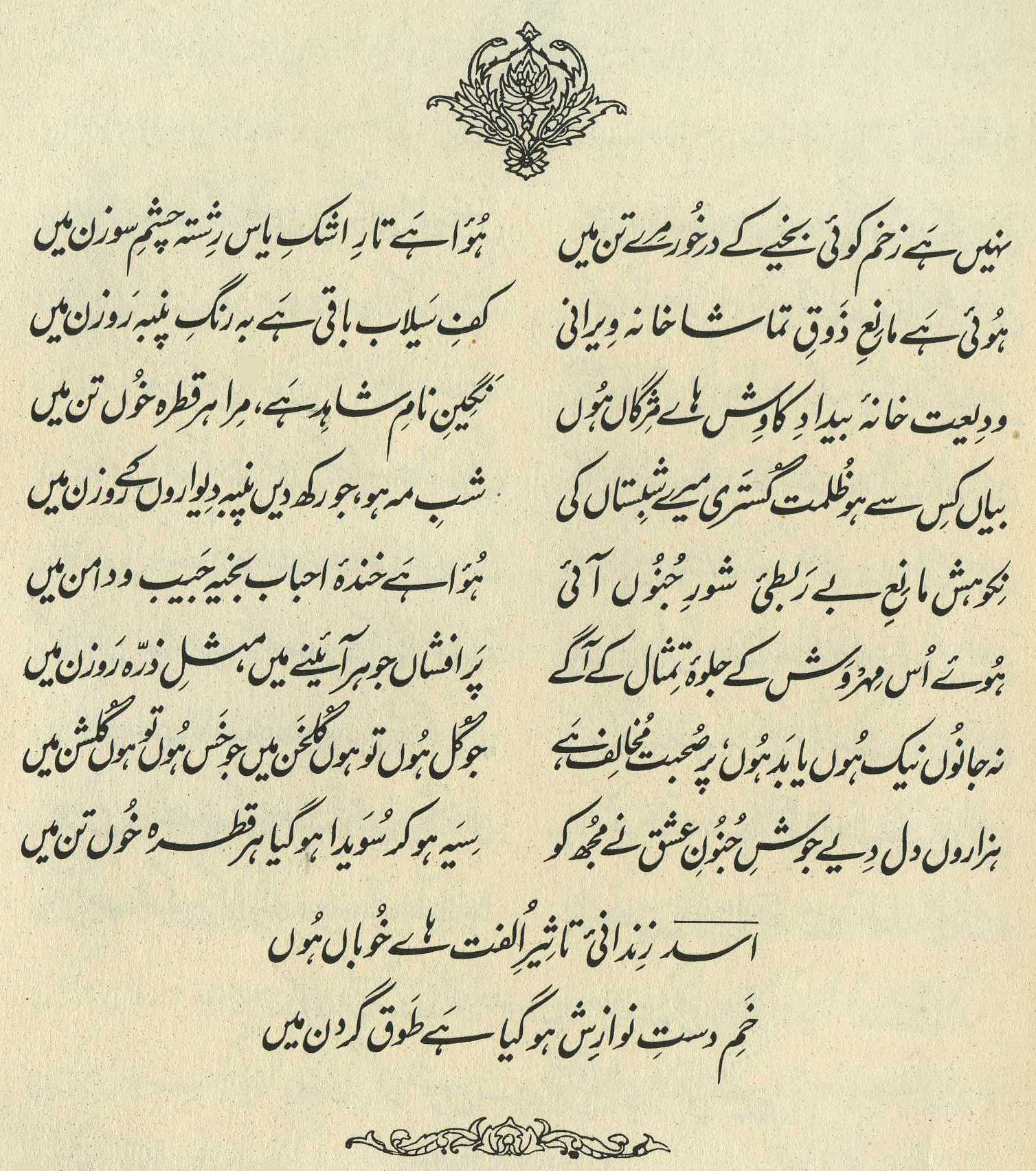
The subject of 'became' is 'polish-lines', and 'wing-fluttering' is adjectival. The gist is that the way when a ray of sunlight falls, the dust-motes in the crevice-work are wing-fluttering, in the same way from the reflection [] of that sun-faced one, the polish-lines in the mirror are wing-fluttering. (122)
== Nazm page 122

The way when rays of sunlight fall on them, dust-motes in the crevice-work writhe around, in the same way the polish-lines in the mirror, when the reflection fell on them, became restless or began to dance. That is, the radiance/appearance of the beloved has an effect on everything-- so much so that it even affects a metal [] mirror (because polish lines are only in a metal mirror). (229)
The point has been brought out that before the glory of the beloved, the mirror is crushed. Its began to fly away; without its , the mirror does not retain the power to reflect. (The taking flight of the is like the taking flight of color from the face, and so on.) This point is fine, although the peerless image in the second line does not manage to be entirely in harmony with it. Now please consider the following things:
1) When the sun's rays fall on dust-grains, they seem to move. In the second line the sun's rays have nowhere been mentioned, but the idea seems entirely clear, because in the first line 'sun-faced' has been used....
2) When it received the reflection of the beloved, the mirror's color did not take flight; rather, the mirror became brighter, the way cloudy dust-motes are seen as illumined by the effect of the sun's rays. The mirror's polish-lines became dust-motes and began to fly away. The rays of reflected glory illumined those dust-motes. When the illumined dust-motes were reflected in the mirror, the mirror became brighter.
3) The beloved's beauty has a magnet-like pull. When the radiance falls on the mirror, the grains of the polish-lines, fluttering their wings, try to emerge and move toward the beloved. In the same way a ray of sun too has a pull. When it falls on the dust-motes in the crevice-work, the dust-motes can be seen to move, as if they are being drawn toward the sun....
4) The dust-motes in the crevice-work were lifeless. Under the effect of the sun-rays they seemed to move, as if the rays had given them life. Similarly, the moment that the beloved's reflection fell on them, in the dead (unmoving) dust-motes life appeared.
5) The nearness of beauty makes the heart restless. This testimony is common in eastern and western poetry. The way the nearness of a sun-ray makes the dust-motes restless and quivering, and they are seen fluttering and taking flight, in the same way the nearness of the beloved's beauty has made the polish-lines on the mirror moving and restless: see 29,2 .
6) It was only one sun-ray that gave life to the dust-motes of the crevice-work. If the light of the whole sun had fallen on them, then the Lord knows what would have happened! Similarly [with the beloved and the mirror]....
[Another meaning can be elicited that somewhat resembles that of 87,3 .]
== (1989: 191-93) 2006: 213-15
Faruqi suggests comparison to 87,3 . I would add 17,4 , in which the polish-marks want to become eyelashes, which also flutter like wings.
Dust-motes in shafts of bright sunlight appear to dance; this would be especially the case in the openings in the crevice-work [], which would put the dust-motes in a series of small 'spotlights' surrounded by the darker inner wall of the room. Dust-motes are lively, insubstantial, casual, quivering, hovering, darting here and there with every tiny breath of air. They are the very essence of unattached, delicate, floating responsiveness. On the nuances of , 'crevice-work', see 64,4 , and the earlier references in this ghazal.
Polish-marks [] on a metal mirror are the complete opposite of dust-motes in crevice-work: they are static, metallic, incised, confined, linear, immutable, produced deliberately by hard scrubbing. They are the very essence of durability, stolidness, rigidity, one-dimensionality.
Crevice-work in a wall is open, transparent, and in no danger of degradation in quality; a metal mirror is closed, opaque, and subject to verdigris that requires constant scrubbing to keep it at bay.
Yet Ghalib has shown us affinities between dust-motes and polish-marks, crevice-work and mirrors-- because of further, more fundamental affinities between the beloved and the sun. The commentators have explained these, and it's clear how it all fits together: in their mutual relationships the beloved's likeness to the sun endows the polish-marks on the mirror with a likeness to the dust-motes in the crevice-work.
In the first line, we have as a quality of the beloved's; in the second line, from the same root we have . To say that something is something else is so common an expression for 'like' or 'resembling' that it's normally almost invisible. But here, it is foregrounded by the prominence of its cousin in the first line. The beloved's glory/appearance of, or for, 'likeness' or 'resemblance' is what sets all lesser likenesses or resemblances going. Thanks to the multivalence of the , she has a glory/appearance 'of' resemblance (to the brilliance of the sun); or even possibly a glory/appearance 'for' resemblance, a power to generate or invite or compel in the polish-marks a resemblance to dancing dust-motes-- that is, to some of the least plausible simile-material that could possibly be adduced for them.
Or, even more radically, the beloved might be 'sun-faced' [] not as a resemblance at all, but in the most literal sense: her face might act as the sun, or even be the sun; perhaps there is no other sun than her face. So her glorious power of inducing resemblance might be the only life-force in the universe, as her beauty transmits life and elicits life-like behavior from everything within its range.
graphics/dustmotes.jpg
graphics/palebluedot.jpg