Verse 41821aa;Nhonaa
G5
In this meter the first long syllable may be replaced by a short; and the next-to-last long syllable may be replaced by two shorts.
1
{since / to such an extent} glory/appearance makes a claim of a look/gaze
2
even/also the polish-marks on the mirror want to be eyelashes
'Manifestation, publicity, conspicuousness; splendour, lustre, effulgence'.
'Look, glance, sight, view, regard; consideration; --look, aspect (of); --watching, observation, attention; --custody, care'.
is an archaic form of ( GRAMMAR)
| References | |
|---|---|
| Arshi, Imtiyaz Ali | Ghazal# 23 |
| Raza, Kalidas Gupta | 327-328 |
| Nuskhah-e-Hamidiyah | 69-70 |
| Hamid Ali Khan | Open Image |
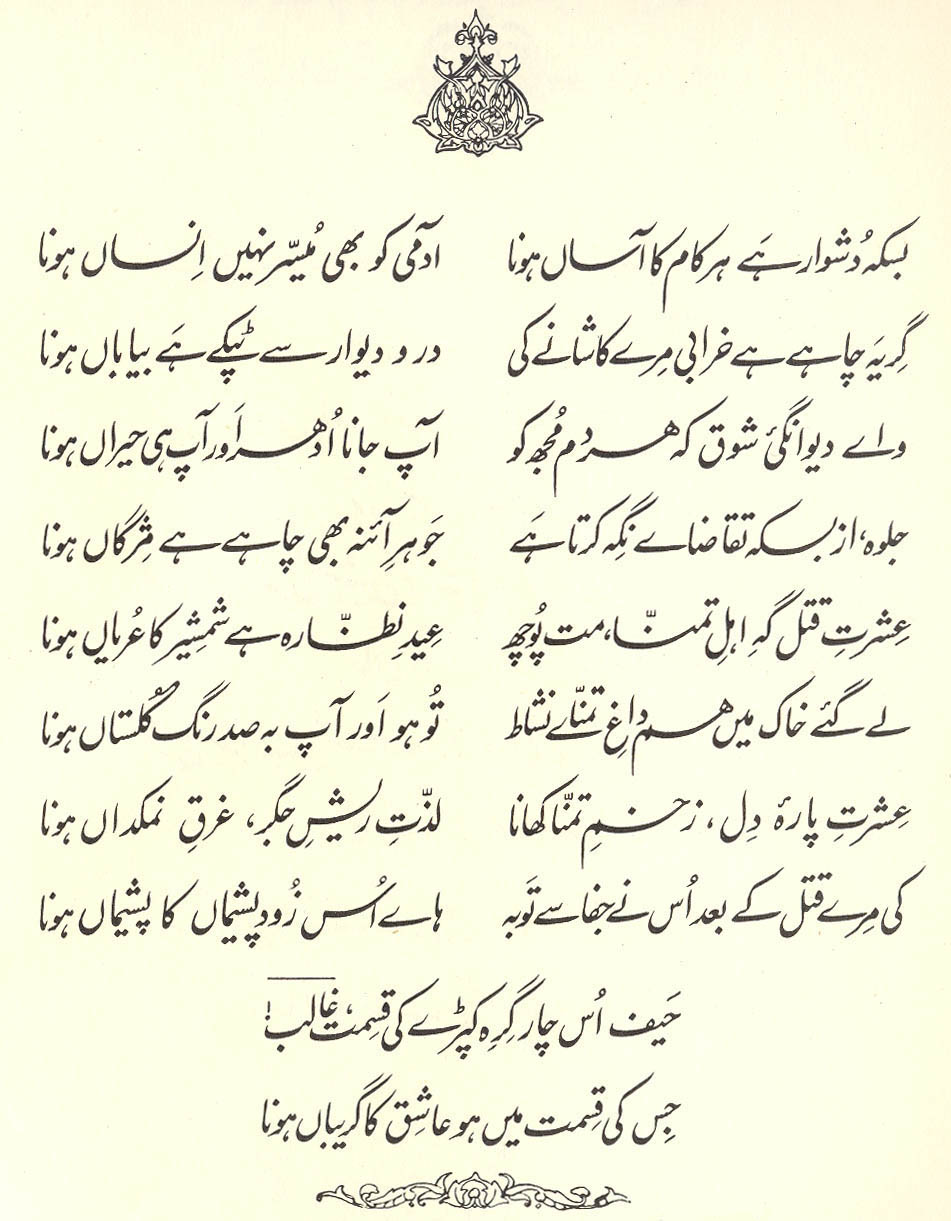
That is, when the radiance/appearance of her beauty is saying, 'Look at me', then the mirror wants to become an eye, and the polish-mark wants to become an eyelash. The simile of eyeball for mirror is a famous theme , and here by 'mirror' an iron mirror is intended, which has polish-marks. (18)
== Nazm page 18

Seeing the power of the radiance/appearance of the beloved to create an ardor for sight, even the polish-line on the mirror wants to become an eyelash. That is, if I cannot myself see like the eye of the mirror, then let me become a part of the seer. (41)
This verse is an extremely fine example of theme-creation , but the pity is that loftiness of thought has killed off poetic-ness []. (301)
Why is a polish-mark on a metal mirror like an eyelash? Because both are part of a set of many small fine linear things; and because the polish-mark results from the cleaning that keeps the mirror bright, while the eyelash protects the eye from dust and dirt. A mirror held up to the beloved's face seems to draw near in eagerness to 'see' her; an eye would seek to approach her face for the same close view.
Compare 230,4 , in which the mirror goes even farther in its rapture at the sight of the beloved.
graphics/eyelashes.jpg