Verse 11821aa;Nhonaa
G5
In this meter the first long syllable may be replaced by a short; and the next-to-last long syllable may be replaced by two shorts.
1 a
it's difficult to such an extent for every task to be easy
1 b
although it's difficult for every task to be easy
2
even/also for a human, it's not attainable/attained/easy to become humane
'although'; [also short for:]
'To such an extent that; --inasmuch as, whereas'.
'A descendant of Adam; a human being; man; individual, person; adult; a sensible, or honest man'.
'Rendered easy, facilitated; easy, feasible, practicable; favourable; --ready, prepared; --obtained, attained; attainable, obtainable, procurable: -- or (- ), To be attained, or attainable (by); to come (to), to be within the reach (of)'.
'Man, mankind, human being, mortal (= )'.
| References | |
|---|---|
| Arshi, Imtiyaz Ali | Ghazal# 23 |
| Raza, Kalidas Gupta | 327-328 |
| Nuskhah-e-Hamidiyah | 69-70 |
| Hamid Ali Khan | Open Image |
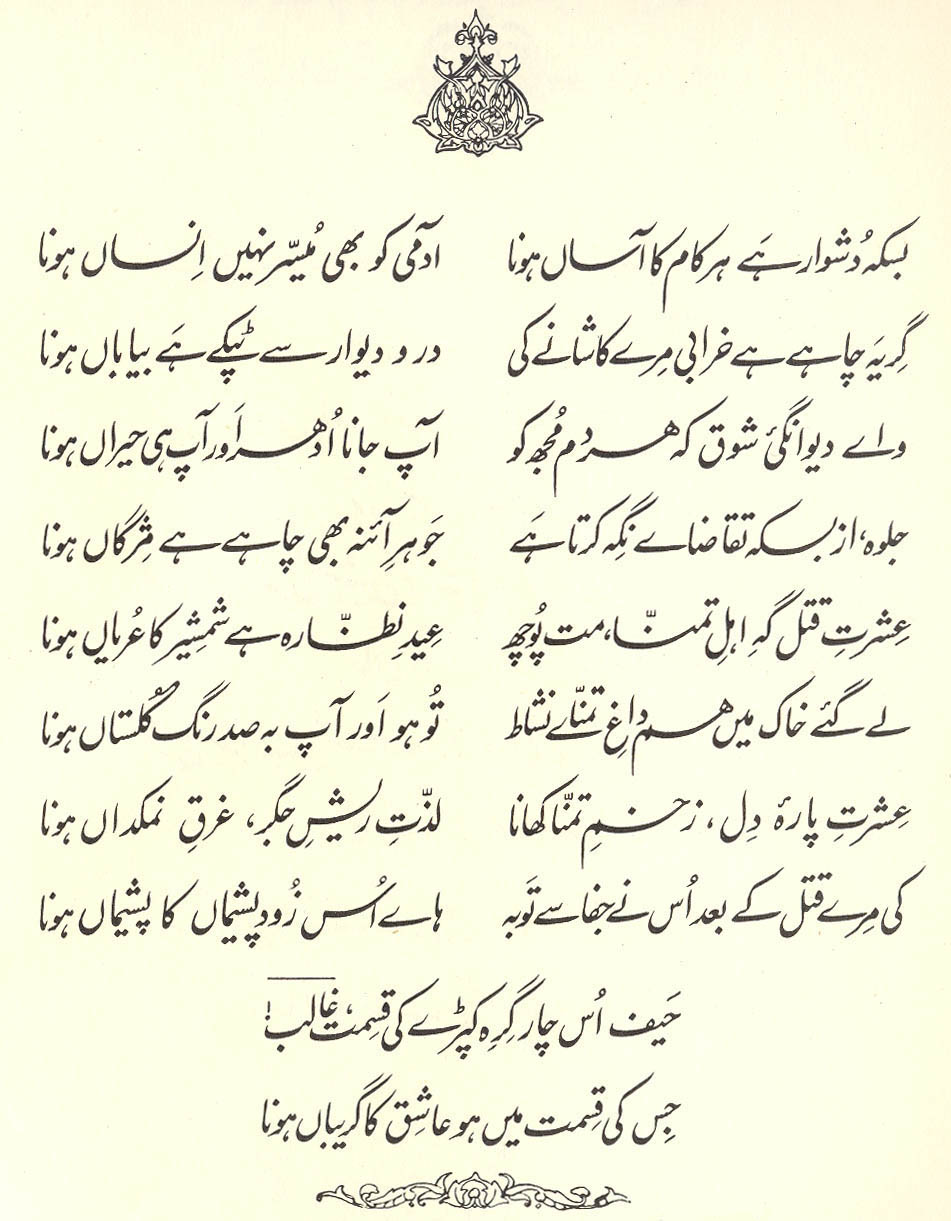
At first glance, this seems a commonplace idea; but if examined attentively, it is an entirely unprecedented thought. The claim is that in the world, even the easiest task is difficult. And the proof is that man, who by definition is human-- even for him to become human is difficult. This is not a logical proof; rather, it is a poetic proof, a proof better than which no poet can offer.
==Urdu text: Yadgar-e Ghalib , p. 120
That is, to reach the rank of complete humanness [] is not simple. (17)
== Nazm page 17

No task in the world is easy. Thus for a man to create human [] qualities and become a 'perfect human' [] is not at all possible. Because a 'perfect human' is one in whom divine morality of a lofty order would be found. (40)
[See his discussion of M 302,3 .]
[Also, in another connection the subject came up, and Faruqi offered (June 2020) the following thoughts:]
The distinction between admi and insan has always been there, though it wasn’t perhaps so tellingly expressed before Ghalib. Admi was supposed to mean an ordinary human being, of light brown (gandum gun) complexion, and made of clay, etc. Insan was supposed to have its etymology in uns (affection, love). Or some people even believed it somehow came from nisyan (forgetfulness). So insan was something intellectual and internal. Admi is more physical. In the Qur’an, insan is used most frequently, and always in the meaning of a member of the human race.
So the distinctrions have always been there, but never so sharply stated. I don’t recall admiyat in Persian, in the sense of human-ness = some sort of nobility of mind. This, I think, is an Urduism and has been known for some time. In Urdu, it means good, gentle conduct, general nobility of mind, etc.
Thus the distinction made by Ghalib may be credited to him, in the sense that he expressed it like an aphorism.
The verse turns on the pivot of , which can also be short for (see the definitions above), and thus yields two distinct readings for the first line that stand in two different logical relationships to the second line. The 'to such an extent' reading: 'It's remarkably difficult for even seemingly easy tasks to be easy, and the proof is that man doesn't even manage to become human' (1a). The 'although' reading: 'Although it's difficult for every task to be easy, one would think that it would be easy for man to become human-- but, surprisingly, this is not the case' (1b).
Ghalib is fond of playing on the easy/difficult dichotomy. In this verse he also plays on the distinction between , a child of Adam who may (or may not) be good at heart, and , a person in society who may be expected to behave according to a more humane and sophisticated standard. These two complex words, both derived from Arabic, are sometimes used almost as synonyms (as Platts shows them in the definitions above), but Ghalib emphasizes their differences; although the nuances may be hard to pin down, it's clear that to be is a superior achievement.
Whose fault is it that an doesn't manage to become an ? The excellently chosen verb balances right on the edge (see the definition above), leaving it up to us to decide whether this status is not 'attainable' (in which case people can't be blamed if they don't achieve it), or whether it's not 'attained' (in which case the situation is left in doubt), or whether it's not 'easy' (in which case people can be blamed for not trying hard and achieving it).
Nowadays is often used to mean masculine in gender (a man as opposed to a woman), but in principle (see the definition above) and also in the usage of Ghalib and his contemporaries, women could quite readily and unselfconsciously be described as .
Compare Mir's juxtaposition of and in M 502,3 .
graphics/insaniyat.jpg