Verse 71821aa;Nhonaa
G5
In this meter the first long syllable may be replaced by a short; and the next-to-last long syllable may be replaced by two shorts.
1
the enjoyment of the piece of the heart-- to receive/'eat' the wound/cut/gash of longing
2
the relish/savor of the wound/sore of the liver-- to be plunged into the salt-dish
'Wound, sore, scar, cut, gash; fracture; injury; damage; loss'.
'Pleasure, delight, enjoyment; sweetness, deliciousness; taste, flavour, relish, savour'.
'Wound; sore; scar; pus, matter'.
| References | |
|---|---|
| Arshi, Imtiyaz Ali | Ghazal# 23 |
| Raza, Kalidas Gupta | 327-328 |
| Nuskhah-e-Hamidiyah | 69-70 |
| Hamid Ali Khan | Open Image |
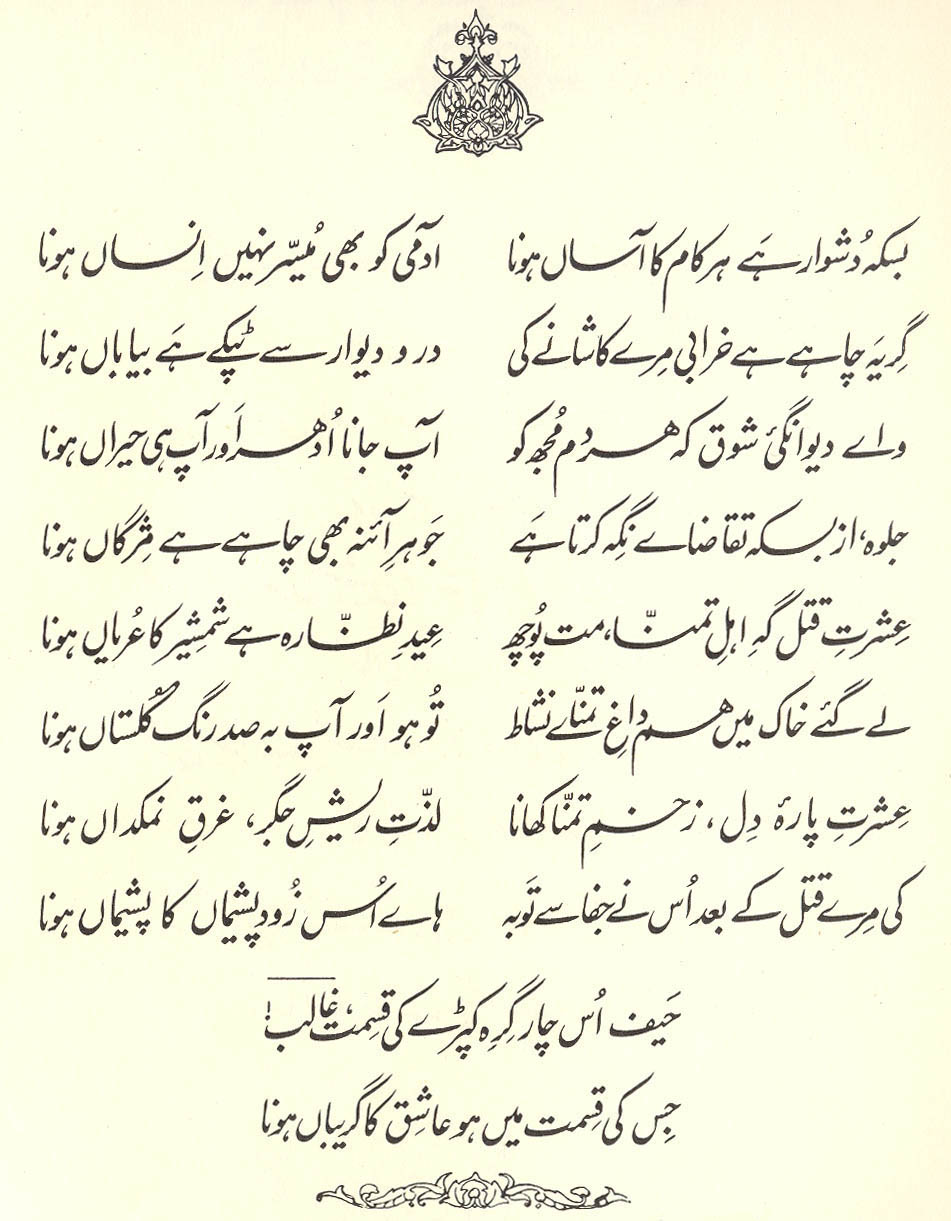
In both lines the verb 'is' is omitted . (18)
== Nazm page 18

Urdu text: Vajid 1902 {17}
This verse is ' two-part ,' and in a two-part verse there is usually an omitted verb. To balance the weight of both lines with this excellence is a task fit only for masters of the art like Mirza [Ghalib]. (37)
That is, the greatest good fortune of the faithful ones is in failure. (43)
Here's a wry, amused reflection on the lover's state: even though he laments and complains, he revels in suffering. Or rather, it's almost because he laments and complains that his enjoyment of suffering is complete. Suffering maintains his intense private emotional world and saves him from the mere commonplace that is the only alternative to the of 20,7 . Other verses that play with this central ghazal paradox of pain as pleasure: 191,3 ; 202,2 ; 233,5 // 287x,7 * (an explicit statement).
The primary charm of the verse is of course its wordplay about eating and food. The first line initially has a semi-serious ring because can simply refer to the heart's wounded, broken state, while , 'to eat,' is also the proper verb to use for receiving a wound-- and the 'wound of longing' is a sufficiently abstract concept to sound like a ghazal truism. Under mushairah performance conditions, we're made to wait a while for the second line. And even when we hear it, too is a wide-ranging noun (see the definition above). Not until the last possible moment, when we hear , do we truly understand that we're dealing not with lofty abstractions but with actual bits of food that sound almost like hors d'oeuvres.
The wounded liver-- and liver, unlike heart, is commonly eaten, though the word for the edible kind is -- joyously seeks to be plunged into the salt-dish, which both aggravates its ecstatic suffering, and makes it resemble a choice morsel-- perhaps like a small kabob. In this verse the poet is surely writing tongue-in-cheek (sorry, sorry, I couldn't help it).
And what about versus ? Broadly speaking, they are rough synonyms, both meaning 'wound' (see the definitions above). But the former has more abstract connotations ('loss, damage') as well-- while the second has the unfortunate tendency to mean 'pus, matter' (which would tip us way over into the domain of what I call 'grotesquerie'). So are we to consider them synonymous, or subtly differentiated? Similarly, what about versus ? The heart likes to 'eat' wounds, and the liver likes to, so to speak, 'rub salt into' them. Are we meant to perceive a difference there? As so often, it's left for us to decide.
Apparently the countless heart-wounds too enjoy a good dip in the salt-dish, as we learn in 233,5 . For other verses that connect wounds and salt, see 77,1 .
graphics/saltdish.jpg