Verse 21826aaniimujhe
G1
1
I became a whetstone of the sword of the glance/gaze of the friend/beloved
2
fortunate am I! what a blessing 'heavy-lifedness' is to me!
'Heavy, weighty, ponderous; great, important, momentous; difficult; burdensome, grievous; --precious, valuable; dear, expensive'.
| References | |
|---|---|
| Arshi, Imtiyaz Ali | Ghazal# 198 |
| Raza, Kalidas Gupta | 367 |
| Hamid Ali Khan | Open Image |
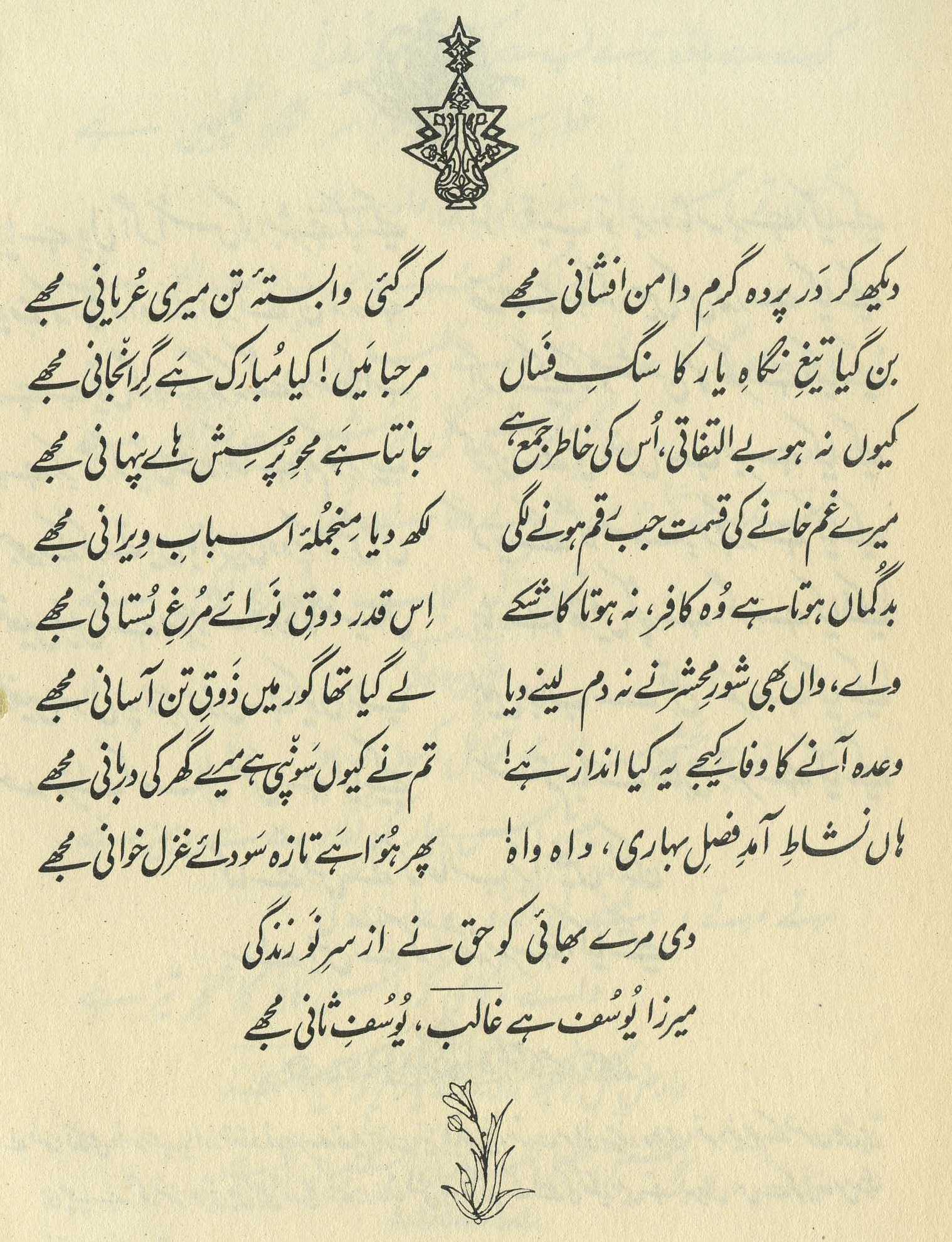
I am so tough-lifed [] that slashes of the sword of the glance keep occurring and I am alive-- like a whetstone, on which as many times as the sword is scraped along it, it doesn't get cut. In the second line he says as a taunt, bravo to me-- my heavy-lifedness is a great blessing, since it has made me a whetstone of the sword of the beloved's glance! (226)
== Nazm page 226

He says, I have become so tough-lifed that I endure the wounds of the sword of the beloved's glance and am alive, as if I am a whetstone, such that no matter how much you scrape the sword along it to sharpen it, it doesn't get cut. In the second line he says sarcastically, my tough-lifedness has become a great blessing for my life, since it has made me a whetstone for the sword of the beloved's glance. (284)
That is, they were fortunate who were slain by one single glance. We are unfortunate, that slashes are constantly made at us and we're nowhere close to dying. This verse is like 60,1 . (398)
In true mushairah -verse style, the punch-word is withheld until the last possible moment. Why did the speaker become a whetstone? We're never really told, but the exclamation at what a blessing it is to have 'heavy-lifedness' at once pulls it all together. A stone is heavy; heavy things are hard to wear away, hard to kill; and heaviness is a quality of suffering (one's heart is 'heavy').
Being a whetstone for the beloved's glance or gaze is a piquant notion in other ways as well. The sword that is scraped repeatedly along the whetstone is off-duty, it's casual, it's even intimate, since it's only preparing for its real duties elsewhere. The more it scrapes along the whetstone, again and again, the better prepared the sword is not to make any other repeated strokes: it's being sharpened to slash through anything else with a single swift stroke. Thus the lover's role is unique. Is this role as a whetstone a blessing (he's the only one at whom the glance-sword is directed over and over again), or a curse (everyone else is killed painlessly with one blow)? Is it a sign of his superior virtue, devotion, and 'tough-lifedness' (no one else could endure what he endures), or a token of his failure (perhaps it would be more lover-like to die at once, after a single glance)?
As the commentators observe, the tone of the exclamatory second line works wonderfully when it's sarcastic. But of course, it could perfectly well be read quite straightforwardly: the fundamental pain-is-pleasure paradox of the ghazal world (for more on this see 17,7 ) looms before us once again, and can be flipped back and forth any number of times.
I don't think the verse Bekhud Mohani recommends is really very much to the point. More suggestive is a comparison with other verses that play enjoyably with the imagery of stones; on these see 62,5 .
graphics/whetstone.jpg