Verse 51826aaniimujhe
G1
1
that infidel is [habitually] suspicious-- if only I didn't have
2
to this extent, a taste/relish for the voice of the Bird of the Garden !
| References | |
|---|---|
| Arshi, Imtiyaz Ali | Ghazal# 198 |
| Raza, Kalidas Gupta | 367 |
| Hamid Ali Khan | Open Image |
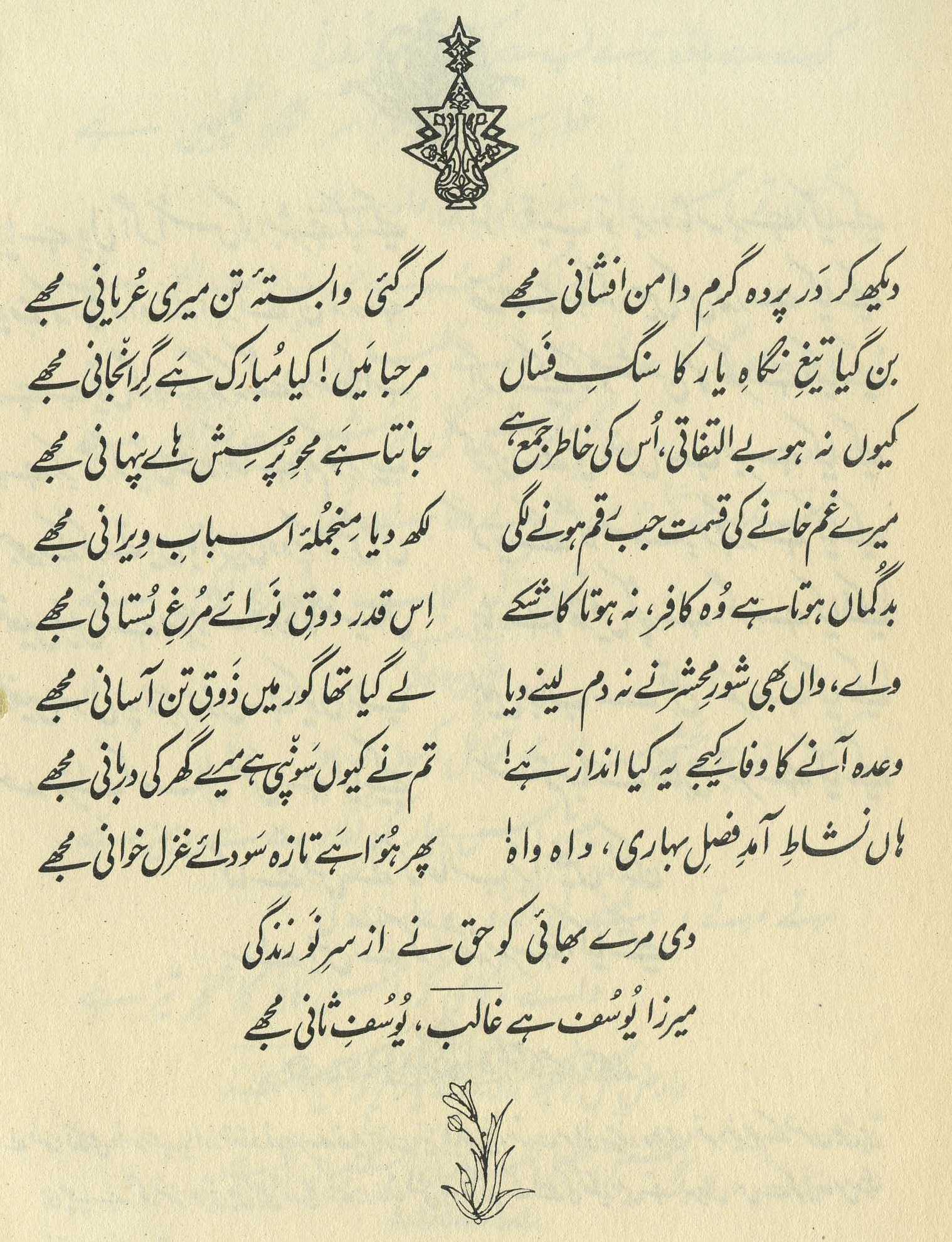
In her temperament there is so much jealousy/envy that when I feel ardor for the Nightingale , even this doesn't please her. The theme has no pleasure, but on this very theme the author has elsewhere said, as has already passed before us, 60,10 . (227)
== Nazm page 227

He says, 'I have an ardor for listening to the melodies of the sweet singers of the garden, and that infidel is [habitually] suspicious of this ardor of mine. Oh, if only I didn't have this ardor!' (285)
The Nightingale's voice pleases me because in the Nightingale's song is pain, and because of similarity (that is, I too am one of the people of pain, with the temperament of a lover), in hearing his voice I feel pleasure. At this, that infidel (the beloved) becomes suspicious. That is, 'While I'm here, he feels that he doesn't love me completely; if he did, then he wouldn't pay attention to anyone else'. Seeing this state of the beloved's, the lover feels a longing: 'If only I didn't have such a taste for lamentation!'. (399)
Compare 60,10 . (203, 301)
This unpretentious little verse surrounds itself with a nice set of overtones and implication s. For the 'bird of the garden' par excellence is the Nightingale , who is himself a lover (of the rose) and thus a fellow-sufferer with other tormented lovers. And the lover has the taste for his voice 'to this extent', which seems in the context to be a substantial one.
The verse points up the lover's dismal situation: even something so innocent as his listening to a bird sing is enough to excite the beloved's possessive jealousy and cruelty. And then, his response is not resentment, defiance, or stoicism-- but a morbid wish that he didn't have even this innocent, simple little desire, since it angers her (however unreasonably).
There's also a clever Catch-22 here: the beloved's cruelty and suspicion make the lover mournful, and incline him toward the melancholy songs of the Nightingale; but this inclination on his part is exactly the kind of thing that reinforces her irrational jealousy, and thus increases her cruelty and suspicion.
Note for meter fans: The spelling is instead of since the last (official) syllable in any meter must be long.
graphics/bulbul.jpg