Verse 61826aaniimujhe
G1
1
alas-- even/also there, the tumult of Doomsday didn't let me take a breath!
2
the taste/relish for body-ease had taken me into the grave
'Ease of body, bodily comfort, indulgence'.
| References | |
|---|---|
| Arshi, Imtiyaz Ali | Ghazal# 198 |
| Raza, Kalidas Gupta | 367 |
| Hamid Ali Khan | Open Image |
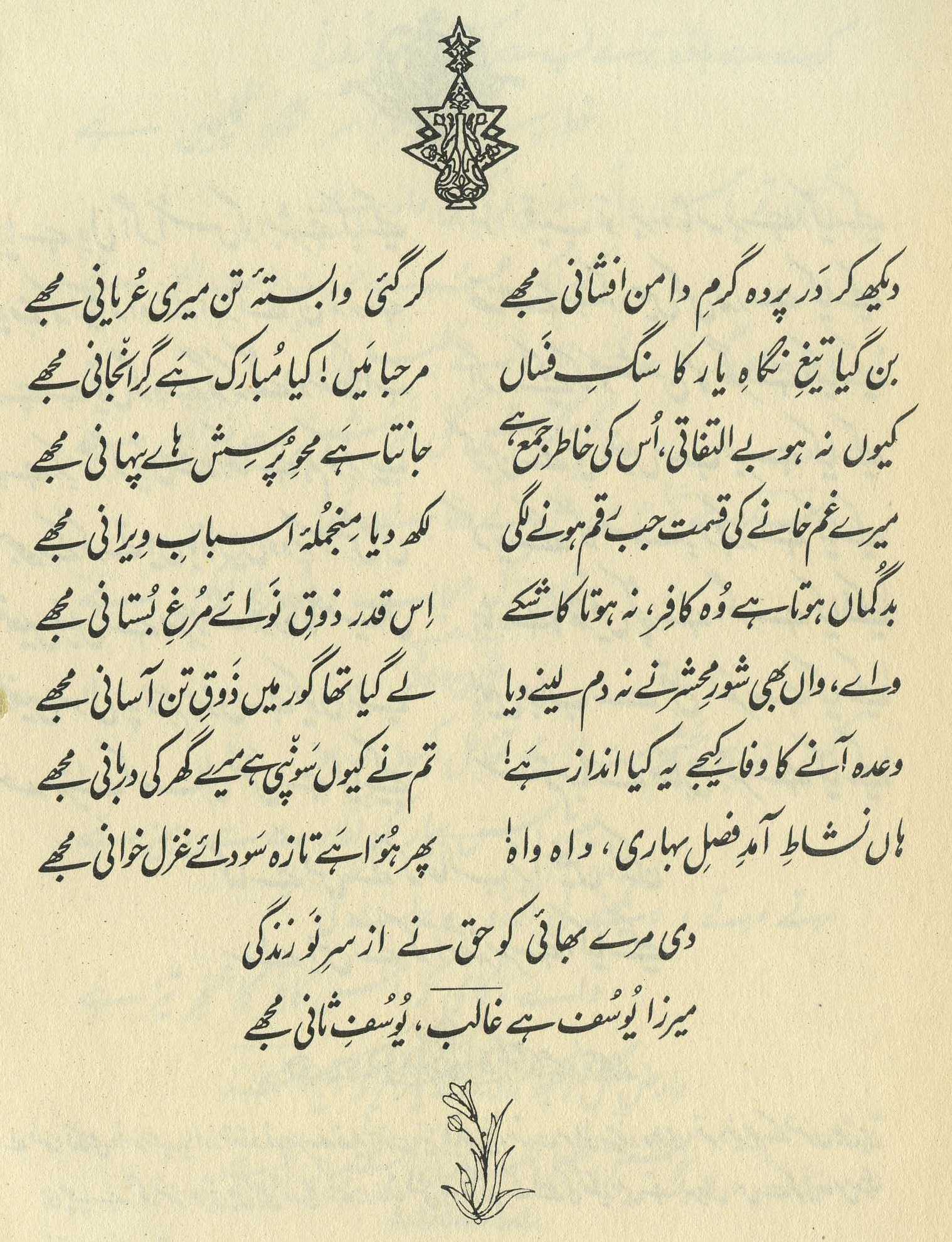
In this ground , this verse is the ' high point of the ghazal '. To be awakened from the sleep of the grave by the tumult of Doomsday is a commonplace theme , which many people already have used on many occasions. The excellence of this verse is that the reason for going into the grave is very fresh-- that is, a relish for pampering of the body. It is the spirit/life of this verse, which has made a dead theme alive; and with it a witness to the author's miraculousness of speech has come to hand. How well he has expressed the evil of the pampering of the body and the pursuit of comfort! (227)
== Nazm page 227

He says, 'It's a pity that even/also in the grave the tumult of Doomsday awakened me. I had gone into the grave in order to sleep to my heart's content and find rest.' It's a peerless verse. (285)
bhii means that in the world I had found no rest. I hoped that in the grave I would sleep at my ease, but there too I didn't manage to get any rest. means that not even for the smallest moment did I manage to find complete rest, before the tumult of Doomsday awakened me. The late Zauq has also well said,
[now, feeling anxious, we say that we will die
if even having died we find no peace, then where will we go?]...
[Nazm is wrong about the 'evil of pampering the body and seeking rest'.] Not at all! Mirza shows that for a man there is peace neither here, nor anywhere. This is almost exactly the verse recorded here, that Mirza Rafi Sauda has written:
[here, there is worry over livelihood; there, the commotion of Doomsday
there's not the smallest bit of carefreeness either here or there] (400)
This is a member of the set of 'dead lover speaks' verses; for others, see 57,1 .
Both meanings of come elegantly into play: we can read either 'there too' (such that 'there' is just one more member of a list of places); or 'even there' (such that 'there' is in a special class by itself). Needless to say, both readings work most enjoyably with the rest of the verse. The lover's suffering during life is evoked by a powerful use of implication : he eagerly sought death in order to find peace and rest, because he never found any during life, and had no hope of ever finding any. It's especially poignant that not just mental calm but even 'bodily' ease or relaxation, which surely should be most readily available during one's mortal lifetime, utterly eluded him. So he sought refuge in the grave-- but even there, he hardly managed to get any ease or rest at all, and then suddenly an irritating noise and turmoil began!
Bekhud Mohani points out that 'didn't let me take a breath' is powerfully and colloquially emphatic: not even for a moment did the speaker get any rest, before being rudely disturbed. There's also the amusing wordplay: how many 'breaths' would one expect to take in the grave, anyway? The tone of the verse-- plaintive, aggrieved, annoyed-- is perfect for someone deeply in need of sleep who is suddenly aroused by some infuriating triviality. The fact that the infuriating triviality is the clamor and tumult of Doomsday is even more delightful. To the speaker, Doomsday is not an awesome, terrifying confrontation with Divinity, but merely a vexation that interferes with the far more important matter of his finally managing to get some sleep, or at least some rest and peace.
In the argument between Nazm and Bekhud Mohani, Bekhud Mohani has it right. Nazm's 'natural poetry' reading is one-dimensional, and generates simply a moral disapproval of physical laziness. Bekhud Mohani's reading is much richer, and has room for the kind of rueful humor ('no rest for the weary!') that can be read into the mood of the verse. For as in so many exclamatory verses, tone is crucial. Is the speaker more annoyed than amused, or more rueful than annoyed? Is he laughing at himself, or at human folly generally? Or is he simply aggravated at the noisy neighbors who insist on having their inopportune Doomsday? As usual, we're left to decide for ourselves; and as usual, all the choices have their own pleasures.
graphics/tomb.jpg