Verse 91826aaniimujhe
G1
1
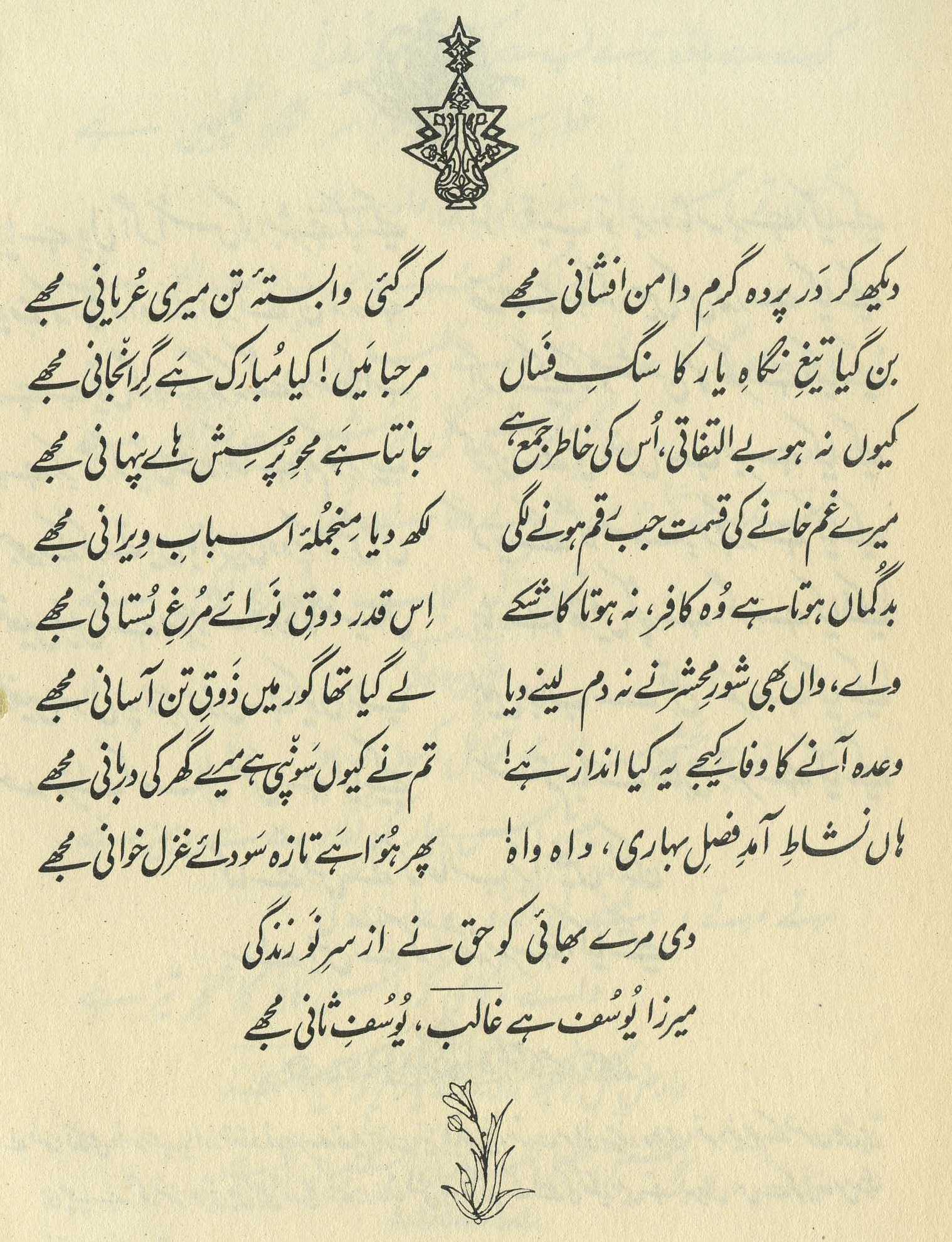
God gave my brother a life anew/'from a new head'
2
Mirza Yusuf is, Ghalib, a second Joseph to me
| References | |
|---|---|
| Arshi, Imtiyaz Ali | Ghazal# 198 |
| Raza, Kalidas Gupta | 367 |
| Hamid Ali Khan | Open Image |
[in 'Dastanbu', in ornate archaic Persian:] Monday, the nineteenth of October [1857], should be erased from the calendar. Like a fire-breathing dragon that day engulfed the world when in the morning the unfortunate brought the relieving news of my brother's death. He told me that this traveller speeding on the path of death (Yusuf Mirza) had been afflicted with a high fever for five days and, close to midnight, had departed from this world.
Oh, do not speak to me, I beg you, of water or of the kerchief to clean the face, or the man who bathes the dead body or digs the grave, or of bricks or mortar! Please tell me how I can go out (of this lane), where to take this dead body, and in what graveyard to bury it? In the bazaar it is impossible to get cloth, either good or bad. It is as if labourers and earth-diggers had never existed in the city. The Hindus can carry their dead to the shores of the river and burn them, but the Muslims dare not go abroad, even in groups of two or three, so how can their dead be borne from the city?
The neighbours took pity on my plight and offered to perform this task. With one Patiala soldier leading them, they took two servants and set out. They bathed the dead body and wrapped it in two or three white sheets which they had taken from my house. They dug a grave in the mosque adjoining my house and put the dead body in the pit before returning.
O pity this man who lived for sixty years, and thirty years were happy but thirty years were sad!
In his grave not even a pillow of stone, and dust is his destiny.
O Lord, pity this dead one who found no comfort in his life!
Send an angel for the solace of his heart and deliver his soul to paradise!
This kindly but unfortunate man spent sixty years of his life in happiness and sorrow; for thirty years he was sane and for thirty years he was mad. During the days of his sanity he restrained his anger and during the days of his madness he gave pain to no one. This was his custom. He died on the 29th of Safar, 1274 AH.
Someone asked me, the afflicted
the date of the death of Mirza Yusuf,
who lived his life a stranger to his own self.
I answered this question by sighing, and said .
It should be known that from the letters of we get 1290. If sixteen, which is the number equivalent to the word (sigh), is subtracted from this, it gives us the correct date, 1274 AH.
==this trans.: Khwaja Ahmad Faruqi , pp. 53-54
==another trans.: Russell and Islam , pp. 145-46
==Hali's account of Mirza Yusuf's life and death: Yadgar-e Ghalib , pp. 38-39
Yusuf's life took place a second time, as if a second Yusuf was given. (227)
== Nazm page 227

Mirza Yusuf was Mirza Sahib's older brother, who in his youth had gone mad. He has written this closing-verse in appreciation of his companionship. The meaning is that from his finding a second life, a second Joseph has been given. (285)
The Lord gave health to my brother Yusuf Mirza, or saved him from a disaster; as if a second Yusuf was given to me.
[Or:] The way Hazrat Yusuf's brothers had pushed him into a well, his emerging from the well was equal to becoming alive a second time-- of the same kind is my Yusuf's attaining of health. (401)
Mirza Yusuf Ali Khan was Ghalib's brother. For thirty years he remained insane. Ghalib loved him very much. It seems that he had become healthy. By way of love, ths joy of this has been expressed in this verse. (490)
This ghazal was composed, according to Raza, in 1826-- which is said to be the year in which Mirza Yusuf, Ghalib's beloved older (and only) brother, went mad. (On Ghalib's life in this period see Russell and Islam , p. 44.) Here as so often, S. R. Faruqi's analysis of the situation (Sept. 2006) has been invaluable:
The first thing to note is that Raza has erred in dating this ghazal to 1826. It first appears in the Sherani manuscript (1826), so the ghazal need not be dated to 1826 itself: it could be from any date between 1821 and 1826. More important, not all the verses are in the Sherani manuscript. Some, including this one, were added much later, perhaps in April 1828, in Calcutta.
As regards Mirza Yusuf's illness, the exact date is not known, but he fell ill around 1825-26, maybe in early 1826, and Ghalib seems to have left Delhi shortly thereafter. Mirza Yusuf's illness was nothing else but his mental derangement. He was incontinent, went naked, and didn't recognize his wife, daughter, or mother. He was reportedly 28 years old at the time. Since he was 2 (lunar) years younger than Ghalib, having been born in 1214 (=1799/1800), his madness could have started in 1214 = 28 = 1826/7. Treatment didn't have any effect. Finally he was put under the care of an elephant driver who was also an (white magician of a sort). This treatment lasted five months, if not more.
While Ghalib was in Calcutta in April 1828, he received a letter written by Mirza Yusuf himself-- a letter that apparently bore almost no trace of madness. Ghalib writes that Mirza Yusuf seemed to be two-thirds cured. Naturally, he was extremely happy. In this letter he wrote that his brother's recovery was dearer to him than his father's rising up from the dead would have been. (Source: , trans. by Partav Ruhela, Karachi, Idarah-e Yadgar-e Ghalib, 1999, pp. 84-85.) It is clear that the verse refers to the recovery of Yusuf as reported by Yusuf himself in 1828.
This is the only verse in the divan that mentions Mirza Yusuf, and one of the extremely few verses that mention anybody in Ghalib's private life. Thus it belongs in the company of 66 .
Note for chronogram fans: The second quatrain composed by Ghalib has the last line ''. This literally means, 'I heaved/'drew' a sigh and said, alas, the mad one!'. What Ghalib points out with pride at the end of the passage quoted above is that in the chronogram system, if you add up the letters in according to the rules, you get 1290. Then if you remove 16, which is the total formed by the letters in , you get 1274 A.H., the correct date of Mirza Yusuf's death. The clever part is that the line could also suggest, 'I pulled out, or drew out, or removed [the letters in] and said '. The effect is to turn the line containing the chronogram into a kind of puzzle or word game. Even though Ghalib claimed to be very poor at making chronograms, he was proud of pulling off an occasional good one through what he said was a kind of spontaneous inspiration; in a letter (1858) he speaks with pride of this particular one ( Khaliq Anjum , vol. 1, p. 364). For the original Persian text of the chronogram, see Hali's account cited above.
graphics/yusuf.jpg