Verse 11826aaniimujhe
G1
1
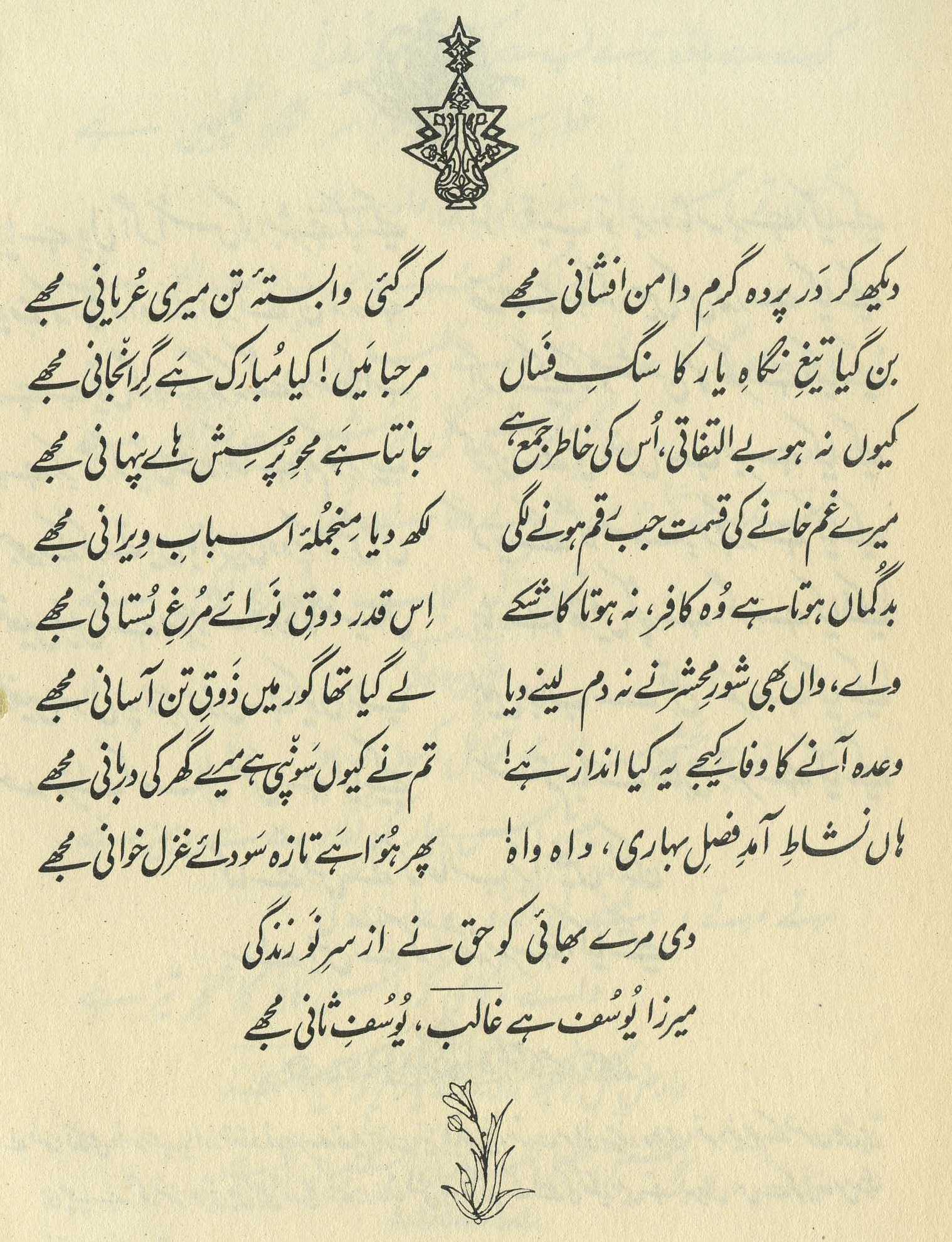
having seen me secretly/'behind the veil' eager for 'skirt-spreading'
2
my nakedness, having bound me to the body, went away
'Spreading or expanding the skirts (of the robe); walking proudly, or gracefully'.
'Sprinkled, scattered over, &c.; --s.f. Scattering, sprinkling, dispersion'.
'Bound, restrained; --referred back (to); related, connected (with), depending (on); -- s.m. A manservant; a relative, or connexion; a dependant; an adherent'.
'Nakedness, nudity, &c.'.
'Stripping or denuding oneself; cutting oneself off from society, living in solitude; solitude; celibacy'.
'Bare; mere; only; solitary, alone; --single, unmarried; --bodiless, incorporeal; immaterial'.
| References | |
|---|---|
| Arshi, Imtiyaz Ali | Ghazal# 198 |
| Raza, Kalidas Gupta | 367 |
| Hamid Ali Khan | Open Image |
In this verse the theme is mysticism; 'nakedness' is a metaphor for withdrawnness [], and 'skirt-scattering' for the breath. That is, I was a hermit [], I had no relationship to physicality []. But seeing me eager for skirt-spreading, my solitude connected me to the body and took leave of me. That is, having seen me absorbed and eager in the numbering of breaths in the world of bodies, Withdrawnness imprisoned me in the cell of the body and took its leave. That is, the person who would have an ardor for skirt-spreading-- what connection would he have with withdrawnness and nakedness? In the word he has made the wordplay that breathing too has a connection with veiling of the bosom.
The author's intention is what has been explained, but tangledness and knottedness have befallen his meaning-- that is, after being eager for skirt-spreading, what does it mean for nakedness to take leave? Nakedness cannot be associated merely with the skirt, nor can there be skirt-spreading either. (226)
== Nazm page 226

This verse is about mysticism. He says, 'I was a hermit, I had no connection at all with physicality. But having seen me eager for skirt-spreading, my withdrawnness ensnared me in the prison of the body, and it itself took its leave.' By nakedness is here meant being without relationship. (284)
[Disagreeing with Nazm:] That nakedness is a metaphor for withdrawnness is correct. But that skirt-spreading is a metaphor for breath, is incomprehensible. Because skirt-spreading is from the renunciation of relationship. If it is intended as breathing, then the renunciation of relationship won't remain; rather, its meaning will become the control over relationship. Probably when writing the meaning of skirt-spreading, the learned commentator was thinking of 'wing-fluttering' [], thus this meaning was written. Furthermore, the commentator's conclusion tells us that seeing me absorbed and eager in breath-numbering in the physical world, withdrawnness left me in the prison of the body. The Lord knows what this means! Because what relationship does the hermit have with the physical world, and thus with breath-numbering?...
Now it remains to ask, while there is skirt-spreading, how can there be nakedness? The answer to this is that Mirza has taken nakedness in the sense of 'withdrawnness'. And the intention of skirt-spreading is the cutting of relationships with the world, and the effort and restlessness for things of the spirit. This is the aspect of meaning; there remains the verbal aspect, and it is not worth much attention, because the author's goal is a mirror. (397-98)
The verse clearly relies on wordplay ('behind the veil', 'skirt-spreading', 'body', 'nakedness'), but that's almost the only thing that's clear. The first line obviously centers on 'skirt-spreading', which seems to have two opposite idiomatic meanings: worldly grace or elegance (as Platts observes and many commentators seem to assume); or Bekhud Mohani's sense of world-rejection, which would presumably be based on taking to mean 'scattering, dispersing'. I don't know how well-established Bekhud Mohani's sense is; it's somewhat suspiciously convenient as a weapon in his perpetual combat with Nazm. (Of course, it would be very Ghalibian to have the meaning go both ways.)
Then the second line is the main puzzle. The full prose form would be something like -- What?! Why did 'nakedness' do this to the speaker, and how? And what exactly did it do? Nazm rightly observes that the line is obscure and convoluted: it relies on poorly grounded hyper-abstractions that are almost impossible to visualize. For a discussion of the uses-- and positioning-- of the word 'nakedness' [], see 6,1 .
The verse thus also creates an apparent major problem of connection . How do the two lines fit together? The commentators read 'nakedness' [], a plain and literal word, as though it were 'withdrawnness' [], a much more complex one (see the definitions above) that indeed has the kind of multiple dimensions (nakedness, withdrawal or solitude, and celibacy) that would resonate more effectively with the first line by suggesting some reasons for punishing the speaker's 'skirt-spreading' (or else, on Bekhud Mohani's reading, for deliberately frustrating his mystical quest).
I can't think of a way to improve on the 'withdrawnness' reading. But it doesn't leave me very satisfied with the verse itself.
graphics/skirtspreading.jpg