Verse 71826aaniimujhe
G1
1
[that] the promise of coming would be faithfully upheld --what style/measure/guess is this?!
2
why have you confided/entrusted to me the Doorkeeper -ship of my house?
is an archaic form of ( GRAMMAR )
'Measure, measurement; quantity; weighing, weight; degree, amount; valuing, valuation, value; rough estimate; conjecture, guess; proportion, symmetry; elegance, grace; mode, manner, style, fashion, pattern; carriage, bearing, gait'.
| References | |
|---|---|
| Arshi, Imtiyaz Ali | Ghazal# 198 |
| Raza, Kalidas Gupta | 367 |
| Hamid Ali Khan | Open Image |
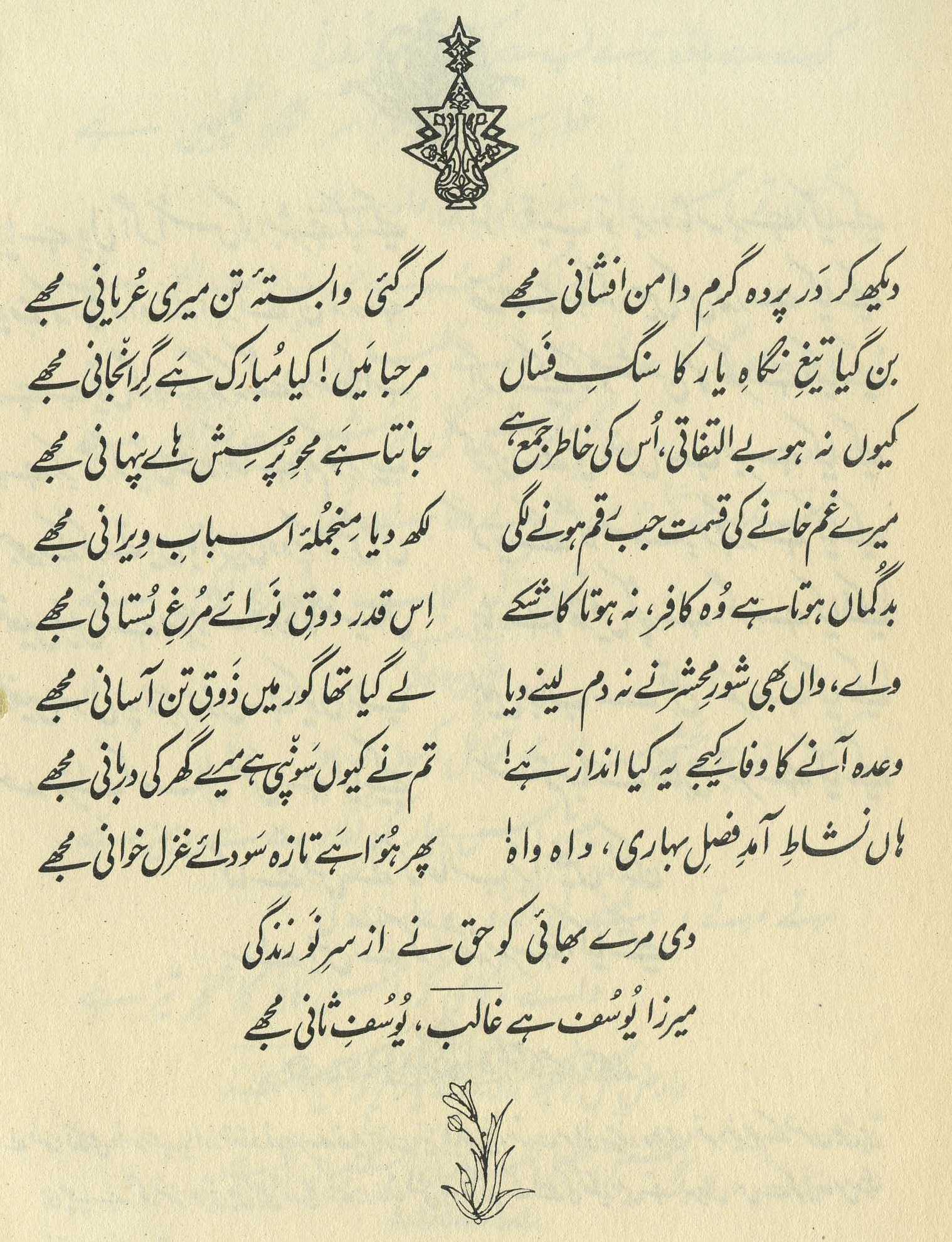
While waiting for faithfulness to the promise, he presents his not going anywhere as 'You've confided the doorkeeping of my house to me'. It's an entirely fresh expression.
==Urdu text: Yadgar-e Ghalib , p. 162
That is, 'With the promise of coming that you've made, I can't emerge from my house at all-- I've become a Doorkeeper !' Here, would seem better than . It wouldn't be strange if it would be a copyist's error. (227)
== Nazm page 227

[Disagreeing with Nazm:] Only is good, is not good. Because in there's a glimpse of anger and blame. That is, 'What a fine thing, you've decreed that I'm to be a Doorkeeper!'. And from the heart's perplexity and restlessness can be learned, and love drips from the tone too. (401)
This is one of the set of verses about the beloved's visiting the lover; for others, see 106,2 .
It's also almost a limit case of speech-- a sort of passive subjunctive, followed by a radically ambivalent exclamation or question, followed by another exclamatory-sounding question. The first part of the first line proposes-- but pointedly doesn't affirm-- that the beloved might uphold her promise of coming to the lover's house.
Then the second part of the first line opens out, thanks to the radical multivalence of both and (see the definition above). Here are some of the possible ways to read :
=What am I expecting will happen? (the whole idea of such promise-keeping is very bizarre and confusing).
=What are you really up to here? (surely it can't be that you're actually proposing to uphold your promise?).
=What kind of assumption is this for a lover to make?! (don't be silly, she'll never uphold her promise!).
=What kind of style/behavior is this for a beloved?! (as if you'd really uphold your promise!).
Needless to say, all these possibilities work in different, piquant ways with the second line. The beloved's confiding to the lover the ' Doorkeeper -ship' of his own house could have been an explicit command: 'You stay home and wait-- I'll be coming over'. In that case, he asks why she has given that command, and whether it really, even conceivably, could mean that she might actually intend to come over.
Alternatively, his 'Doorkeeper-ship' could be an implicit effect of her subtle hints and his guesses and desperate hopes: 'I can't possibly leave the house, if there's even the smallest chance that she might conceivably drop by'. In that case, his question is perhaps even a reproachful one-- why is she raising hopes that both he and she know are false, but that he can't stop himself from vainly entertaining? Is she just being sadistic? Compare her similar dream-generated cruelty in 97,3 .
An evocative photogravure of a Rajput door-guard by Martin Hurlimann, 1935:
graphics/hurlimann1935.jpg
