Verse 31821aa;Nhonaa
G5
In this meter the first long syllable may be replaced by a short; and the next-to-last long syllable may be replaced by two shorts.
1
alas, the madness of ardor! --that at every moment/breath I
2
myself have to go in that direction, and only/emphatically myself have to be amazed
| References | |
|---|---|
| Arshi, Imtiyaz Ali | Ghazal# 23 |
| Raza, Kalidas Gupta | 327-328 |
| Nuskhah-e-Hamidiyah | 69-70 |
| Hamid Ali Khan | Open Image |
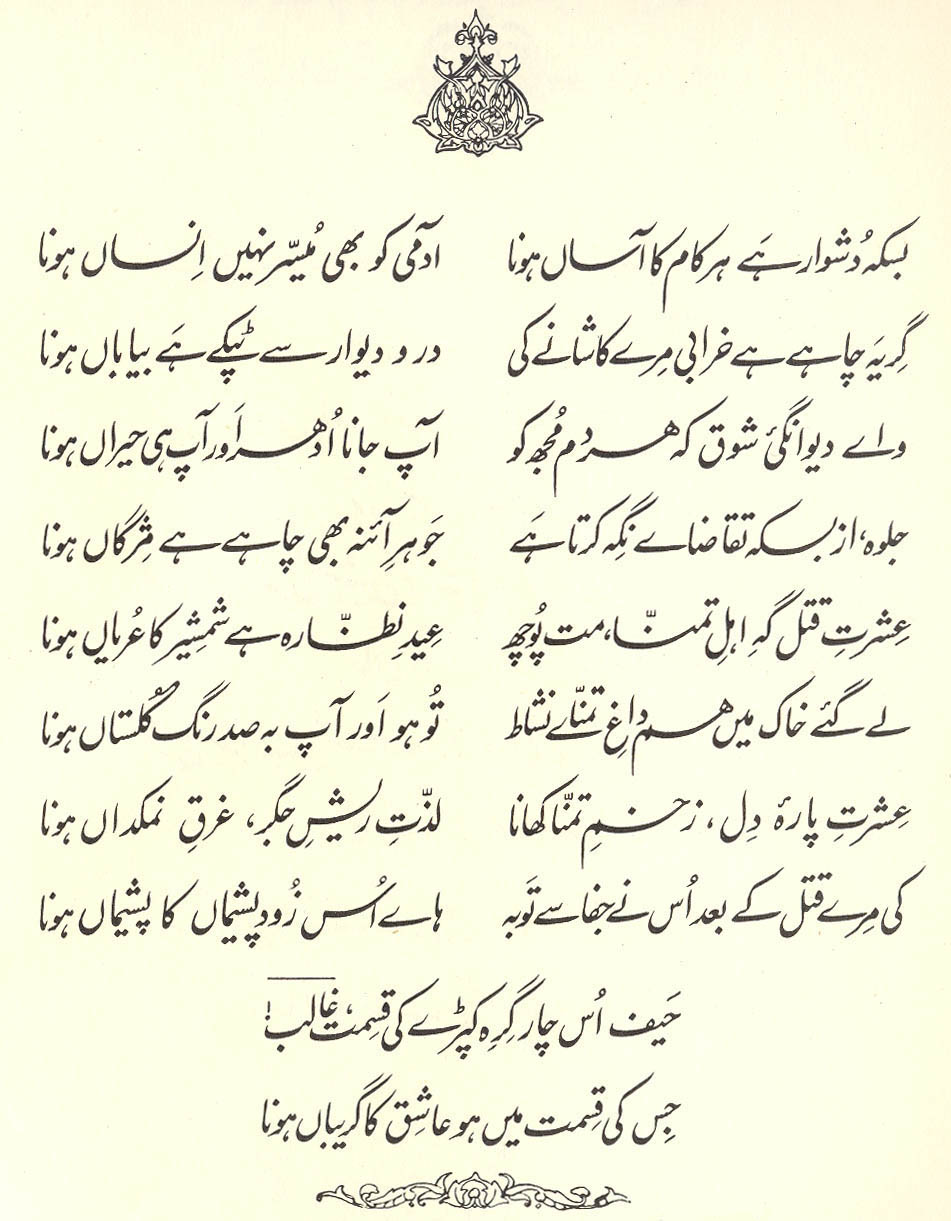
Every , that is, every time I take a breath, I run toward that Source of life and existence, and remain amazed at my lack of access. (18)
== Nazm page 18

Urdu text: Vajid 1902 {17}
He says, the madness of ardor-- that is, the excess of ardor-- has caused me to flee so far from myself that time after time I become ardent for the beauty of the True Beloved and pass outside my selfhood and, stupefied by lack of access, I think, 'Where am I, and where is the sight of Him!' (36-37)
Alas for the madness of ardor, that I myself go toward the beloved and-- seeing her style, her glory, her indifference, her radiance, her elegant surroundings, and my own coercion and helplessness-- I say in my heart, here who will listen to me, why have I even come here? (41)
The first part of the first line is exclamatory, and its relationship to the rest of the verse is entirely unspecified. That requires us to search through the rest of the verse to discover the cause of the exclamation. The best way I've found to do this is to pretend that each word or phrase in turn is the crucial one, and see how that would alter the reading of the verse. I've decided to call this 'stress-shifting'; see 10,8 for more examples.
For the present verse in fact provides a remarkable number of possible causes for the initial exclamation-- each of which could give rise to a different interpretation. Does the madness lie in the lover's having to go in the first place? Or in his having to go, as opposed to someone else? Or in his being amazed at having to go, instead of expecting it? Or in his having to go in that direction, rather than some other? Or in his having to go with every breath (or at every moment), and not just sometimes?
I can't resist pointing out that Gilbert and Sullivan are entirely familiar with such 'stress-shifting', as can be seen in the first act of 'Thespis' (with original italics):
Thespis: Oh why did the gods make me a manager?
Sillimon: (as guessing a riddle) Why did the gods make him a manager?
Sparkeion: Why did the gods make him a manager?
Daphne: Why did the gods make him a manager?
Prettias: Why did the gods make him a manager?
Thespis: No--no--what are you talking about? what do you mean?
Then is another crux point. For can often be merely an emphasizer-- 'I myself' am amazed at my behavior (though you'd think that I of all people would not be). Yet it can also be restrictive-- 'I alone' am amazed, nobody else is surprised in the least. (Everybody else expects such behavior from a madman like me; a proof of how mad I am is that I am surprised at it.) On the special nature of 'amazement', see 51,9x .
The madness of ardor sounds like something sought and chosen by the lover, but the use of a compulsion construction sounds like helplessness. Perhaps this is just the nature of passion. Compare the similar, though less dire, helplessness in 46,4 .
graphics/thatstreet.jpg